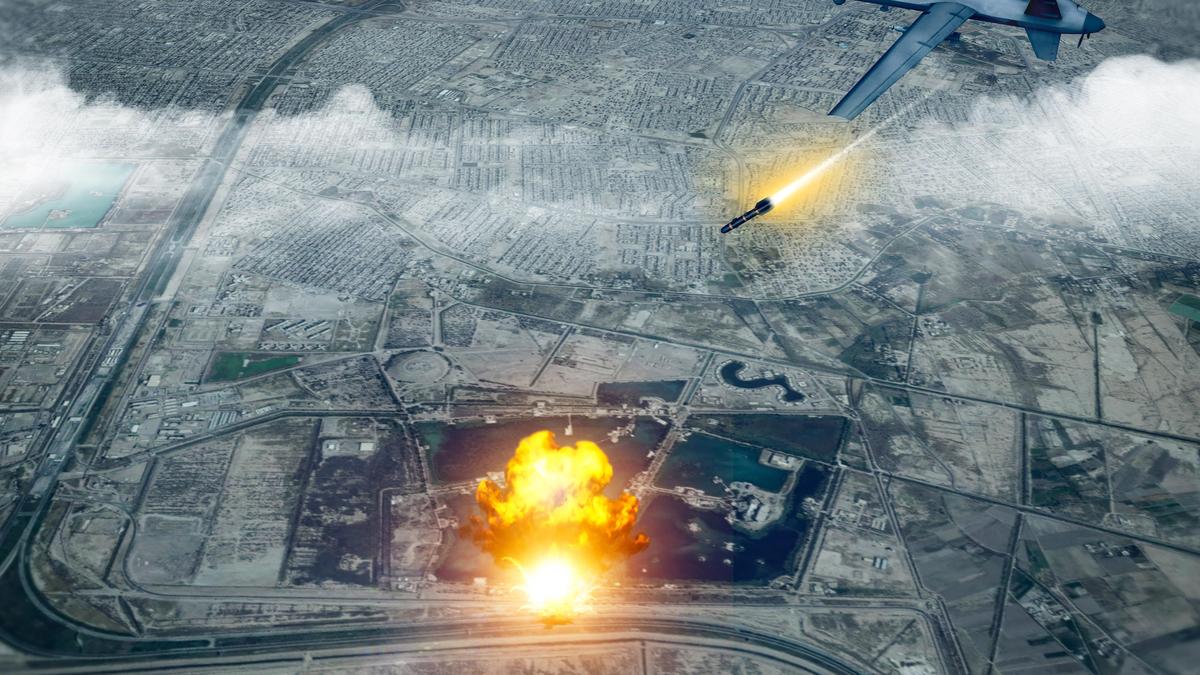
The flash over the Persian Gulf at 3:00 AM was not a meteor. It was the kinetic signature of an interceptor meeting a ballistic threat in the upper atmosphere. On paper, the United Arab Emirates Ministry of Defence reported a flawless defense against seven ballistic missiles and sixteen unmanned aerial vehicles (UAVs) launched from Iranian territory. While the official narrative celebrates a total success rate, the technical and geopolitical reality underneath those explosions suggests a shift in regional warfare that the UAE's current hardware may find increasingly difficult to sustain. This was not just a skirmish; it was a stress test of the most expensive integrated air defense network on the planet.
For decades, the strategic calculus in the Middle East relied on the assumption that traditional air superiority could suppress any localized threat. That assumption is dead. The sheer volume of this latest swarm demonstrates that the adversary is no longer interested in "winning" a dogfight. Instead, the goal is to overwhelm sensor arrays and deplete the economic reserves of the defender. When a $50,000 drone forces the launch of a $2 million interceptor, the defender is losing the war of attrition long before the first fragment hits the sand.
The Arithmetic of Attrition
To understand the severity of this engagement, one must look at the intercepted payload. Ballistic missiles, particularly those capable of reaching the UAE from Iranian launch sites, travel at hypersonic speeds during their terminal phase. They require specialized systems like the Terminal High Altitude Area Defense (THAAD) or the Patriot PAC-3 to neutralize. These are not infinite resources.
The UAE is currently the only international customer operating THAAD. During this specific engagement, the pressure on the fire control units was immense. Intercepting seven ballistic targets simultaneously requires a level of radar fidelity and processing power that pushes even American-made hardware to its limit. If any one of those seven missiles had carried a maneuverable re-entry vehicle, the intercept probability would have plummeted.
The UAVs present a different, arguably more annoying problem. Sixteen drones might sound manageable, but in a synchronized attack, they function as "clutter." Their purpose is to force the UAE’s radar to lock onto low-slow targets while the high-fast ballistic threats scream in from a higher altitude. It is a classic shell game played with explosives.
The Sensor Saturation Trap
The core of the problem lies in the way modern radar systems handle "tracks." Every object in the air, from a bird to a Boeing 777, creates a track. The UAE’s integrated air and missile defense (IAMD) system must differentiate between civilian traffic at Dubai International and a low-profile Shahed drone hugging the coastline.
During this 23-missile-and-drone assault, the Ministry of Defence utilized a layered approach. Short-range systems like the Russian-made Pantsir-S1 and the South Korean Cheongung-II (M-SAM) were likely the workhorses for the drone interceptions. This "multi-source" defense architecture is a double-edged sword. While it provides variety, it also creates a massive data-integration headache.
If the command-and-control (C2) software stutters for even three seconds, the "hand-off" from a long-range radar to a short-range fire unit fails. The adversary knows this. They are betting on the UAE’s inability to manage the sheer volume of data generated by 23 incoming projectiles. This time, the veil held. Next time, the attacker might double the number of UAVs to 32, not to cause damage, but to "blind" the system with too much information.
The Deep Pocket Defense Paradox
Economic warfare is the silent partner in this kinetic exchange. We are witnessing a radical disparity in the cost of conflict.
- The Attacker's Bill: Sixteen drones at roughly $30,000 each and seven older-generation ballistic missiles perhaps totaling $5 million. Total cost: Under $6 million.
- The UAE’s Bill: A single THAAD interceptor costs approximately $12 million. A Patriot PAC-3 missile costs around $4 million. Launching two interceptors per target—a standard safety protocol—means the UAE spent upwards of $100 million in less than an hour to defend against a $6 million attack.
This math is unsustainable. Even for a nation as wealthy as the UAE, the cost-per-kill ratio is skewed so heavily toward the aggressor that "success" feels like a slow-motion financial bleed. This is why the UAE has been aggressively scouting directed-energy weapons (lasers) and high-powered microwave systems. Until those technologies mature, they are stuck buying incredibly expensive "bullets" to shoot down incredibly cheap "flies."
Intelligence Failures and the Launch Site Mystery
There is a glaring question that the Ministry of Defence’s statement carefully avoids: How did 23 projectiles leave Iranian soil without being neutralized on the pad?
Satellite surveillance in the Gulf is constant. The U.S. Fifth Fleet, based in nearby Bahrain, monitors the region with Aegis-equipped destroyers and persistent overhead SIGINT (Signals Intelligence). Launching seven ballistic missiles involves a massive logistics trail—fuel trucks, launch vehicles, and personnel. That these were able to launch simultaneously suggests either a significant gap in pre-emptive intelligence or a deliberate choice by regional powers to allow the launch to happen to avoid a wider escalatory "first strike."
Furthermore, the flight paths indicate a sophisticated understanding of "dead zones" in the UAE's radar coverage. The drones likely used GPS-waypoint navigation to skirt the most heavily defended corridors, forcing the interceptors to fire at awkward, high-deflection angles. This level of mission planning suggests that the groups launching these attacks have access to high-resolution mapping of the UAE’s defensive posture.
The Geopolitical Fallout of a Flawless Record
The UAE’s public declaration of 100% interception is a necessary piece of psychological warfare. If they admitted even one "leaker" hit a desert patch, it would embolden the Iranian-backed proxies or the IRGC themselves. However, the international community should be wary of this perfection.
In the world of air defense, 100% is an anomaly. It suggests either an incredibly lucky day or a limited capability on the part of the attacker. If the launch had involved the "Fattah" hypersonic missile or a more advanced swarm of "Ababil" drones with anti-radiation seekers, the UAE's Ministry of Defence would be writing a very different press release today.
This engagement signals that the "buffer zone" provided by the Persian Gulf has evaporated. The UAE is now a front-line state in every sense of the word. Their reliance on Western hardware is absolute, but their strategic autonomy is being tested. They are being forced into a defensive crouch, spending billions to maintain a status quo that the attacker can disrupt for the price of a luxury sedan.
Redefining the Shield
The current strategy of "intercept everything at any cost" is reaching its expiration date. To survive the next decade of Gulf tensions, the UAE must move beyond kinetic interceptors. The shift toward Integrated Battle Command Systems (IBCS)—which allow a South Korean radar to talk to an American missile via a French data link—is the only way to manage the complexity of these swarms.
More importantly, the UAE needs to address the "left of launch" problem. If the missiles are in the air, the defense has already partially failed. True security in the region will not come from more Patriot batteries, but from the ability to hold the launch infrastructure at risk in real-time. This requires a level of offensive capability that the UAE has traditionally outsourced to the United States.
The skies over Abu Dhabi are clear for now, but the silence is deceptive. Every intercepted drone provides the attacker with valuable data on radar frequencies, response times, and battery locations. They are learning. They are iterating. They are waiting for the moment when the number of incoming tracks exceeds the number of available interceptors.
You should examine the logistics of the THAAD resupply chain, as the UAE's ability to withstand a multi-day sustained bombardment depends entirely on how quickly Lockheed Martin can put "all-up rounds" on a transport plane.