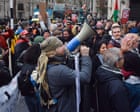
A cold drizzle hangs over the Thames, the kind that doesn't so much fall as it does soak into your very marrow. On days like this, the stone of the Embankment feels like it’s sweating. For months, this grey backdrop has been punctuated by flashes of red, green, and white. Thousands of boots have drummed against the asphalt, a rhythmic heartbeat of dissent that has become as much a part of the city’s weekend routine as the changing of the guard or a packed Sunday roast.
But something in the air changed this morning. The wind hasn't shifted, yet the atmosphere is brittle.
The Metropolitan Police have decided that the period of "negotiated patience" is over. The tactical retreat of the law—the soft-touch policing that allowed a certain level of disruption to pass with little more than a stern look and a yellow vest—has been retracted. They are going back to the old ways. They are going back to the handcuffs.
The Anatomy of a Badge
Imagine a young officer named Elias. He’s twenty-four, originally from a quiet town in the Midlands, and he’s spent the last six months standing in cordons until his calves ache and his eyes burn from the glare of neon banners. For Elias, the law isn't an abstract philosophy debated in the high courts of the Strand. It is a set of laminated instructions in his pocket.
For a long time, those instructions were focused on "de-escalation." If a group from Palestine Action occupied a roof or blocked a road, the priority was to contain, to watch, and to wait. It was a slow-motion chess match where the police were often criticized for simply standing by.
Then comes the memo. The Met announces a "robust" return to arrests for those showing support for Palestine Action. Suddenly, the line in the pavement is no longer a suggestion. It is a tripwire.
This isn't just about a change in shift patterns. It’s about the fundamental tension of a democracy. On one side, you have the right to scream until your throat is raw about perceived injustices thousands of miles away. On the other, you have the right of a delivery driver to get his van through a junction, or a mother to get her child to a doctor’s appointment without a two-hour detour. The Met is now signaling that the balance has tipped back toward the latter.
The Cost of a T-Shirt
Palestine Action isn't your average protest group. They don't just march; they disrupt. They target the machinery—the factories, the offices, the logistics hubs—of companies they claim are complicit in global conflict. Because of their history of direct action, the Met has decided that even the appearance of support for this specific group now carries the weight of a criminal act.
Think about the implications of that for a moment.
If you wear a shirt that displays the logo of a group the state has deemed a "proscribed-adjacent" threat, does the fabric itself become a weapon? This is where the human element gets messy. A college student picks up a badge because they believe in a cause. They see it as a symbol of peace. A police sergeant sees that same badge as a signal of intent to commit criminal damage.
In the middle of this stands the law, a giant, clumsy engine trying to distinguish between a political statement and a conspiracy to break the law. The Met’s decision to resume arrests isn't just a tactical shift; it’s a psychological one. They are trying to re-establish the "fear of the law" in a city that has spent months feeling like the streets belonged to whoever could shout the loudest.
The Weight of the Concrete
The statistics tell a dry story. Numbers of arrests, hours of diverted man-power, millions of pounds in policing costs. But statistics don't feel the rain. They don't feel the adrenaline spike when a hand clamps down on a shoulder and says, "You’re under arrest."
For the protesters, this is a badge of honor. They view the increased policing as proof of their effectiveness. In their narrative, the state is showing its teeth because it is scared. They see the factories they target—specifically those linked to arms manufacturing—as the true criminals. For them, a night in a cell is a small price to pay for the chance to gum up the gears of a global industry.
But there is a secondary human cost: the erosion of trust.
When the rules of engagement change mid-game, people get confused. One week, you can stand on a corner with a placard. The next week, that same placard might get you a ride in a van. This ambiguity is where resentment grows. It’s where the "them vs. us" mentality, which already plagues our social fabric, turns into something more permanent.
The Echo in the Courtroom
The legal reality is a labyrinth. The Met cites Section 12 and 14 of the Public Order Act like they are reciting holy scripture. These laws give them the power to impose "conditions." If you break the conditions, you break the law.
But "conditions" are often invisible. They are a verbal command given over a megaphone in a crowded square. "You must move to the designated protest area." "You must stop chanting this specific slogan."
Consider a hypothetical woman named Sarah. She’s a librarian who has never had a parking ticket. She joins a march because she feels a moral obligation to do something. She doesn't hear the command. She doesn't see the line. She just stays where she is, holding her sign, until a wall of black uniforms moves in.
Suddenly, Sarah isn't a librarian anymore. She’s a statistic in the Met’s Monday morning briefing. The trauma of that transition—from law-abiding citizen to "offender"—is a weight that stays with a person long after the charges are dropped or the fine is paid. It changes how she looks at every police car she passes for the rest of her life.
The Quiet After the Storm
What the Met is betting on is that the threat of arrest will act as a sieve. It will filter out the Sarahs—the people who have jobs, families, and a fear of the system—leaving only the "hardcore" activists. By thinning the crowd, they make the remaining group easier to manage, easier to film, and easier to prosecute.
It is a strategy of attrition.
The streets of London have seen this before. From the Suffragettes to the Poll Tax riots, the city has always been a theatre of friction. But the current tension feels different because it is so deeply tied to an identity crisis within the police force itself. After years of being told they are "too woke" by one side and "too heavy-handed" by the other, the Met is trying to find a solid place to stand.
They have chosen to stand on the side of "Order."
Order is a clean word. It suggests quiet streets, moving traffic, and predictable Saturdays. But Order has a shadow. Its shadow is the suppression of the uncomfortable, the inconvenient, and the angry.
As the sun sets over the city, the red and green banners are folded away. The police vans sit idling in side streets, their blue lights casting long, rhythmic shadows against the brickwork. The news will report the number of arrests. The politicians will argue over the necessity of the crackdown.
But the real story isn't in the press release. It’s in the silence of the person who decided to stay home today because they couldn't afford the risk of a criminal record. It’s in the weary sigh of the officer who knows that tomorrow, he has to do it all over again.
The line in the pavement is still there, invisible and absolute, waiting for the next person to step over it.