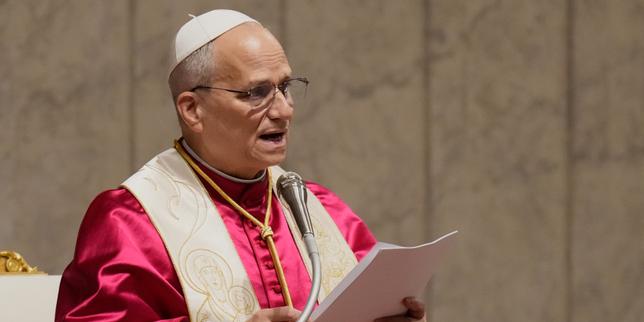
The marble floors of the Apostolic Palace have a way of swallowing sound, turning even the most urgent footsteps into a rhythmic, hushed prayer. When Pope Leo XIV sat at his heavy oak desk to draft his public opposition to the escalating conflict, he wasn’t just writing a policy memo. He was throwing a thousand years of moral weight against the machinery of modern warfare. He spoke of mothers in dust-choked basements and the soul-deep scars that no victory parade can heal.
Across the Atlantic, the response didn't come in parchment or Latin. It came in pixels, high-definition glare, and the unmistakable, percussive cadence of Donald Trump.
This wasn't a standard diplomatic disagreement. It was a collision of two worlds that rarely occupy the same space: the eternal and the immediate. On one side, a man who views time in centuries and souls; on the other, a man who views time in news cycles and leverage. The video response released by the Trump campaign wasn't just a rebuttal. It was a reimagining of what "peace" actually looks like when the cameras are rolling and the stakes are measured in steel.
The Anatomy of the Counter-Punch
Most political responses are drafted by committees to be as beige as possible. Not this one. The video was edited with the jagged energy of a movie trailer, juxtaposing images of American military might with the quiet, somber halls of the Vatican. It was a deliberate aesthetic choice. By showing the Pope against the backdrop of ancient statues, the video framed the Papacy as a relic—beautiful, perhaps, but disconnected from the grit of the 21st century.
Trump spoke directly to the lens. He didn't lead with theology. He led with the concept of the "Gilded Shield." His argument was visceral: peace isn't something you wish for with folded hands; it is something you enforce with an overwhelming shadow. To Trump, the Pope's opposition wasn't just idealistic—it was dangerous.
The rhetoric relied on a specific kind of logic. If you have the biggest stick, you never have to use it. If you throw the stick away because a man in a white robe tells you it’s uncivilized, you invite the wolves to the door. It was a narrative of the "Reluctant Warrior," a hypothetical father standing at the edge of his property, holding a shotgun not because he wants to pull the trigger, but because he wants his children to sleep through the night.
The Invisible Stakes of a Digital Crusade
While the headlines focused on the "War of Words," the real battle was happening in the hearts of the millions of people who feel a dual loyalty to their faith and their flag. Consider a voter in a small town in Ohio. On Sunday morning, they hear a homily about the sanctity of life and the scourge of violence. By Sunday afternoon, they see a video on their phone explaining that without that violence—or at least the credible threat of it—their way of life collapses.
That tension is where the modern political soul lives.
The Trump video exploited this friction with surgical precision. It didn't attack the Pope’s character; it attacked his "navigation." The video suggested that Leo XIV was being led astray by globalist advisors who didn't understand the "real world." This is a classic rhetorical pivot. It allows the supporter to remain a "good Catholic" or a "faithful Christian" while simultaneously rejecting the specific instructions of their spiritual leader. It frames the politician as the one truly looking out for the flock, while the shepherd is busy looking at the stars.
The Language of Power vs. The Language of Grace
There is a profound difference in how these two men use silence. For the Pope, silence is the space where God speaks. In his addresses, he often pauses, letting the weight of human suffering hang in the air. He uses words like solidarity, mercy, and sacrifice. These are soft words, but they are heavy. They require the listener to look inward.
Trump’s video occupied every millisecond of the viewer's attention. There were no pauses. There was only the driving beat of a cinematic score and the rapid-fire delivery of a man who knows that if you stop talking, you lose the room. His vocabulary is built on hard angles: strength, protection, winning, disaster.
The video used a technique called "The Mirror of Fear." By showing clips of chaotic protests, foreign dictators, and burning streets, it created a vacuum that only a "strongman" could fill. It suggested that the Pope’s call for peace was actually a call for surrender. It’s a powerful narrative because it plays on our most primal instinct: survival. When we are scared, we don't want a philosopher. We want a bodyguard.
The Human Cost of the High Ground
Behind the theatricality of the video and the solemnity of the Papal decrees, there are people whose lives are the literal currency of this debate. Imagine a young corporal stationed at a forward operating base. He reads the Pope’s words and feels a pang of moral vertigo. Is his service a violation of his faith? Then he watches the video response. He sees himself portrayed as a hero, a "sentinel of the West."
The video offers him an exit ramp from his guilt. It tells him that his strength is the only thing keeping the world from spinning into darkness.
This is the "Human Element" that the dry news reports missed. This wasn't just a spat between two world leaders. It was a tug-of-war over the identity of the foot soldier, the taxpayer, and the believer. It was an attempt to redefine the word morality itself. In the Vatican’s view, morality is found in the refusal to strike. In Trump’s view, morality is found in the capacity to strike so hard that no one dares move.
The Ghost in the Machine
One of the most striking elements of the video response was its use of historical montage. It flashed images of past peace treaties and fallen empires, weaving a tale of "The Great Deception." The narrative claimed that every time a nation listened to the "voices of peace" without the "tools of war," they were eventually slaughtered.
It’s a grim view of history. It’s a world where the only thing that matters is the thickness of the hull and the range of the missile.
But the video was careful to wrap this cynicism in a cloak of American exceptionalism. It suggested that the United States has a "divine mandate" to be the enforcer of order. This is where the two men truly clash. The Pope views the Church as a universal body that transcends borders. Trump views the nation-state as the ultimate moral unit. To the Pope, there is no "us" and "them" in the eyes of the Creator. To the Trump video, "us" is the only thing worth saving, and "them" is the reason we need the Gilded Shield.
The Unseen Audience
While the media analyzed the video for its political impact, a different kind of consumption was happening on social media. The video was designed to be fragmented—sliced into ten-second clips that could live on TikTok or Instagram. Each clip was a distilled hit of adrenaline.
"The Pope is wrong about the war."
"We need strength, not prayers."
"America First means peace through power."
In this digital ecosystem, the nuance of the Pope’s theological arguments never had a chance. The Vatican was bringing a symphony to a knife fight. The Trump campaign knew that in the attention economy, the loudest, simplest story wins. They didn't need to prove the Pope was wrong; they just needed to make him look weak.
Weakness is the ultimate sin in the gospel of the digital age.
We see this play out in our own lives every day. We are constantly forced to choose between the complex, often inconvenient path of empathy and the straight, fast road of tribalism. The video response was a masterclass in providing that straight road. It gave the viewer permission to stop worrying about the "invisible stakes" of global conflict and focus on the immediate feeling of being "on the winning team."
The Resonance of the Iron Fist
As the video draws to a close, the music swells to a patriotic crescendo. Trump isn't just a candidate in this frame; he is an archetype. He is the Father, the Protector, the one who stays awake so you can dream.
It’s an intoxicating image. It bypasses the brain and goes straight to the gut. It makes the Pope’s call for "dialogue" and "negotiation" feel like the mutterings of a man who has never had to hold the line. It ignores the fact that dialogue is often the hardest, most courageous work a human can do. It’s much easier to buy a tank than it is to forgive an enemy.
The video ends with a shot of the American flag waving in slow motion, the sun catching the threads of the fabric. It’s a beautiful, manipulative, and deeply effective piece of storytelling. It leaves the viewer not with a question, but with a feeling of certainty.
But as the screen goes black, the silence of the Apostolic Palace remains. The marble floors are still cold. The statues are still watching. And somewhere, in a basement halfway across the world, a mother is still waiting for a peace that doesn't require a shield to be gilded. She isn't interested in the news cycle or the cinematic score. She is waiting for the world to remember that even the strongest shield is eventually a burden, and even the sharpest sword eventually rusts in the rain.