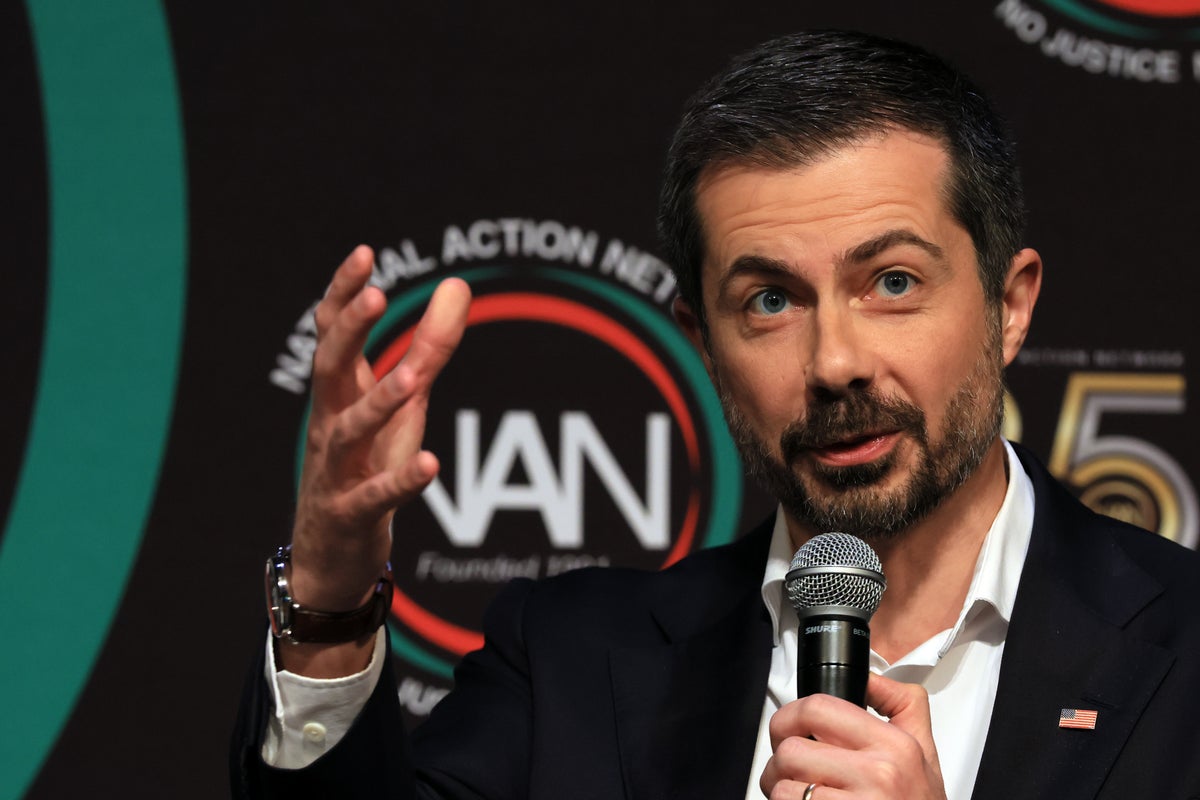
The collision of foreign policy and domestic economic reality creates a specific type of political risk that most media outlets fail to quantify. When a high-level government official, such as a Secretary of Transportation, enters a hostile media environment to discuss the intersection of Iranian military escalation and domestic inflation, they are not merely debating facts; they are managing a multi-variable crisis of perception. The effectiveness of this communication depends on the ability to decouple global geopolitical events from specific administration failures while simultaneously anchoring the opponent’s arguments in historical inconsistency.
The Bifurcation of Inflationary Drivers
To analyze the current economic friction, one must separate "headline inflation" from "core structural components." The political discourse often conflates these, leading to a breakdown in logical accountability. When critics cite "broken promises" regarding price stability, they frequently ignore the lag effect of monetary policy and the external shocks of energy markets.
- Energy Pass-Through Costs: Iranian geopolitical tension acts as a direct multiplier for domestic inflation through the Brent Crude benchmark. Even if domestic production is high, the global nature of oil pricing means that a threat to the Strait of Hormuz—a chokepoint for 20% of the world's petroleum—injects a risk premium into every gallon of gasoline sold in the American Midwest. This is a supply-side shock that no short-term domestic policy can fully mitigate.
- Logistical Friction: As a primary architect of supply chain recovery, the Secretary's defense relies on the "Bullwhip Effect." This economic phenomenon describes how small fluctuations in demand at the retail level cause massive swings at the wholesale and manufacturing levels. The argument presented by the administration suggests that current price levels are the tail-end of a post-pandemic correction, rather than a failure of fiscal oversight.
The failure of the interviewer's logic in these exchanges often lies in the "Single Variable Fallacy"—the idea that one leader or one policy is the sole lever for global pricing. By shifting the focus to corporate profit margins and supply chain efficiency, the administration reframes the debate from "Why is it expensive?" to "Who is preventing it from being cheaper?"
The Geopolitical Risk Function
The escalation of conflict with Iran introduces a "Geopolitical Risk Premium" that directly impacts capital markets. In a clinical analysis of the Secretary’s rhetoric, his primary objective is to highlight the inconsistency between the previous administration’s "Maximum Pressure" campaign and the current reality of regional instability.
The Failure of Sanctions as a Kinetic Substitute
Sanctions are often sold as a non-violent alternative to war, but they frequently function as a slow-motion blockade that triggers unpredictable retaliatory cycles. The logic used to "shred" the opposition in these televised debates rests on a simple cause-and-effect mapping:
- Action: The withdrawal from the Joint Comprehensive Plan of Action (JCPOA) without a secondary containment strategy.
- Reaction: An unmonitored Iranian nuclear program and increased proxy activity via the "Axis of Resistance."
- Outcome: A less stable maritime environment for global trade, which feeds back into the domestic inflationary loop mentioned earlier.
The Secretary’s effectiveness stems from pointing out that the "tough on Iran" stance of the past did not actually yield a reduction in Iranian influence. Instead, it increased the frequency of kinetic skirmishes. This is a strategic pivot from defensive explanations to offensive accountability.
The Asymmetry of Political Debating Frameworks
To understand why these media appearances are perceived as "shredding" the host, we must examine the "Gish Gallop" versus "Socratic Precision." A host often uses a high volume of disconnected statistics to overwhelm a guest. The Secretary counters this by applying a "First Principles" approach.
First Principles Deconstruction
When challenged on inflation, he does not defend the current price of milk. Instead, he deconstructs the components of the Consumer Price Index (CPI). By isolating the "Housing" and "Services" sectors—which are driven by high interest rates—from "Goods," which have seen deflationary trends due to improved logistics, he changes the terms of the engagement.
The host’s argument: Inflation is high; therefore, the administration failed.
The Secretary’s counter-logic: Logistical throughput is at record highs, and unemployment is at historic lows; the remaining inflation is a product of global energy markets and high interest rates controlled by an independent Federal Reserve.
This structural prose forces the interviewer to either concede the complexity of the economy or appear uninformed. The "shredding" occurs when the host cannot pivot from their scripted talking points to the nuanced reality of macroeconomics.
The Cost of Strategic Ambiguity
A significant portion of the debate centers on the concept of deterrence. In geopolitical strategy, deterrence is a function of capability and credibility. The critique leveled at the current administration is that they lack "strength." However, strength is not a measurable data point.
The administration’s counter-argument is built on the Cooperation-Defection Matrix. By rebuilding alliances in the Middle East and coordinating with the G7 on sanctions, they are attempting to increase the "Cost of Defection" for Iran. If Iran acts out, the collective response is more damaging than a unilateral American strike. This is a sophisticated move that prioritizes long-term regional stability over short-term political optics, even though the latter is what drives cable news ratings.
The Cognitive Dissonance of Conservative Fiscal Critique
A recurring theme in these high-stakes interviews is the accusation of "reckless spending." A data-driven response highlights the "Deficit Paradox."
- Tax Revenue vs. Outlay: The Secretary often points to the fact that while spending increased for infrastructure (a long-term asset play), the deficit was impacted by previous tax cuts that failed to generate the promised "trickle-down" growth.
- Infrastructure as an ROI Play: In the Transportation Secretary’s wheelhouse, spending is categorized as "Capital Expenditure" (CapEx). Just as a corporation takes on debt to build a factory that will generate revenue for 30 years, the government’s investment in ports and rail is designed to lower the "Cost of Doing Business" for the entire private sector.
By framing government spending as a strategic investment in efficiency rather than a "handout," the Secretary neutralizes the "inflationary spending" narrative. He argues that the real cause of inflation was a brittle, under-invested supply chain that couldn’t handle the surge in post-COVID demand.
Analyzing the "Broken Promise" Narrative
The host’s most potent weapon is the "broken promise"—the idea that the President guaranteed lower prices and failed to deliver. The defense against this is a "Temporal Shift."
The administration argues that their promises were focused on the rate of change (disinflation), not the absolute price level (deflation). Deflation is actually a sign of a collapsing economy (e.g., the Great Depression). By educating the audience on the difference between "prices going down" and "prices rising more slowly," the Secretary exposes the host's reliance on the audience's lack of economic literacy.
The Strategic Recommendation for Future Engagements
The data suggests that the current administration is winning the "efficiency" argument but losing the "affordability" argument. To bridge this gap, the communication strategy must evolve from defending the macro indicators to validating the micro experience.
- Shift from CPI to Disposable Income: Focus on "Real Wages"—wages adjusted for inflation. If wages are rising faster than the cost of living, the "affordability" crisis is a lag in consumer sentiment rather than a mathematical reality.
- Direct Linkage of Foreign Policy to the Wallet: Every diplomatic mission to the Middle East should be messaged as a "Supply Chain Security Mission." This creates a direct line between seemingly distant wars and the cost of goods at home.
- Exposure of Logical Inconsistency: When a host advocates for both "lower gas prices" and "more aggressive military action in the Middle East," they are advocating for two mutually exclusive outcomes. Military escalation in the Persian Gulf is the fastest way to $7-per-gallon gasoline. Pointing out this contradiction is the ultimate "shredding" of a populist argument.
The final strategic play is not to win the argument on the host's terms but to dismantle the host's terms entirely. By forcing the conversation into the realm of logistics, energy pass-through costs, and first-principles geopolitics, the Secretary moves from a defensive posture to a position of intellectual dominance. The goal is to make the critic’s simplified worldview look not just wrong, but dangerous to the very economic stability they claim to protect.



