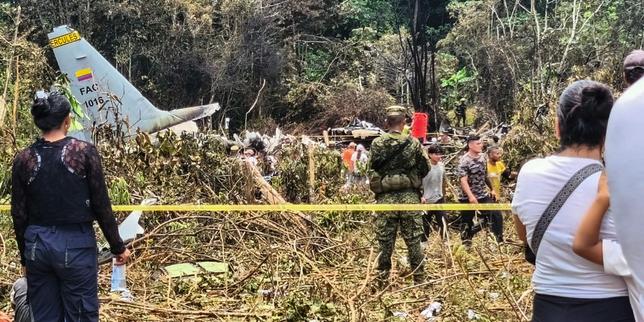
The wreckage near the Colombia-Ecuador border hasn't even cooled, and the script is already written. Media outlets are rushing to count the 66 bodies, map the flight path, and wait for the inevitable "pilot error" or "mechanical failure" verdict from a sanitized government press release.
They are asking the wrong questions.
When a Colombian military transport goes down with dozens of souls on board, the tragedy isn't just the impact—it’s the systemic obsolescence we’ve rebranded as "operational readiness." We treat these crashes like freak weather events. They aren't. They are the mathematical certainty of a global military logistics chain that prioritizes presence over precision and "making do" over modernizing.
The Myth of the Rugged Workhorse
General public perception suggests that military aircraft are indestructible tanks of the sky. The reality is far more fragile. Most tactical transport fleets operating in South America and across the developing world are geriatric platforms held together by the sheer willpower of overworked mechanics and "black market" cannibalization of parts.
When you hear that a military plane crashed in a border region, don't look at the altimeter first. Look at the procurement budget from 1994. We are forcing crews to fly 40-year-old airframes through the most unforgiving Andean thermals, then acting shocked when the metal fatigues.
- The Maintenance Gap: For every hour in the air, these planes require tens of thousands of dollars in specialized upkeep. In austerity-hit budgets, that "upkeep" often becomes "visual inspection and a prayer."
- Electronic Blindness: While civilian airliners enjoy triple-redundant collision avoidance and real-time satellite telemetry, many military transports are flying with tech that would be considered primitive in a budget Tesla.
- The "Mission-First" Fallacy: In civilian flight, a red light on the dash means you don't take off. In a military context, especially near sensitive borders, "operational necessity" overrides the sensor.
Geography is an Excuse for Bad Engineering
The "difficult terrain" narrative is a classic redirection tactic. Yes, the border between Colombia and Ecuador is a nightmare of cloud forests, sudden pressure drops, and jagged peaks. But we have the technology to navigate this. We’ve had it for decades.
The issue isn't the mountains; it’s the Power-to-Weight Deficit.
Imagine a scenario where a fully loaded transport enters a sudden downdraft. A modern, high-bypass engine suite has the thrust-to-weight ratio to climb out of the basement. An aging turboprop, weighed down by 66 passengers and gear, simply cannot beat the physics of the sink rate. The plane didn't "hit a mountain." The plane failed to provide the pilot with the raw physical output required to escape a standard atmospheric event.
By blaming the terrain, we absolve the people who signed off on the flight manifest. We treat the Andes as an unpredictable villain rather than a known constant that our current hardware is no longer fit to challenge.
Stop Asking if the Pilot Failed
"People Also Ask" columns will soon fill with queries about pilot training and flight hours. This is a red herring.
Military pilots in these regions are often some of the most skilled "seat-of-the-pants" flyers in existence. They have to be. They fly without the luxury of the automated flight envelopes that keep commercial pilots from stalling.
The real question is: Why was this specific airframe cleared for a 66-person load in a high-density altitude environment?
Density altitude is the silent killer. As temperature and humidity rise—common in the tropical borderlands—the air becomes thinner. The wings generate less lift. The engines produce less thrust. If you calculate your takeoff based on sea-level physics but fly into a high-altitude border pass, you are effectively flying a brick.
I’ve seen air forces across the globe push these limits to save on fuel costs or to minimize the number of sorties. They pack 66 people into a space meant for 40, ignoring the fact that the "max gross weight" listed in the manual was calculated in 1978 under ideal conditions.
The Geopolitical Cost of Cheap Logistics
This crash isn't just a human tragedy; it’s a failure of regional security architecture.
When a nation loses 66 personnel in a single afternoon due to a transport failure, its ability to monitor borders evaporates. This creates a vacuum. Cartels, insurgent groups, and smugglers don't need to shoot down planes when the planes are falling out of the sky on their own.
We need to stop viewing "military aid" as just guns and ammunition. If the goal is stability, the priority should be Aviation Life Cycle Management.
- Data-Driven Grounding: We need sensors that track airframe stress in real-time, feeding into a neutral database that can automatically "red-flag" a tail number, regardless of what a local commander says.
- Droning the Logistics: Why are we putting 66 humans on a single aging transport for routine border movements? High-risk corridors should be handled by autonomous or semi-autonomous cargo pods.
- The Truth About "Total Loss": We must stop refurbishing planes that have exceeded their fatigue life. A "zero-time" engine overhaul does nothing for a wing spar that has been vibrating for forty years.
The Brutal Reality of the 66
The 66 deaths in Colombia are a symptom of a global delusion. We want the prestige of a military presence without the staggering cost of a modern, safe logistics wing.
We praise the bravery of the soldiers while ignoring the negligence of the procurement officers who put them in a flying coffin. Every time we point to "thick fog" or "engine failure" as the cause, we are complicit in the next crash. The cause is the refusal to admit that some hardware is simply too old to be in the sky, regardless of the mission's importance.
Physics does not care about your mission statement. Gravity does not respect your borders.
Buy new planes or stop flying the missions. There is no middle ground where 66 people survive.
The next time a headline blares about a military crash, don't look at the map. Look at the tail number. Check the age. Then ask yourself why we keep pretending that 1970s technology can survive 2026 demands.
Fix the fleet or bury the dead. Pick one.