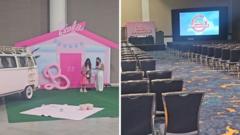
Stop crying about the refunds.
The headlines are all the same: "Disappointed Fans," "Empty Warehouses," and the inevitable "Organizers Issue Apology." We saw it with the Fyre Festival, we saw it with the Glasgow Wonka debacle, and now the latest Barbie-themed "immersive" flop is being dragged through the digital town square. The lazy consensus is that these events are failures of logistics. The public-facing narrative is that greedy promoters overpromised and underdelivered.
They’re wrong.
These events aren't failures. They are the purest expression of the "Hype Economy" we have ever built. If you’re looking at a sparse room with a few sad streamers and a plastic chair and calling it a "scam," you’re missing the point of 21st-century consumerism. You didn't buy a ticket to a physical location. You bought a ticket to a shared grievance.
In the attention economy, a mediocre success is a death sentence. A spectacular, viral catastrophe is a brand legacy.
The Aesthetic of Absence
We have reached "Peak Polish." Every Marvel movie looks the same. Every high-end pop-up is a sanitized, corporate-approved Instagram backdrop designed by a committee of thirty people. They are boring. They offer no friction.
When a Barbie fan event fails to provide the dreamhouse, it provides something far more valuable: Friction.
The modern consumer doesn't actually want a "perfect" experience. Perfection is static. You take one photo, you post it, and you move on. But a disaster? A disaster is a narrative engine. I have consulted for firms that spent $500,000 on "experiential marketing" only to have the footage vanish into the algorithm because it was too clean. It lacked the grit of reality.
The "lacklustre" event is a radical act of minimalism. It forces the attendee to engage with the absurdity of the brand itself. When you stand in a cold hall staring at a single pink balloon, you aren't just a victim; you are a witness to the deconstruction of IP.
The Refund is the New Engagement Metric
The mainstream press focuses on the refund as a sign of defeat. In reality, the refund is the ultimate hook.
Think about the math of virality. A successful, mid-tier event gets 1,000 local impressions. A failed event that makes international news for being "terrible" gets 100 million impressions. The cost of those 100 million impressions—if bought through traditional ad spend—would be astronomical. By issuing a few thousand dollars in refunds, the organizers have effectively bought global brand recognition for pennies on the dollar.
I've seen tech startups burn $10 million on "customer acquisition" with less reach than a single viral photo of a sad Oompa Loompa or a barren Barbie photobooth.
If you want to disrupt a market, stop trying to please everyone. Start trying to provoke them. The outrage cycle is a more reliable traffic driver than any loyalty program.
The Fallacy of the Immersive Experience
Let’s define our terms. "Immersive" has become a garbage word used by marketers who don't understand spatial design.
True immersion isn't about the props. It's about the psychological state of the participant. The people complaining about these Barbie events were never more "immersed" in the Barbie world than when they were unified in their collective disappointment. They were living the drama. They were the protagonists in a David vs. Goliath story against "The Man" who stole their pink paradise.
That is more emotional engagement than a well-lit gift shop could ever provide.
The Logistics of the "Scam" (And Why It’s Smart)
The critics point to the lack of "stuff." They say, "There was no food, the music was quiet, and the decor was cheap."
From a lean business perspective, this is genius. Why over-capitalize on physical assets that have zero resale value?
- Asset Lightness: Buying 500 custom-built Barbie mirrors is a liability. Renting a warehouse and putting up three rolls of pink crepe paper is a manageable risk.
- The "Wait" Economy: Keeping people in line is the oldest trick in the book. It builds perceived value. When they finally get inside and find nothing, the cognitive dissonance creates a "flashbulb memory." You will remember that empty room for twenty years. You wouldn't have remembered a decent cocktail party for twenty minutes.
- Algorithm Baiting: TikTok doesn't care about "good." It cares about "weird." A video of a child crying next to a cardboard cutout of a car is 10x more likely to hit the For You Page than a video of a child smiling.
Stop Trying to Fix the Experience
If you are an organizer, the worst thing you can do is try to "fix" a failing event mid-stream.
The pivot shouldn't be toward quality; it should be toward the spectacle of the struggle. Admit the failure immediately. Lean into the "underdog" narrative. Tell the world the "supplies were seized at the border" or the "creative director had a breakdown." People love a train wreck, but they stay for the recovery arc.
The "broken" event is the only honest interaction left in a world of AI-generated perfection. It is human. It is messy. It is a reminder that behind every billion-dollar movie franchise, there is a guy in a rented van trying to make a buck.
The Truth About Your Expectations
People ask: "How can they get away with this?"
They get away with it because you—the consumer—are addicted to the gamble. You knew deep down that a $40 ticket to a warehouse in an industrial park wasn't going to be a trip to Malibu. You went because you wanted to see if the hype was real, or if you could be the one to "expose" it.
You got exactly what you paid for: a story.
In a world where everyone has the same polished photos from the same "Museum of Ice Cream" clones, having a photo of the "Worst Barbie Event Ever" is actual social capital. It’s a badge of honor. It’s proof you were there when the facade cracked.
The Actionable Order for Brand Managers
Stop aiming for "satisfied" customers. Satisfaction is a flatline.
Aim for Polarization.
If 50% of your attendees think your event was a transcendental art piece and the other 50% want to sue you, you have won. You have created a conversation. You have exited the "Ignore" zone and entered the "Identity" zone.
The Barbie refund saga isn't a cautionary tale for promoters. It’s a blueprint. It’s a reminder that in the age of digital saturation, the only thing that cuts through the noise is a magnificent, unmitigated disaster.
The warehouse wasn't empty. It was full of exactly what we crave: something to talk about.
Next time you see a "lacklustre" fan event, don't look for the exit. Look for the camera. You're in the middle of a masterpiece of unintentional performance art.
If you wanted a perfect world, you should have stayed in the cinema. Out here, the mess is the point.
Now go ask for your refund and post the video. You’re welcome for the views.