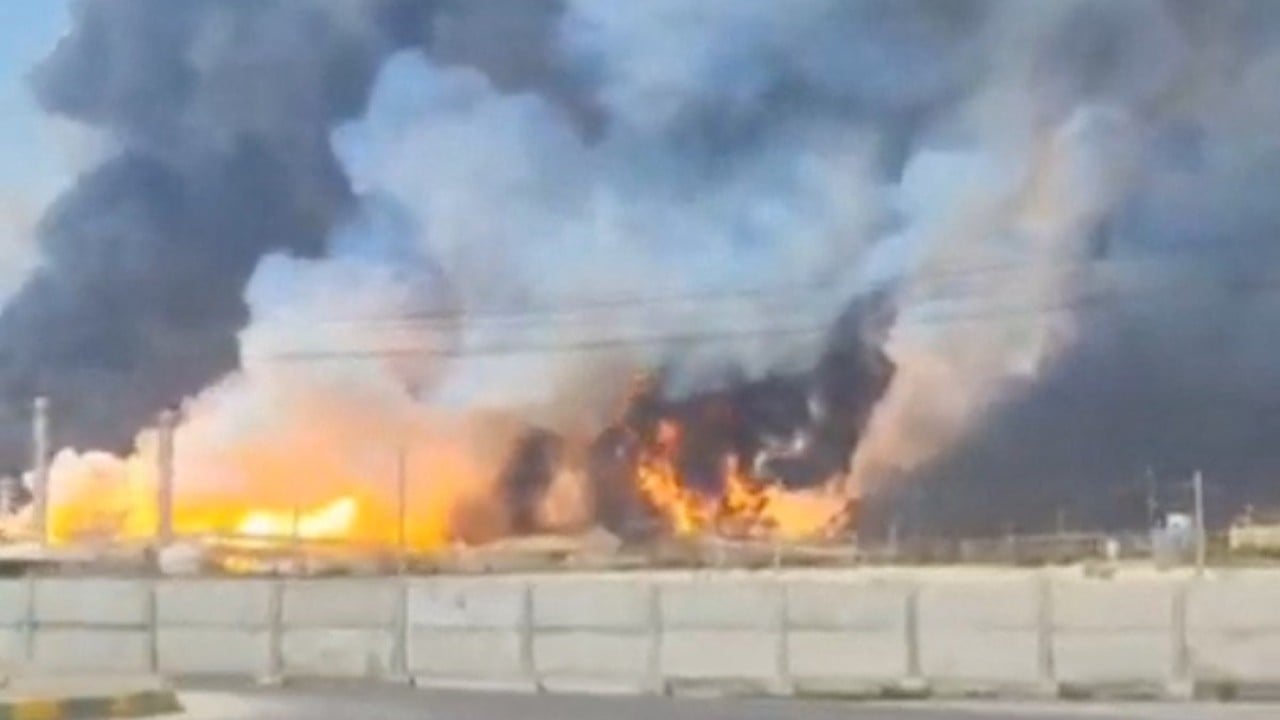
The stability of the global energy market currently rests on a fragile equilibrium of "managed escalation" that is reaching its structural limit. While media narratives focus on the immediate optics of kinetic strikes, a rigorous analysis reveals that the Persian Gulf has entered a phase of tri-lateral attrition. This phase is defined by the convergence of high-intensity regional conflict, the systemic vulnerability of energy infrastructure, and the erosion of traditional maritime deterrence. The tipping point is not a single event but a cumulative degradation of the "Risk Premium" that has historically kept global markets liquid.
The Mechanics of Tri-Lateral Attrition
The current conflict has expanded beyond a bilateral exchange into a three-front strategic bottleneck. To understand the gravity of the situation, one must categorize the operational theaters not by geography, but by their specific impact on global supply chains.
- The Maritime Chokepoint (The Bab el-Mandeb and Hormuz): This is the primary kinetic theater. The objective here is not total closure—which would be self-defeating for regional players—but the imposition of a "War Tax" via insurance premiums and rerouting costs.
- The Domestic Energy Infrastructure (The Hubs): This involves direct strikes on processing plants and desalination units. Unlike tankers, which are mobile and replaceable, fixed infrastructure has a multi-year recovery period.
- The Digital and Proximal Buffer Zones: This includes cyber-kinetic operations and the use of non-state actors to create plausible deniability while maintaining pressure on logistics hubs.
The Cost Function of Infrastructure Vulnerability
Energy hubs in the Gulf are designed for efficiency, not resilience. The transition to highly integrated, automated "Super Hubs" has created a concentrated risk profile. A single successful strike on a stabilizer or a gas-oil separation plant (GOSP) does not just stop production; it creates a systemic failure in the downstream flow.
The cost of a disruption can be quantified through three primary variables:
- Repair Latency: The time required to source specialized components, such as high-pressure turbines or customized control systems, which often have 12-to-18-month lead times.
- Contagion Effect: The degree to which a shutdown in one facility forces a pressure buildup or emergency flaring in connected pipelines.
- Confidence Discount: The long-term withdrawal of foreign direct investment as the "safe haven" status of Gulf infrastructure is reassessed.
Standard economic models often fail to account for the "Interdependency Loop." For instance, if power generation is hit, desalination plants fail. If desalination fails, the labor force cannot remain on-site to repair the energy infrastructure. This creates a feedback loop that transforms a tactical strike into a strategic collapse.
Asymmetric Warfare and the Logic of Deniability
The use of Unmanned Aerial Vehicles (UAVs) and loitering munitions has fundamentally altered the cost-exchange ratio of regional defense. A drone costing $20,000 can successfully disable a facility or vessel protected by multi-million dollar interceptors. This is the "Asymmetry Gap."
Modern defense systems are optimized for ballistic missiles or fast-moving jets. They struggle with "low-slow-small" (LSS) threats that mimic the radar signature of birds or civilian craft. When these threats are deployed in swarms, the probability of a "Leaker"—a single unit getting through—approaches statistical certainty. This reality forces energy producers to spend exponentially more on defense for diminishing returns in actual security.
The Deterrence Deficit
The historical framework of "deterrence by punishment" (threatening a massive counter-strike) is losing its efficacy. In a three-front conflict, the aggressor is often decentralized. When a maritime hub burns, the responsibility is diffused through a network of proxies, making a clear "Return to Sender" strike politically and kinetically complex.
We are seeing a shift toward "deterrence by denial," where the goal is to make the target too difficult or expensive to hit. However, hardening a 500-acre refinery against swarm attacks is a physical impossibility. The second limitation of current strategy is the reliance on US-led maritime coalitions. As regional powers build their own domestic capabilities, the unified command structure required for effective theater defense begins to fracture, leading to gaps in intelligence and response timing.
Quantifying the Global Impact of a Tipping Point
The "Tipping Point" is defined as the moment when the physical cost of shipping energy through the Gulf exceeds the profit margin of the commodity itself. This is not a binary switch but a sliding scale of economic viability.
- Insurance Escalation: At a certain threshold of kinetic activity, Lloyd’s of London and other underwriters declare "No-Go Zones." This effectively grounds the fleet regardless of the physical status of the water.
- The VLCC Bottleneck: Very Large Crude Carriers (VLCCs) are the backbone of the market. There is no alternative land-based route that can handle the volume of the Strait of Hormuz. A 20% reduction in Hormuz traffic equates to a global supply shock that cannot be mitigated by the Strategic Petroleum Reserve (SPR) in the long term.
The Kinetic-Economic Feedback Loop
The relationship between regional conflict and energy prices is non-linear. In the early stages of a conflict, prices spike due to speculation. However, in the current "Three-Front" scenario, we are seeing the emergence of "Physical Scarcity Logic." This occurs when the damage to infrastructure is so severe that even a total cessation of hostilities would not restore supply for months or years.
The strategic error made by many analysts is treating "energy" as a monolith. In reality, the Gulf provides specific grades of crude and Liquefied Natural Gas (LNG) that certain refineries—particularly in Asia—are hard-wired to process. Switching to North American WTI or Brent is not a "seamless" transition; it requires complex refinery re-tooling that adds weeks to the supply chain delay.
Defensive Architecture Failures
The current deployment of Patriot batteries and Aegis-equipped destroyers is a legacy solution to a modern problem. These systems face a "Saturation Constraint." An adversary does not need to destroy the defense system; they only need to exhaust its magazine. Once the interceptor count hits zero, the remaining drones have a clear path to the target.
Furthermore, the "Point Defense" of individual energy hubs often lacks integration. A refinery might have its own electronic warfare (EW) suite, but if that suite isn't synchronized with the national air defense grid, it can inadvertently jam friendly communications or leave "blind corridors" that savvy operators can exploit.
Strategic Reconfiguration of Regional Power
The burning of Gulf energy hubs signifies the end of the "Rentier Security" era, where regional stability was essentially purchased through external guarantees. We are entering an era of "Self-Correction," where states must choose between total escalation or a fundamental redesign of their economic dependencies.
The shift toward hydrogen, solar, and nuclear within the Gulf is often framed as a "green" transition. Strategically, it is a "resilience" transition. Decentralized power grids are significantly harder to disable than a few massive gas-fired plants. However, this transition will take decades, leaving a massive "Vulnerability Window" that is currently being exploited.
The Logic of the Final Escalation
The final stage of this conflict path involves the transition from "Infrastructure Harassment" to "Total Asset Neutralization." In this scenario, the objective shifts from leverage to the literal destruction of the opponent's economic base. The markers for this shift include:
- Targeting of Desalination: Moving from oil (revenue) to water (survival).
- Subsea Cable Interdiction: Moving from energy to information flow.
- Mining of Deep-Water Ports: Transitioning from ship-targeting to permanent geographic denial.
The probability of this transition increases as the internal political pressures on the involved regimes grow. When a state feels its survival is at stake, the "rational actor" model of economic preservation is discarded in favor of maximum regional disruption.
Strategic Play: The Resilience Mandate
For stakeholders operating within or dependent upon the Gulf energy corridor, the priority must shift from "Risk Mitigation" to "Operational Redundancy."
Operators must immediately audit the "Single Points of Failure" within their supply chains, specifically focusing on the lead times for customized industrial components. Relying on "Just-in-Time" logistics in a three-front war zone is a systemic failure of leadership.
The focus should be on the deployment of "Passive Defense" measures—physical hardening, localized EW bubbles, and the creation of "Dark Facilities" that can operate with minimal digital signatures. Simultaneously, global energy consumers must accelerate the "Refinery Decoupling" process, ensuring their internal infrastructure can process diverse grades of crude to mitigate the inevitable loss of Gulf-specific blends. The era of cheap, guaranteed energy flow from the Persian Gulf has concluded; the era of high-friction, high-cost energy security has begun.
Would you like me to develop a detailed risk-assessment framework for the "Repair Latency" of specific GOSP components?