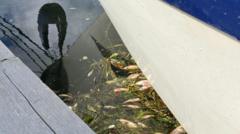
The sudden mortality of fish populations within enclosed water management systems—specifically dykes and polders—is rarely a random act of nature. It is almost always a failure of systemic equilibrium between hydraulic engineering and biological oxygen demand. When a Member of Parliament questions the legislative body regarding fish deaths in a dyke, the inquiry often focuses on optics and immediate blame. However, a rigorous analysis reveals that these events are the byproduct of a specific "Toxicity Triad": stagnant flow dynamics, nutrient loading, and infrastructure-induced thermal stress.
To understand why these deaths occur, one must move beyond the surface-level observation of "dead fish" and examine the dyke as a closed-loop thermodynamic system. The failure of this system is not a single point of collapse but a cascading degradation of water quality metrics.
The Mechanistic Drivers of Mass Mortality
Fish mortality in artificial water bypasses or dyke systems is governed by the relationship between Dissolved Oxygen (DO) and the chemical oxygen demand of decomposing organic matter. The "Kill Zone" is reached when DO levels drop below $2$ mg/L for extended periods, a state known as hypoxia.
1. The Kinetic Bottleneck
Dykes are designed for flood control and land reclamation, not for ecological throughput. When sluice gates remain closed or pumps are deactivated for maintenance, the water column becomes lentic (still). In a lentic state, the physical re-aeration—the process where oxygen from the atmosphere dissolves into the water via surface turbulence—drops to near zero.
2. Hyper-Eutrophication and the Algal Inverse
The presence of agricultural runoff or untreated greywater introduces high concentrations of nitrogen and phosphorus into the dyke. This triggers rapid algal blooms. While algae produce oxygen during the day via photosynthesis, they consume it at night through respiration. In a densely packed dyke, this creates a "Diurnal Oxygen Swing." If the biomass is high enough, the nighttime dip crosses the critical threshold for fish survival, leading to mass gasping and death by dawn.
3. Thermal Stratification and Benthic Collapse
Water temperature inversely correlates with oxygen solubility. As temperatures rise, the water's ability to hold $O_2$ decreases. In shallow dyke environments, sunlight penetrates the entire water column, heating it rapidly. This creates a stratified layer where the bottom (benthic zone) becomes entirely anoxic. Fish are forced into the upper, warmer layers where they face high metabolic demands but decreasing oxygen availability—a biological pincer movement.
The Infrastructure Liability Framework
The parliamentary debate often misses the technical reality that the dyke itself is a piece of aging technology. The "Infrastructure Decay Function" suggests that as these systems age, their ability to self-regulate decreases.
- Siltation Accumulation: Over decades, dykes accumulate organic silt. This silt acts as a "carbon battery," constantly pulling oxygen out of the water to fuel the decomposition of sunken organic matter.
- Mechanical Failure Points: Many fish kill events coincide with the failure of automated aeration systems or the delayed opening of tide-locked gates. This is a management failure of the "Maintenance-to-Risk" ratio.
- Permeability Paradox: Modern dykes are often too efficient. By creating a near-perfect seal from the larger river or sea system, they eliminate the "Flushing Effect" that historically diluted toxins and replenished oxygen levels.
Quantifying the Economic and Ecological Debt
The death of fish in a dyke is a lagging indicator of a bankrupt ecosystem. The costs are not merely the loss of biodiversity but the accrual of "Ecological Debt" that the state must eventually service through expensive remediation.
The Cost of Neglect
Replacing a collapsed fish population is significantly more expensive than the proactive management of water levels. The economic loss includes:
- Bio-remediation Costs: Removing thousands of rotting carcasses to prevent secondary bacterial outbreaks (such as botulism) requires specialized hazardous waste protocols.
- Loss of Ecosystem Services: Fish act as natural controllers for mosquito larvae and algae. Their absence leads to an explosion of pests and further water quality degradation.
- Infrastructure Repair: Often, the "cause" of the death is a clogged culvert or a rusted pump that went uninspected for years. The emergency repair costs are invariably higher than scheduled preventative maintenance.
The Three Pillars of Hydraulic Stability
To prevent the recurrence of these events, water management authorities must transition from reactive crisis management to a predictive modeling approach.
High-Frequency Monitoring (HFM)
Static sampling (taking a water bottle to a lab once a month) is useless for preventing fish kills. Authorities require real-time sensor arrays that measure:
- Oxidation-Reduction Potential (ORP): A leading indicator of water's ability to cleanse itself.
- Electrical Conductivity: To detect illegal industrial discharges or sudden runoff spikes.
- Real-time DO Sensors: Linked to automated alarm systems that trigger mechanical aeration or gate opening before levels hit the $3$ mg/L warning threshold.
Structural Permeability
Engineering must move toward "Smart Dykes" that allow for controlled leakage or "Environmental Flows." By allowing a minimum percentage of water exchange even during non-flood periods, the system maintains a kinetic baseline that prevents stagnation.
Nutrient Sequestration
The use of floating treatment wetlands (FTWs) within the dyke structure can provide a biological buffer. These artificial islands utilize hydroponic roots to strip nitrogen and phosphorus from the water column, effectively competing with algae and stabilizing the oxygen swing.
Limitations of Current Remediation Strategies
There are no low-cost shortcuts to fixing a compromised dyke system. Common "quick fixes" often introduce new failure modes:
- Chemical Flocculants: Using alum or clay to sink algae can temporarily clear the water but adds to the benthic silt load, worsening long-term oxygen demand.
- Emergency Aeration: Bubblers and fountains are effective only in small surface areas; they cannot compensate for the volume of a massive dyke system once a total anoxic event has begun.
The parliamentary inquiry should pivot away from seeking a single "guilty party" and instead audit the Water Management Protocol (WMP). If the WMP does not include mandatory oxygen-triggered gate operations or strict nutrient runoff limits for adjacent land, the infrastructure is designed to fail.
The immediate strategic priority for the relevant department is the implementation of a Dynamic Hydraulic Model. This model must simulate the impact of projected summer heatwaves on specific dyke segments. By identifying "High-Risk Zones" where depth is shallow and flow is minimal, the agency can pre-emptively deploy mobile aeration or initiate flushing cycles 48 hours before peak thermal stress occurs. This shifts the operational stance from one of cleaning up carcasses to one of managing a biological asset.