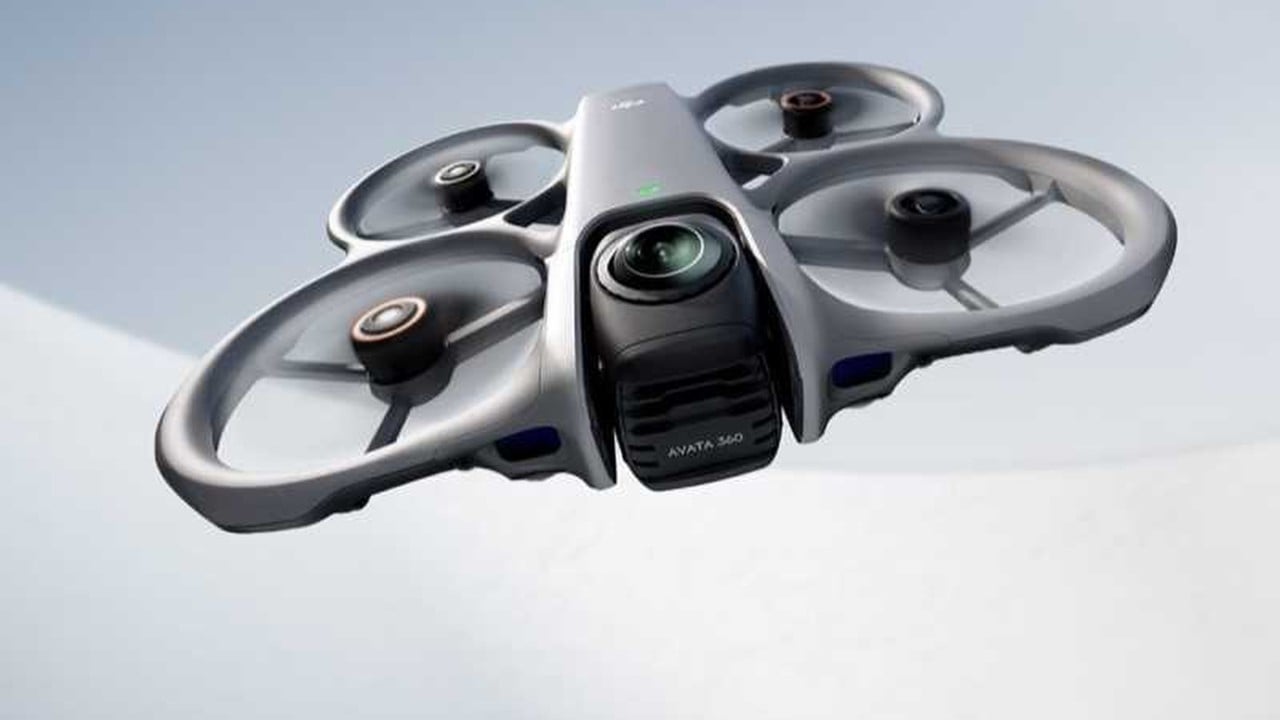
The consumer drone market has long been a predictable kingdom with one undisputed ruler, but a sudden legal and technical blitz has shattered that peace. On March 23, 2026, DJI filed an unprecedented patent ownership lawsuit against its neighbor and rising rival, Insta360. The timing was a calculated strike, landing exactly three days before DJI officially unveiled the Avata 360, its first-ever dedicated 360-degree FPV drone.
This is no longer just a race for better specs. It is a desperate, high-stakes territorial dispute. By suing Insta360 in the Shenzhen Intermediate People's Court—the first time DJI has initiated a patent ownership dispute in China—the industry leader is effectively trying to claw back the intellectual "DNA" it claims was stolen by former employees. At stake is the future of immersive flight, a category Insta360 recently entered with its Antigravity A1, only to find DJI standing at the gate with a lawsuit in one hand and a superior 8K drone in the other.
The Service Invention Trap
The legal mechanism DJI is wielding is the "service invention" doctrine under Chinese patent law. This rule states that if an employee leaves a company and files a patent within one year that is "directly related" to their previous work, that patent legally belongs to the former employer. DJI alleges that several core R&D personnel migrated to Insta360 and quickly filed six patents covering critical flight control systems, structural designs, and image processing.
Insta360 CEO Liu Jingkang has dismissed the claims as a "market leader's" reaction to losing ground. He argues that the patents in question are either obsolete, were his own original ideas, or were developed entirely within Insta360's ecosystem. However, the most damning evidence DJI pointed to involves "hidden" inventors. According to court filings, Insta360 allegedly omitted real names on domestic Chinese patent applications while listing the actual inventors—former DJI staff—on international filings. Liu defends this as a standard tactic to protect his team from corporate headhunters, but in the eyes of a judge, it may look like a paper trail of intellectual poaching.
Technical Dominance as a Defense
While the lawyers trade blows, the engineers have delivered a clear message. The Avata 360 is not just a defensive product; it is a hardware overmatch designed to make the competition look antiquated.
Imaging Superiority
The Avata 360 utilizes dual 1-inch-equivalent sensors capable of capturing 8K video at 60fps. For context, the rival Antigravity A1 is limited to 8K at 30fps. The larger 2.4 μm pixels provide a dynamic range that handles the harsh transitions of 360-degree environments—sky to shadow—with significantly more grace than smaller-sensor alternatives.
The Virtual Gimbal
One of the most significant shifts in this new hardware is the move away from mechanical limitations. The Avata 360 features a 360-degree Virtual Gimbal. This software-driven stabilization allows for "infinite" rotation and tilt. A pilot can fly the drone forward in a straight line while the "camera" looks backward, performs a vertical flip, or mimics a complex dolly-zoom, all without any physical gimbal movement.
Logistics and Repair
In a nod to the rough-and-tumble world of FPV flying, DJI introduced a replaceable front lens element. Given that 360-degree drones use protruding fisheye lenses that are magnets for scratches and cracks, the ability for a user to swap the lens in the field rather than mailing the entire unit for repair is a massive operational advantage.
The Twenty Eight Patents in the Pocket
The defense from Insta360 is not just rhetorical; it is a counter-threat. Liu revealed that his team identified 28 instances where DJI products allegedly infringe on Insta360’s own patents, covering everything from hardware structure to software methods.
"We didn't sue them because, as a smaller company, we prioritize innovation over litigation," Liu stated in a Weibo post. This posture of the "innovative underdog" is a powerful narrative, especially following Insta360’s recent victory over GoPro in the U.S. International Trade Commission. In February 2026, the ITC cleared Insta360 of several patent infringement claims brought by GoPro, finding the patents either invalid or not infringed.
By winning in the U.S., Insta360 proved it could survive the legal "tax" imposed by legacy players. But the Shenzhen court is a different beast entirely. In China, the service invention laws have real teeth, and if the court finds that the disputed patents were indeed built on DJI’s proprietary research, the ownership of those patents could be forcibly transferred back to DJI.
Market Cannibalization
The launch of the Avata 360 creates a strange internal friction for DJI as well. With 42GB of internal storage and a 20km transmission range via the O4+ system, the drone is a powerhouse. However, it enters a space where DJI’s own Osmo 360 handheld camera also exists.
The industry is watching to see if 360-degree capture becomes a niche feature of the FPV world or if it eventually swallows the traditional gimbal-drone market. Why bother with a mechanical gimbal when you can capture the entire sphere in 8K and "film" the shot later in post-production? The Avata 360 supports ActiveTrack 360 and a "Spotlight Free" mode that keeps subjects in frame automatically, essentially acting as an AI director in the sky.
The End of the Gentleman’s Agreement
For years, DJI and Insta360 existed in parallel—one owned the air, the other owned the 360-degree action camera market. That boundary has dissolved. DJI’s Osmo Action 5 Pro and Osmo 360 directly challenged Insta360’s core business, while Insta360’s entry into drones threatened DJI’s monopoly.
The current lawsuit marks the end of any remaining diplomatic ties. This is a battle for the very ownership of the ideas that make immersive imaging possible. If DJI wins the patent ownership dispute, it could potentially block Insta360 from using its own core flight technologies in future drones. If it loses, it will have spent its "first time" suing at home on a failure that emboldens its largest competitor.
The Avata 360 is currently available for purchase, but the legal framework it sits upon is vibrating with tension.
Would you like me to analyze the specific technical differences between the Avata 360's O4+ transmission system and the Antigravity A1's proprietary link?