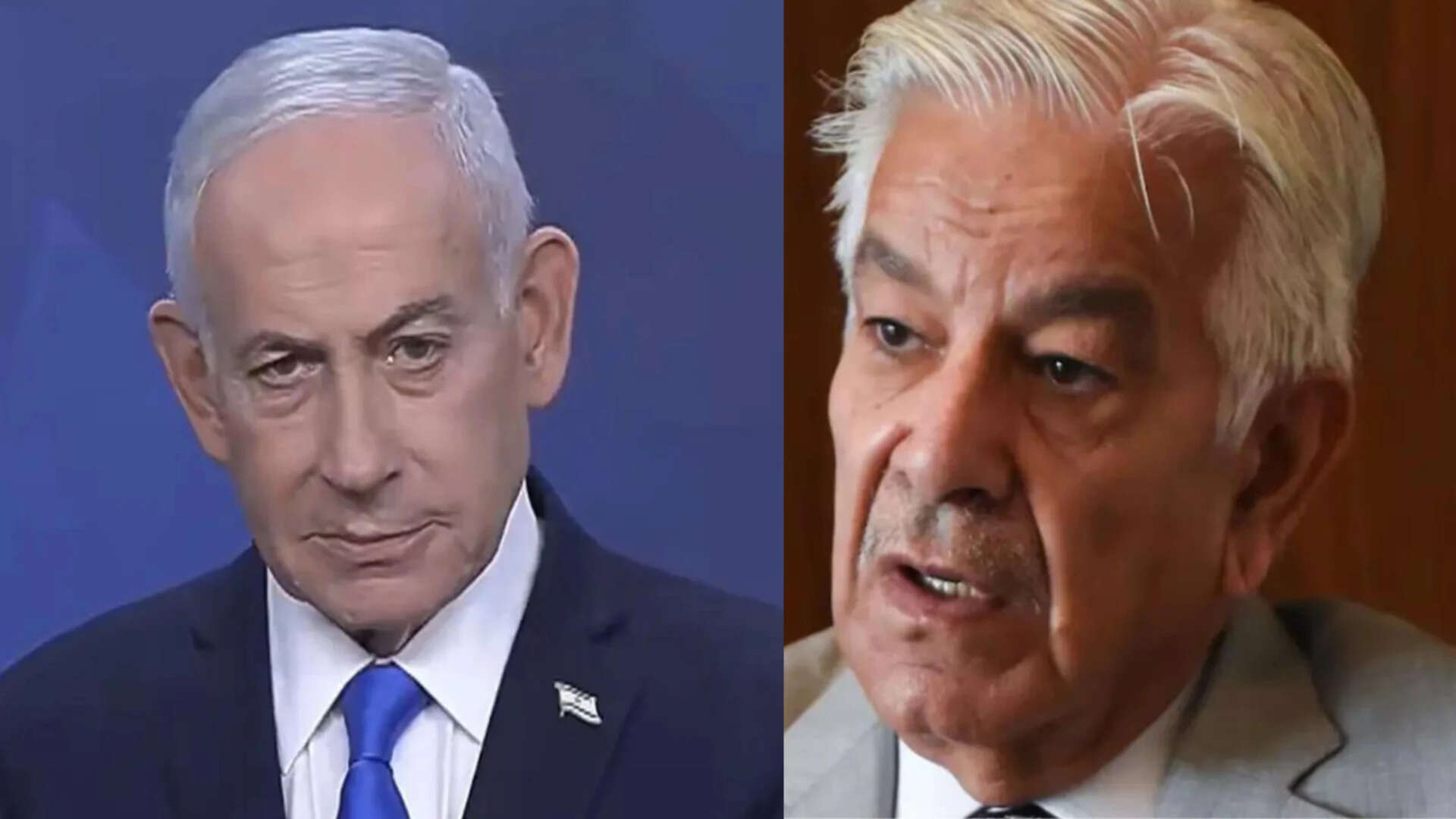
Words carry a weight that traditional weapons sometimes can't match in the volatile world of international relations. We’ve seen this play out recently as Pakistan and Israel engaged in a blistering exchange of rhetoric that moved far beyond standard diplomatic disagreements. When Pakistan’s Defense Minister Khwaja Asif told Israel to "burn in hell," he wasn't just venting frustration. He was signaling a hardening of a decades-old stance that has zero room for compromise. This isn't just about a tweet or a single speech. It's about how two nations with no formal ties use global platforms to perform for their domestic audiences while testing the limits of international decorum.
The spark that lit this particular fuse was the ongoing conflict in Gaza. As the humanitarian situation worsened, Pakistani officials ramped up their condemnation. But Asif's specific choice of words—invoking a religious and eternal damnation—pushed the tension into a different territory. Israel’s response was swift, labeling the rhetoric "outrageous" and "incendiary." If you’re trying to understand why this matters now, you have to look at the internal pressures both governments face. Leaders often find that loud, aggressive foreign policy is the easiest way to distract from domestic economic or political struggles.
Why Khwaja Asif’s Burn in Hell Remark Changed the Narrative
Diplomacy usually operates in a gray area of polite "grave concerns" and "deep regrets." Khwaja Asif threw that playbook out the window. By using the phrase "burn in hell," he tapped into a visceral, emotional vein that resonates deeply with the Pakistani public. For many in Pakistan, the Palestinian cause isn't just a political issue. It’s a foundational part of their national identity.
Israel’s reaction wasn't just a defensive reflex. They viewed this as an escalation of state-sponsored anti-Zionism. The Israeli foreign ministry’s rebuttal didn't just target the words; it targeted the legitimacy of the messenger. They pointed to Pakistan's own internal human rights record, a classic "whataboutism" tactic used to deflect international pressure. It’s a predictable cycle. One side uses moral outrage to condemn military action, and the other side uses political history to undermine the critic’s moral standing.
The Domestic Audience Factor
You have to realize that these leaders aren't always talking to each other. They’re talking to the people back home. Pakistan is currently navigating a brutal economic crisis and a fractured political landscape. In that environment, standing tall against a perceived global villain is a quick win for any politician. It’s high-reward, low-risk because there are no diplomatic ties to sever. You can’t break a relationship that doesn't officially exist.
Israel operates under similar, though different, pressures. With a government under intense scrutiny for its military operations, hitting back at international critics is a way to project strength. When an official from a nuclear-armed state like Pakistan uses such inflammatory language, Israel uses it as evidence that they are surrounded by irrational actors. This reinforces the "us against the world" mentality that keeps certain political coalitions in power.
The Long History of Pakistan and Israel’s Non-Relationship
To grasp the current "war of words," you need the context of 1947 and 1948. Pakistan was founded as a homeland for Muslims, and it has never recognized the state of Israel. This isn't just a policy. It’s written on the Pakistani passport: "This passport is valid for all countries of the world except Israel." Think about that for a second. Every single citizen is reminded of this geopolitical stance every time they travel.
There have been "under the table" moments, of course. Intelligence agencies sometimes talk when interests align, like during the Soviet-Afghan war. But publicly? It’s pure ice. The recent outbursts are just the latest chapter in a book that’s been written over seventy years. When you have no formal channels to talk, you shout. That’s exactly what’s happening on social media and at the UN.
Security Implications of Nuclear Rhetoric
The stakes are higher because Pakistan is a nuclear power. When a high-ranking defense official uses language usually reserved for street protests, the international community gets nervous. It’s not that anyone expects a nuclear strike, but the degradation of professional discourse makes miscalculations more likely. If the top brass is talking about eternal damnation, how much room is left for de-escalation in a real crisis?
Israel is also a suspected nuclear power, though they maintain a policy of ambiguity. This creates a weirdly symmetrical tension. Two high-stakes military powers, both religiously grounded in their founding ideologies, screaming at each other through digital megaphones. It’s a recipe for long-term instability in the Middle East and South Asia regions.
How Social Media Turned Diplomacy into a Cage Match
We used to wait for official statements on letterhead. Now, we get policy shifts in 280 characters or less. The "outrageous" response from Israel likely came via a social media platform before it ever hit a press release. This speed is dangerous. It doesn't allow for the "cooling off" period that traditional diplomacy provides.
In the past, a diplomat might take twenty-four hours to draft a response to a slight. That time allowed for nuance. Today, if you don't respond in twenty minutes, you’ve lost the news cycle. This creates a race to the bottom where the most extreme statement wins the most engagement. Khwaja Asif’s remark went viral because it was extreme. Israel’s "outrageous" tag went viral for the same reason.
The Role of Misinformation and Echo Chambers
It’s easy to get lost in the noise. During these verbal spats, old videos are often recycled as new, and fake quotes are attributed to officials on both sides. This happens because the audience is already primed to believe the worst about the "other." In Pakistan, any rumor of Israel’s involvement in local instability is bought wholesale. In Israel, any Pakistani criticism is often dismissed as radicalism.
Breaking out of these echo chambers is nearly impossible when the officials themselves are fueling the fire. If you’re trying to find the "truth" in these exchanges, you won't find it in the insults. The truth is in the timing. These outbursts almost always coincide with specific events on the ground—a new settlement announcement, a protest in Lahore, or a vote at the UN.
What Happens When the Shouting Stops
The current war of words will eventually fade, but the damage to the "vibe" of international relations remains. We’re moving into an era where "undiplomatic" is the new standard. If you’re watching this play out, don't expect a sudden reconciliation. There is no path to "normalization" between these two right now. The political cost for Pakistan would be a revolution, and the strategic benefit for Israel is minimal compared to the optics of the fight.
Instead of looking for a peace treaty, watch the alliances. Pakistan is leaning harder into its relationship with regional players who share its stance. Israel is doubling down on its "Abraham Accords" partners, trying to prove that Pakistani-style rhetoric is a thing of the past. These two are moving in opposite directions, and the "burn in hell" exchange is just a marker of the distance between them.
Keep an eye on the UN General Assembly. That’s where the next round will likely happen. Watch for the specific words used by lower-level officials. If they start mirroring Asif’s "hell" rhetoric, it means the policy has shifted from a one-off outburst to a permanent stance. If they dial it back to "unacceptable actions," the storm might be passing. For now, the rhetorical bridge is burnt, and neither side seems interested in rebuilding it. You should focus on how this affects Pakistan's standing with the US, as Washington often plays the middleman in these silent conflicts. When Islamabad gets loud about Israel, it usually complicates their meetings in DC. That’s the real-world consequence of a tweet.