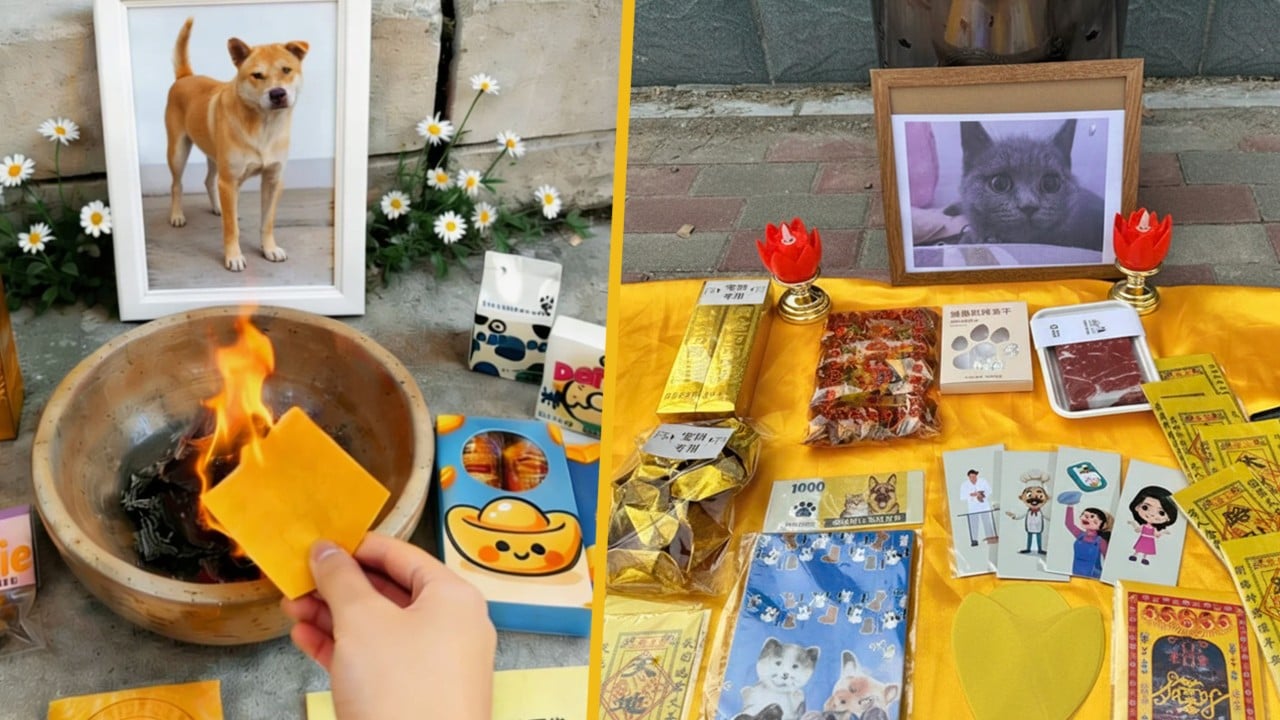
The mainstream media is obsessed with the "luxury" tag. They see a golden retriever being sent off with Wagyu beef and gold-flecked joss paper and call it a "rising trend" or a "shift in consumer behavior." They look at the $7 billion valuation of China’s pet economy and mistake a desperate search for meaning for a sophisticated market evolution.
They are wrong. This isn't about luxury. It’s about a profound failure of human intimacy.
When you see a pet owner in Shanghai spending $3,000 on a miniature mahogany casket, you aren't looking at a "premium lifestyle choice." You are looking at the byproduct of a society that has optimized for efficiency so aggressively that it has forgotten how to handle the messy, inconvenient reality of death. We’ve turned mourning into a transaction. We’ve replaced the community support system with a service fee.
The Myth of the Pampered Pet
The prevailing narrative suggests that these elaborate ceremonies are the ultimate expression of love. "He was a family member," the owners say. "He deserves the best."
Let’s dismantle that.
If you truly treated a pet as a family member, you wouldn't need a professional "grief consultant" to choreograph a performance for social media. In traditional human mourning, we have rituals that serve the living—gathering, sharing food, acknowledging the void. But the current pet funeral industry in China isn't serving the living; it’s serving the ego of the survivor.
I have watched people drop a month’s salary on "spirit money" for a cat they barely saw because they were working 9-9-6 shifts. The luxury funeral is a guilt tax. It’s a retroactive payment for the time you didn't spend when the animal was actually breathing.
The industry knows this. They aren't selling dignity; they are selling absolution.
The Joss Paper Fallacy
Burning joss paper for ancestors is a practice rooted in thousands of years of lineage and filial piety. Applying it to a French Bulldog is a category error that reveals a deeper crisis.
In the traditional sense, burning spirit money ensures the ancestor’s comfort in the afterlife so they can, in turn, bless the family line. It’s a contract of continuity. Pets, by definition, have no lineage. They have no "house" to uphold. By dragging pets into the realm of ancestral worship, we aren't elevating the pet—we are diluting the culture.
We are seeing a generation of urbanites who find it easier to relate to a creature that offers unconditional, non-verbal validation than to a human being who demands compromise and work. The "pet as child" phenomenon is a coping mechanism for the atomization of the modern Chinese city. When we treat a poodle’s death with more ceremony than we treat the passing of a neighbor, we have lost the thread of what makes a society functional.
The Business of Manufactured Catharsis
Let’s talk about the mechanics of these "boutique" funeral homes. They follow a predictable script:
- The Aesthetic Isolation: Minimalist rooms, soft lighting, and an absence of the "smell" of death. They sanitize the experience.
- The High-End Upsell: Wagyu beef for the "final meal," silk shrouds, and jewelry made from carbonized fur.
- The Digital Afterlife: Professional photography and videography designed specifically for WeChat moments.
The "innovation" here isn't the service; it's the commodification of the tearduct. I’ve spoken with founders in this space who admit that the markup on a pet casket is roughly 600%. A ceramic urn that costs $12 to manufacture is rebranded as a "vessel of memory" and sold for $400.
This isn't an industry. It's a predatory capture of emotional vulnerability.
If you want to honor a pet, you do it while they are alive. You give them space to run, quality food that isn't a "gimmick," and your actual presence. Spending $5,000 on a cremation ceremony because you feel bad about leaving your dog in a 40-square-meter apartment for 12 hours a day isn't love. It’s a bribe to your own conscience.
Why the Market is a Bubble of Insecurity
Economists point to the "silver hair" and "singlehood" economies as the drivers for this growth. They claim that as people live alone longer, pets become the primary emotional anchor. While true, they miss the dark side of this dependency.
When a pet becomes your only source of emotional stability, its death isn't just a loss; it’s a structural collapse of your identity. The funeral industry feeds on this instability. They offer "memorial diamonds" created from pet ashes—a permanent, physical anchor to a loss that should, healthily, be processed and moved past.
By encouraging people to carry the physical remains of their pets in jewelry, we are stalling the grieving process. We are creating a culture of perpetual mourning.
"We aren't helping people say goodbye," one former industry employee told me. "We are helping them stay stuck so we can sell them the next memorial service."
The Counter-Intuitive Truth
The most respectful thing you can do for a dead animal is to acknowledge its animality. A dog does not want a silk shroud. A cat does not care about the quality of its joss paper. These are human vanities projected onto a creature that lived a life of simple, physical needs.
The "luxury" funeral is the final insult to the pet. It’s the final time we force the animal to participate in a human performance that serves no purpose for them.
If you want to fix the "grief crisis," stop looking for better urns. Start looking for better ways to build human communities that don't leave people so isolated that their only connection to the world is a four-legged animal they have to pay a stranger to help them bury.
The Real Cost of "Premium" Farewells
We are seeing the rise of a "Grief Industrial Complex." It thrives on the idea that the depth of your sorrow is measurable by the height of your invoice.
Consider the "Wagyu Final Meal." It’s a centerpiece of many viral stories. From a biological standpoint, a dying animal often has no appetite; their digestive system is shutting down. Forcing a high-fat steak onto a dying dog isn't a kindness—it can actually cause physical distress or pancreatitis. But the funeral director pushes it because it looks good in the brochure. It creates a "memory" for the owner at the expense of the animal’s actual comfort.
This is the height of narcissism.
We have reached a point where the image of being a "good pet parent" is more valuable than the actual welfare of the pet. We are spending billions to convince ourselves that we are empathetic, while ignoring the fact that our lifestyles make true empathy almost impossible.
Stop Buying the Absolution
The next time you see a headline about the "booming pet funeral market," don't celebrate it as a sign of progress. Don't view it as a sign that we are becoming more "humane."
View it for what it is: a red flag.
It is proof that we have reached a level of social alienation where we have to outsource our most basic emotional duties to companies with slick marketing and high margins. We are losing the ability to face death without a credit card in hand.
If you love your pet, give them a quiet spot in the ground or a simple, no-frills cremation. Take the $3,000 you would have spent on a "luxury farewell" and donate it to a shelter that is struggling to keep living animals from starving. That is a tribute. That is an act of meaning.
Everything else is just expensive theater for a lonely audience.
Put the Wagyu away. The dog is dead. The only person you're trying to impress is yourself.