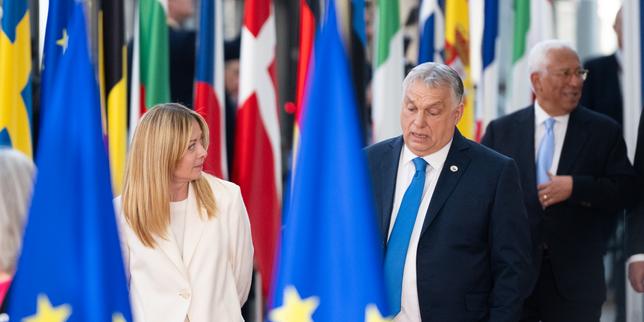
The coffee in the Justus Lipsius building in Brussels is famously mediocre, a bitter brew served in paper cups to people tasked with holding a continent together. It is in these sterile corridors, amidst the hum of translation booths and the soft scuff of Italian leather shoes, that the exhaustion is most visible. It isn't the fatigue of long hours. It is the weary realization that the locks on the front door no longer work, and one of the roommates is inviting a stranger to peer through the windows.
For years, the European Union has operated on a gentleman's agreement: we might argue over milk quotas or fishing rights, but we all agree on who the enemy is. That certainty has evaporated. Viktor Orbán, the Hungarian Prime Minister, has transformed from a troublesome relative into a structural threat. He is no longer just "the enfant terrible" of the East. He has become a sophisticated architect of obstruction, a man who has realized that in a system built on consensus, a single "no" is a superpower.
Consider a hypothetical village council. Twelve neighbors meet to decide how to repair a shared dam that protects them all from a rising river. Eleven neighbors are ready to pile the sandbags. The twelfth neighbor, however, spends his evenings dining with the man who owns the land upstream—the man who is currently diverting the water toward the village. When the council meets, the twelfth neighbor doesn't just disagree; he vetoes the purchase of the sand. He questions the quality of the burlap. He suggests that perhaps the man upstream is actually a misunderstood friend.
The village is paralyzed. Not because they lack the resources, but because their own rules require every single person to agree before a shovel touches the dirt.
The Mechanics of Frustration
The European Union was designed for peace, not for internal sabotage. When the founders drafted the treaties, they envisioned a club of democracies that would naturally align on existential threats. They didn't build a "kill switch" for a member state that decides to court a dictator. They didn't account for the possibility that a country receiving billions in development funds would use its seat at the table to protect the interests of Vladimir Putin.
This isn't just about optics. It is about cold, hard consequences. When Hungary blocks military aid to Ukraine or softens sanctions against Russian oligarchs, the delay is measured in lives. In Brussels, diplomats call it "Orbán’s dance." He pushes until the very last second, extracts a concession or a handful of cash, and then allows the vote to pass—usually after the momentum has been sapped and the message of unity has been blurred.
But the dance is getting more dangerous. The music is getting louder.
The tools available to the EU are notoriously blunt. There is Article 7, the so-called "nuclear option" that can strip a country of its voting rights. It sounds powerful on paper. In practice, it is a legal labyrinth. To trigger it, all other member states must agree. For years, Orbán had a pact with Poland’s previous government: "I’ll protect you, if you protect me." Even with a shift in Warsaw, the process remains glacially slow, a bureaucratic marathon while the house is on fire.
Then there is the money. The EU has frozen billions intended for Budapest, citing "rule of law" violations. It’s a financial chokehold. Yet, Orbán has learned to turn this into a domestic narrative of martyrdom. In the cafes of Budapest, the story isn't about corruption or democratic backsliding; it’s about a brave little nation standing up to the "Brussels bureaucrats" who want to dictate how Hungarians live.
The Invisible Stakes
Why does this matter to a shopkeeper in Lyon or a teacher in Berlin? Because the European Union’s greatest asset isn't its currency or its trade deals. It is its credibility.
When the world watches the EU struggle to handle a single internal dissenter, the collective power of the bloc withers. Moscow sees the cracks. Beijing sees the hesitation. If a union of twenty-seven nations cannot find the spine to enforce its own core values within its own borders, why should any external power fear its warnings?
The stakes are personal. They are about the security of a continent that has spent the last eighty years trying to forget what total war feels like. Every time a veto is used to shield the Kremlin, the shadow of the past grows a little longer. We are witnessing the slow-motion dismantling of the idea that Europe is a single, unbreakable shield.
The Human Cost of Diplomacy
I spoke recently with a diplomat who spent a decade in the room during these negotiations. He spoke of the "quiet rage" that fills the room when the Hungarian delegation enters. It’s not a shouting match. It’s worse. It’s the silence of people who know they are being played.
"You look across the table," he told me, "and you see someone who isn't there to build. They are there to audit the demolition. We spend three days debating a single paragraph because they want to remove the word 'aggression.' Three days. In those three days, how many missiles landed on Kyiv? We are fighting a war of semantics while people are fighting a war of survival."
The frustration is visceral. It’s the feeling of having your hands tied with red tape while you watch a crime in progress.
There is a growing movement to change the rules—to move toward "qualified majority voting" on foreign policy. This would mean that one or two countries could no longer hold the entire continent hostage. It sounds like a logical fix. But it is also a terrifying leap. Small nations fear that if they give up the veto, they will be crushed by the weight of France and Germany. They fear that in trying to stop one rogue actor, they will accidentally destroy the very sovereignty that makes the Union worth joining.
The Stranger at the Table
We are at a point of no return. The "case of Orbán" isn't a legal puzzle to be solved by the European Court of Justice. It is a test of whether the European project is a real entity or just a fragile collection of interests that scatters at the first sign of real internal pressure.
In Budapest, the statues of the Soviet era have long been cleared from the squares, replaced by the grand architecture of a new kind of illiberalism. It is clean, it is orderly, and it is deeply cynical. It thrives on the idea that Western democracy is a hollow shell, a series of high-minded words that no one actually believes in.
Every time Brussels blink, Orbán wins a little more territory in that psychological war. He isn't trying to leave the EU. Why would he? You don't leave the club that pays your bills and gives you a platform to speak to the world. You stay, you complain about the service, and you make sure the doors never quite lock properly.
The tragedy isn't that one man has found a way to bridge the gap between East and West. The tragedy is that the bridge he built is only one-way, and the people crossing it aren't coming to help.
The lights in the Berlaymont building stay on late into the night. The papers are shuffled. The coffee goes cold. Outside, the world is moving faster than the committees can handle. The river is rising. The sandbags are sitting in a warehouse, waiting for a signature that may never come. We have built a magnificent house, but we forgot to ask what happens when one of the residents decides he’d rather see it burn than see it stand together.
The silence in the room isn't peace. It's the sound of the foundation cracking, one veto at a time.