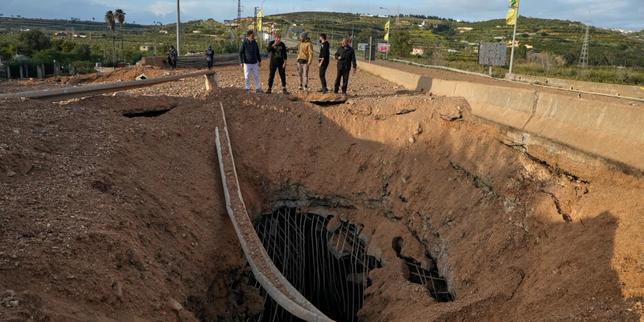
The bridge did not just fall. It groaned, a deep, tectonic protest of rebar and old cement before surrendered to the gravity of a thousand-pound munitions strike. For decades, the Qasmiyeh Bridge had been more than a transit point over the Litani River. It was a lifeline. It carried the weight of watermelons heading north and medicine heading south. Now, it is a jagged tombstone of infrastructure, its broken spine dipping into the rushing water below.
War in Southern Lebanon is rarely about a single explosion. It is about the systematic dismantling of the connective tissue that makes a society breathe. When the Israeli military announced it would target the Litani’s crossings, they weren't just aiming at Hezbollah’s logistics. They were severing the nerves of a nation already paralyzed by a decade of economic rot.
Imagine a farmer in Tyre named Youssef. He is hypothetical, but his predicament is documented in every charred orchard along the border. Youssef’s livelihood sits in the back of a rusted pickup truck—crates of citrus that need to reach the markets in Beirut before the Mediterranean heat turns them into compost. Between him and his payday lies the Litani. With the bridge gone, his journey turns from a twenty-minute crossing into a four-hour odyssey through mountain passes that are themselves being hammered by the sky.
The strategy is clear. By isolating the south, the Israeli Defense Forces (IDF) aim to create a vacuum. They speak of "several weeks" of intensified combat. In military briefings, weeks are tactical windows. In a kitchen in Nabatieh, weeks are an eternity of wondering if the flour will last or if the cellular towers will stay standing long enough to hear a daughter’s voice from across the line.
The Litani River has always been a psychological border as much as a geographical one. Under UN Resolution 1701, it was supposed to be the line behind which Hezbollah retreated. Instead, it became a trench. Today, the water runs clear, but the banks are heavy with the ghosts of previous incursions. The current escalation isn't a flare-up. It is a recalibration of the entire Levantine map.
We often view these conflicts through the lens of "precision strikes." The term suggests a surgical cleanliness. But there is nothing precise about the ripple effect of a destroyed bridge. When the concrete shatters, the price of bread in the next village climbs by thirty percent because the delivery truck has to burn three times the fuel to bypass the ruins. When the bridge goes, the ambulance carrying a woman in labor has to find a dirt path that may or may not be mined.
Israel's objective is the total degradation of Hezbollah’s ability to launch the Kornet missiles and Burkan rockets that have turned Northern Israel into a ghost town of empty kibbutzim and charred forests. They see the south of Lebanon not as a collection of villages, but as a "launching zone." To the IDF, every house with a reinforced basement is a potential silo. To the person living above that basement, it is simply the only home they have ever known.
The air is thick with the smell of scorched earth and wild thyme. It is a sensory overload that no news ticker can capture. The sound of a drone—a persistent, mosquito-like hum—becomes the soundtrack of every waking hour. It is the sound of being watched. It is the sound of a decision being made miles away by a pilot looking at a thermal heat signature that doesn't distinguish between a combatant and a grandfather boiling tea.
Hezbollah’s response is not a retreat, but a tightening. They have spent eighteen years burrowing into the limestone of these hills. Their tunnels are a subterranean city, a shadow Lebanon that exists beneath the olive groves. For them, the destruction of the bridges is a calculated cost. They don't need the roads. They have the earth itself.
The tragedy of the Litani is that the river was meant to be the source of life for Lebanon’s parched agriculture. It was the dream of a modern state. Now, it is a moat.
Consider the mathematics of a "few weeks" of war. If you are a child in a displacement camp in Beirut, three weeks is the time it takes to forget the layout of your bedroom. It is the time it takes for your education to stall, perhaps forever. If you are a shopkeeper in Kiryat Shmona, three weeks is another twenty-one days of living in a hotel, your business gathering dust, your sense of security eroding until you no longer recognize the country you call home.
There is a specific kind of silence that follows a heavy bombardment. It isn't a peaceful quiet. It is a vacuum. The birds stop. The wind seems to hold its breath. In that silence, the people of the South listen. They listen for the whistle of the next shell or the rumble of a tank. They are experts in the acoustics of death. They can tell the difference between an interceptor and an impact by the vibration in their teeth.
The geopolitics are a tangled web of Iranian influence, Israeli security imperatives, and American diplomatic maneuvering. But on the ground, the reality is much simpler. It is about the bridge. It is about the road. It is about the ability to move from one side of a river to the other without becoming a statistic.
The world watches the maps. We see the red arrows indicating troop movements and the yellow circles marking strikes. These maps are abstractions. They don't show the laundry still hanging on a balcony in Bint Jbeil. They don't show the stray dogs wandering through the rubble of a pharmacy. They don't show the way the light hits the Litani at sunset, turning the water to gold even as the smoke from a nearby ridge turns the sky to ash.
The fighting will continue because both sides have convinced themselves that the only way to find peace is through the total exhaustion of the other. It is a war of attrition where the primary resource being spent is human hope. Israel seeks a "buffer zone" to bring its citizens back to the north. Hezbollah seeks "resistance" to maintain its raison d'être.
Between these two immovable forces are the people who simply want to cross the river.
The Qasmiyeh Bridge lies in the water. Its ruins are a reminder that while empires and militias fight over the future, it is the present that is being ground into the dirt. The river continues to flow toward the sea, indifferent to the steel and stone that now chokes its path. It moves with a steady, liquid persistence, washing over the jagged edges of a war that refuses to end.
A lone shoe sits on the edge of the broken tarmac, caked in white dust. It belongs to no one and everyone. It is the quietest thing in a landscape of noise.


