The light in Los Angeles is a liar. It softens the jagged edges of a city built on the uneasy marriage of oil derricks and silver screens, making the smog look like gold dust and the traffic feel like a slow-motion dream. But on a specific stretch of Wilshire Boulevard, the light has finally found something solid to hit.
For years, the Los Angeles County Museum of Art (LACMA) was a fractured identity. It was a collection of buildings that didn't quite speak the same language—a colonial-style fortress here, a 1980s glass box there. Then came the demolition crews. Then came the dust. Now, standing over the street like a spacecraft that decided to settle in for a long winter, is the David Geffen Galleries.
It is a Peter Zumthor creation, a $750 million bet that art shouldn't be trapped in a basement or hidden behind marble. It is a horizontal streak of sand-colored concrete, elevated on seven massive glass "pavilions" that allow the city to breathe right through the museum.
The Weight of the Floating World
Most museums are vertical. They demand you climb stairs, pass through heavy doors, and leave the world behind. Zumthor’s design does the opposite. It hovers.
Imagine a woman named Elena. She has lived in Mid-Wilshire for thirty years. She remembers when the old buildings felt like a maze she wasn't invited to solve. Now, as she walks under the new gallery, she isn't "inside" yet, but she’s already part of the exhibit. The museum spans Wilshire Boulevard itself. It is a bridge.
This isn't just an architectural flex. It is a response to the very soul of Los Angeles. In a city defined by the car and the sprawl, the Geffen Galleries forces a pause. You are walking beneath the art before you ever buy a ticket. The "invisible stakes" here are about belonging. For a century, L.A. has been accused of having no center. This building is an attempt to nail the center of the map to the floor.
But the concrete itself is a character. It’s not the cold, grey slab of a parking garage. It has a warmth, a texture that mimics the prehistoric tar bubbling just a few yards away at the La Brea Tar Pits. It feels ancient and futuristic at the same time.
A Walk Through the Garden of Excess
You don't just "go to a museum" anymore. You enter an ecosystem.
On the grounds, before you even ascend into the belly of the Geffen, you encounter the Jeff Koons. It isn't a balloon dog. It is a "living sculpture." A massive, flowering creature that requires a literal team of gardeners and a complex internal irrigation system to stay alive. It is a miracle of excess.
It sits there, vibrant and pulsing, a stark contrast to the zen-like stillness of the Zumthor concrete. It represents the two halves of the L.A. brain: the loud, colorful spectacle of Hollywood and the quiet, introspective light of the coast.
Consider the logistical nightmare of a living sculpture. It is art that can die. It needs water. It needs sun. It needs a haircut. In a way, it’s a metaphor for the museum itself. A collection of objects is a graveyard unless people are there to breathe life into it. The Koons sculpture serves as the herald, the loud "look at me" that draws you toward the more quiet, cerebral depths of the galleries above.
The Geography of the Soul
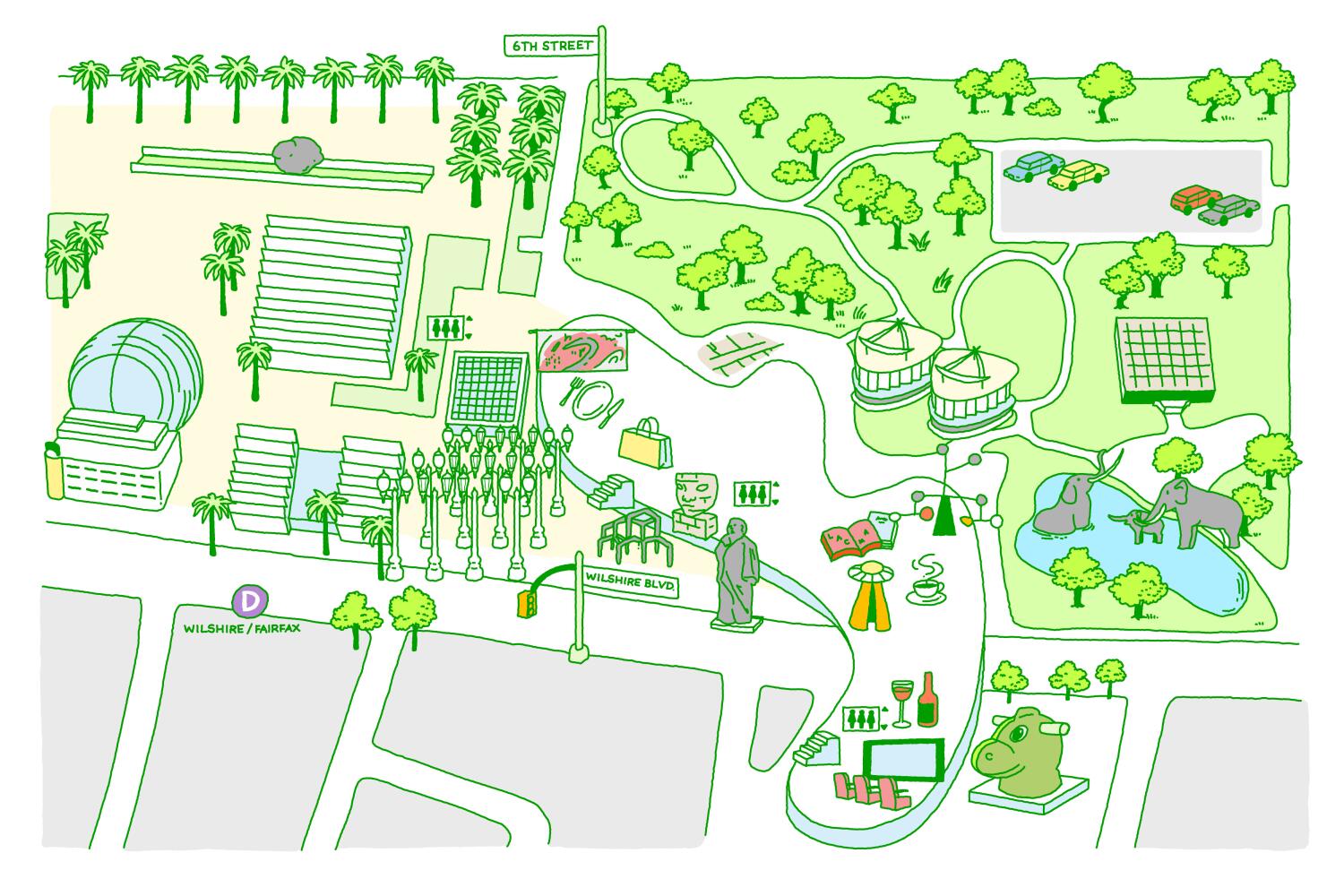
Once you ascend, the map of the Geffen Galleries reveals its true intent. Most museums lead you on a curated, chronological march—Stone Age to Pop Art, no skipping. The Geffen is different.
It is a single, continuous level.
There are no dark corners. Because the building is encased in floor-to-ceiling glass, the "backstage" of the museum—the offices, the storage, the prep areas—is often visible. The art is bathed in that famous, lying L.A. light.
- The North Pavilion: Here, the heavy hitters reside. The permanent collection is stripped of its dusty pretension.
- The Overpass: Walking over Wilshire while looking at a 17th-century tapestry is a disorienting, beautiful experience. You see the 720 bus roaring underneath you while you stare into the eyes of a painted saint.
- The Interior Galleries: These are "pockets" of intimacy within the vast horizontal plane. They offer a sanctuary from the glare of the glass.
The floor plan is a circle. Or rather, an amoeba. There is no right way to see it. You wander. You get lost. You find a wine bar.
The Vine and the Canvas
There is a specific kind of fatigue that sets in after two hours of staring at oil paintings. Your eyes glaze. Your lower back begins to ache. The Geffen Galleries addresses this with a calculated mercy: high-end viticulture.
The wine program at the museum isn't an afterthought. It isn't a lukewarm Chardonnay in a plastic cup. It is a curated extension of the California experience.
Think of a hypothetical couple, Mark and Sarah. They aren't "art people." They came because they heard about the building. After an hour of trying to understand the nuances of abstract expressionism, they find themselves at the wine bar overlooking the park.
They drink a Pinot Noir from the Santa Maria Valley. The acidity of the wine cuts through the sensory overload of the galleries. Suddenly, the art doesn't feel like a test they are failing. It feels like a conversation they are finally part of. The wine softens the edges of the concrete. It grounds the "floating" museum.
The Invisible Bridge
The real triumph of the Geffen Galleries isn't the $750 million price tag or the celebrity donors. It is the way it handles the street.
Wilshire Boulevard is a scar across Los Angeles. It is a river of steel and rubber. By building over it, LACMA has performed a kind of urban surgery. They have stitched the north and south sides of the park together.
When you stand in the middle of the gallery, suspended over eight lanes of traffic, you realize what this is. It is a viewing platform for the human condition. You are looking at a Rembrandt, and then you turn your head three inches to the left, and you are looking at a father teaching his daughter to ride a bike in the park below.
The art isn't separated from life. It is hovering right on top of it.
This is the gamble. Critics have worried that the "curated" light will damage the paintings, or that the horizontal layout limits how much can be shown. They are missing the point. The Geffen Galleries isn't a warehouse for stuff. It is a lens.
It is a place designed to make you feel the scale of your own life against the backdrop of history. The concrete is heavy, yes. But the experience is weightless.
You come for the Koons because it’s loud and it’s famous and it’s on Instagram. You stay for the wine because you are tired and the sun is setting. But you leave with something else.
You leave with the image of the city moving beneath your feet, a blur of motion and light, while the quiet, still faces of the portraits on the wall watch the traffic go by. The museum has finally stopped trying to be a temple. It has decided to be a bridge.
The tar pits continue to bubble. The sun continues to lie. But for a few hours, inside that floating ring of concrete, everything feels exactly as clear as it was meant to be.
The light hits the floor. The wine hits the glass. The city keeps moving.