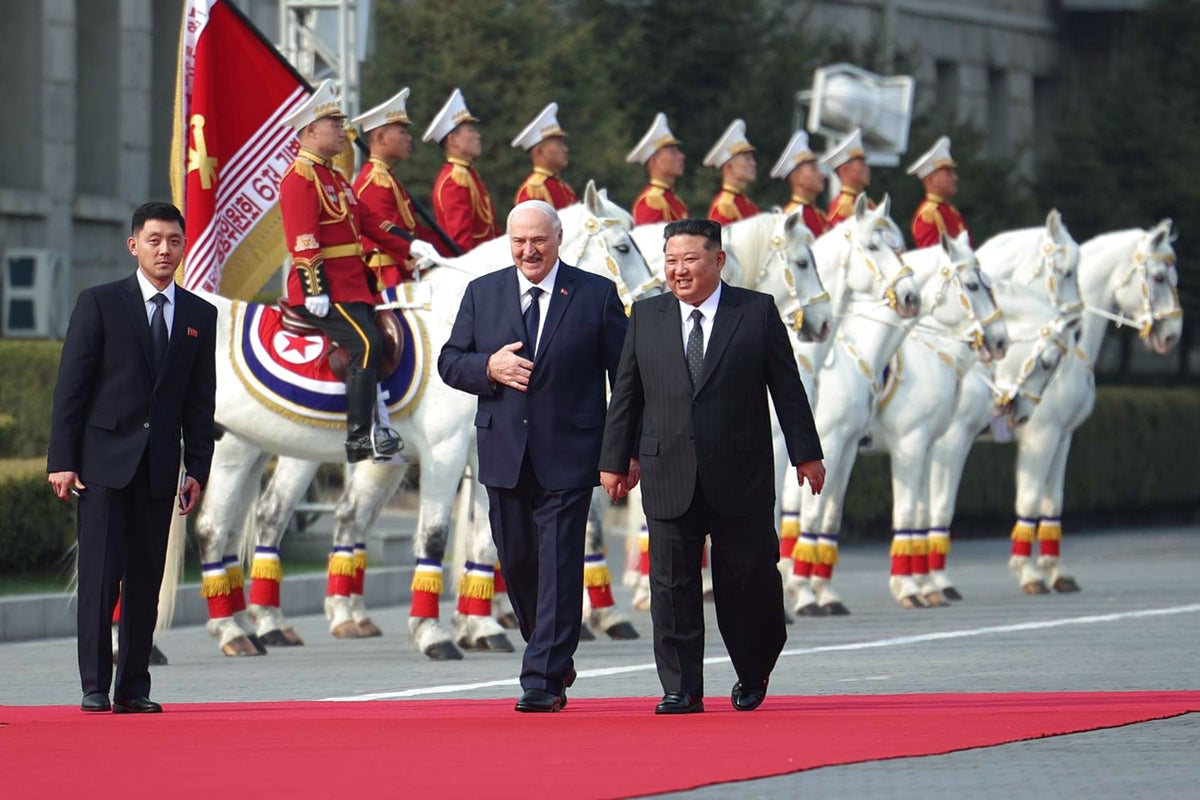
The sight of a high-ranking Russian official being greeted by a literal cavalry of white horses in Pyongyang is easy to dismiss as a relic of a bygone era or a peculiar cult of personality. However, the white horse in North Korean symbolism is not a prop. It is a signal. When Sergei Shoigu or, more recently, other top-tier Kremlin representatives touch down in the Hermit Kingdom, the theatricality masks a desperate, high-stakes industrial exchange that has fundamentally shifted the course of the war in Ukraine and the security of the Pacific. This is not a diplomatic visit. It is a procurement meeting between two pariah states who have found a terrifyingly efficient rhythm in bypassing the global financial system.
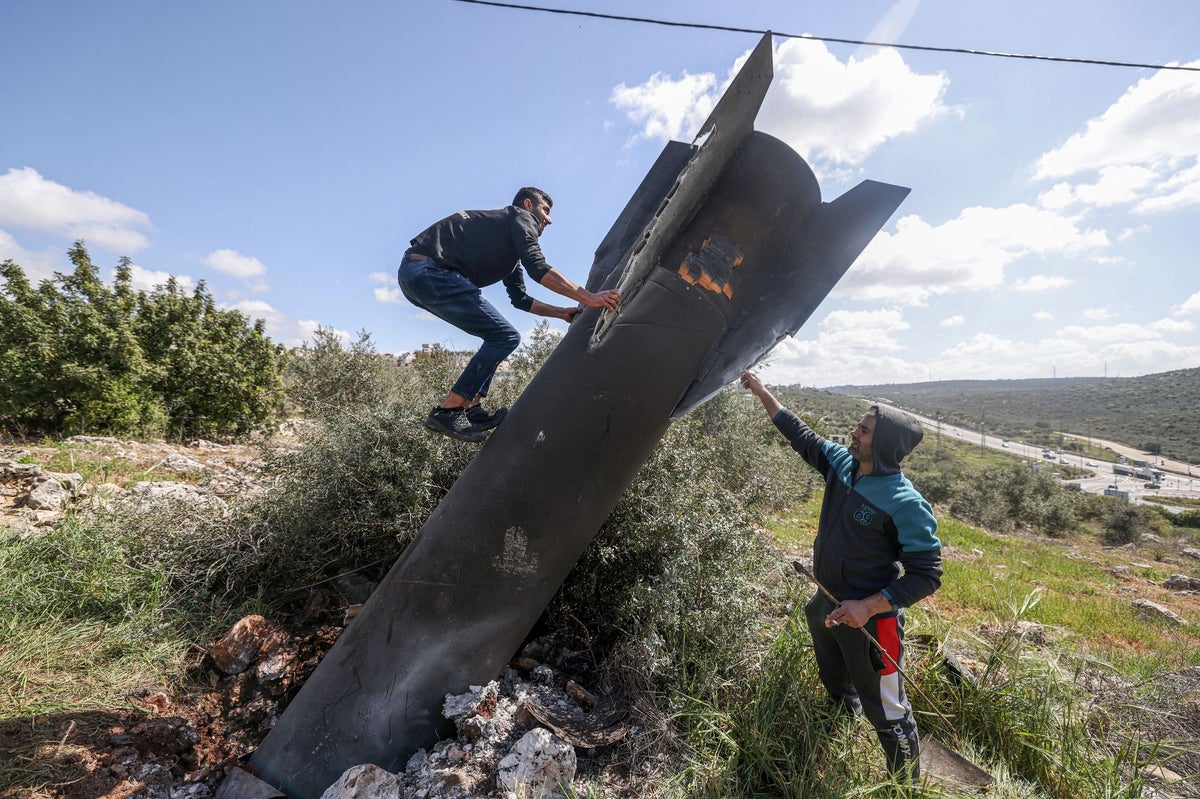
Pyongyang is currently the most significant ammunition factory for the Russian Federation. While Western analysts spent months debating whether North Korean shells were "duds" or lacked precision, the sheer volume has rendered those arguments moot. In modern attrition warfare, quantity has a quality all its own. The "White Horse Welcome" serves as the public-facing receipt for millions of rounds of 152mm artillery shells and dozens of short-range ballistic missiles.
The Desperation of the Russian Supply Chain
Russia entered the 2022 invasion of Ukraine under the assumption of a short, decisive campaign. When that failed, the Kremlin faced a math problem it could not solve internally. Its domestic production lines, though running 24/7, could not keep pace with the daily expenditure of tens of thousands of shells. Enter Kim Jong Un.
North Korea maintains one of the largest stockpiles of legacy Soviet-caliber munitions on the planet. For decades, the regime has been a subterranean fortress, churning out hardware designed specifically for a prolonged conflict against a Western-aligned neighbor. By opening these vaults to Moscow, Kim Jong Un has secured something far more valuable than cash. He has secured the keys to Russian aerospace and missile technology.
The trade is simple. Russia receives the raw firepower necessary to maintain its "creeping barrage" tactics in the Donbas. In return, North Korea receives food, oil, and the technical blueprints for satellite reconnaissance and nuclear-capable delivery systems. This is a transaction of survival. Russia needs the shells to avoid a stalemate; North Korea needs the tech to ensure its regime is untouchable.
The Shell Count Reality
Recent intelligence indicates that North Korea has shipped over 6,700 containers to Russia since the summer of 2023. These containers can hold more than 3 million rounds of 152mm artillery shells. To put that in perspective, the entire combined output of European defense contractors has struggled to meet even a fraction of that number for the Ukrainian side.
The quality is often substandard. Some shells are 30 years old. Some fail to fire. Others explode prematurely, damaging the Russian howitzers they were meant to serve. But for the Kremlin, a 10% failure rate is an acceptable cost when the alternative is a silent front line.
Beyond the Battlefield The Technological Quid Pro Quo
The real danger of this alliance does not lie in the rusting iron of artillery shells. It lies in the sophisticated sensors and propulsion systems moving in the opposite direction. For years, North Korea’s space program was a series of expensive, high-altitude fireworks. Then, suddenly, they achieved orbit.
The timing of North Korea’s successful satellite launches aligns too perfectly with the high-level visits from Russian defense officials. Moscow has a century of experience in rocket science. By providing even minor adjustments to North Korea’s liquid-fuel engines or miniaturized satellite components, Russia is effectively dismantling the "Maximum Pressure" campaign that held the regime in check for decades.
High Tech in Low Places
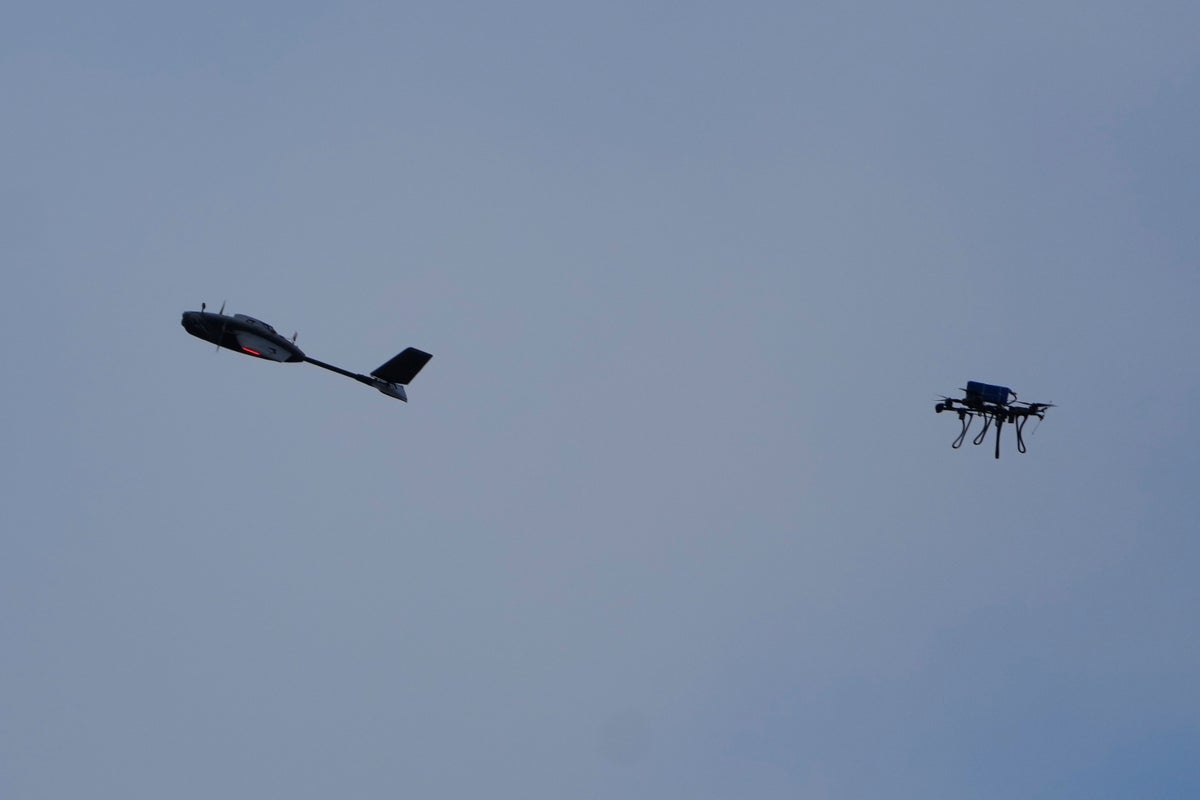
We are seeing evidence of Russian "dual-use" technology appearing in North Korean drones and surveillance equipment.
- Encrypted Communication: Russian hardware is helping Pyongyang harden its command-and-control structures against Western electronic warfare.
- Submarine Technology: There are growing concerns that the Kremlin is providing quietening technology for North Korea’s aging submarine fleet, making them harder to track in the Sea of Japan.
- Sanctions Evasion: The two nations have established a "dark fleet" of tankers and cargo ships that disable their AIS transponders to move goods between Vladivostok and Rajin.
This is a closed-loop economy. It does not touch the US dollar. It does not go through SWIFT. It is invisible to traditional economic sanctions.
The Strategic Failure of the West
The "White Horse" meetings represent a massive failure of Western containment. For thirty years, the global community operated on the assumption that North Korea could be bought or pressured into denuclearization. That era is over. The war in Ukraine has given Kim Jong Un a second chance at relevance, and he has taken it with both hands.
By becoming a critical pillar of the Russian war effort, North Korea has moved from being a "nuisance" to a "strategic partner" of a nuclear-armed P5 member of the UN Security Council. Russia now routinely vetoes sanctions monitoring panels that it once supported. The guardrails are gone.
The New Pacific Axis
This isn't just a European problem. The shells fired in Kharkiv are paying for the missiles that will eventually threaten Tokyo and Seoul. The expertise Russia shares with Pyongyang today will be used to target US carrier groups tomorrow. We are witnessing the birth of a functional, militarized axis that spans from the Baltic to the Pacific.
The hardware is moving across the Tumen River at a record pace. Satellite imagery shows new rail infrastructure and expanded warehouses at the border crossings. This is not a temporary arrangement. It is a long-term logistics corridor that bypasses every maritime chokepoint controlled by the US Navy.
The Myth of the Isolated Dictator
Western media often portrays Kim Jong Un as an isolated madman and Vladimir Putin as a cornered autocrat. This narrative is comforting, but it is inaccurate. They are two cold-eyed pragmatists who have realized that their interests are perfectly aligned.
The white horses, the red carpets, and the meticulously choreographed parades are for the cameras. They are designed to project a sense of normalcy and grandiosity to their domestic audiences. But behind the curtain, the "why" is much more clinical. It is about a 152mm steel casing filled with high explosives. It is about a guidance chip that can survive the vibrations of a long-range flight.
The Economic Engine of the Pariah State
North Korea's economy, long thought to be on the verge of collapse, is seeing a strange, dark stimulus. The factories in the north of the country are humming. Laborers are being moved to the border regions to handle the logistics of the arms transfer. In exchange, Russian wheat and oil are flowing back, stabilizing the domestic price of basic goods and ensuring the loyalty of the military elite.
The Kim regime has found a way to monetize its only real export: the threat of violence. By selling that threat to Russia, they have insulated themselves from the West's primary weapon—economic isolation.
The Intelligence Gap
One of the most concerning aspects of this partnership is how little the West can actually do to stop it. When North Korea was selling small arms to African warlords or Middle Eastern proxies, the shipments could be intercepted. You cannot intercept a train moving across the Friendship Bridge between Russia and North Korea.
The intelligence community is playing catch-up. For years, the focus was on North Korea’s nuclear testing sites. Now, the focus has to shift to the logistics hubs and the quiet transfer of "civilian" technicians who are actually missile engineers.
A War of Attrition by Proxy
In many ways, North Korea is now fighting a proxy war against NATO. Their shells are killing Ukrainian soldiers, and their missiles are being tested against Western air defense systems like the Patriot. This provides Pyongyang with something they could never get on their own: real-world combat data.
They are learning how their weapons perform against modern, Western technology. They are seeing what works and what fails. This data is being fed back into their manufacturing process, making the next generation of North Korean weapons more lethal, more accurate, and more reliable.
The End of the Post-Cold War Order
The "White Horse" summit is the final nail in the coffin of the 1990s dream of a global, rules-based order. It shows that if you are willing to be brutal enough and find a partner who is desperate enough, the rules do not apply.
We are entering a period where the proliferation of advanced weaponry will be driven by necessity rather than ideology. Russia will give North Korea whatever it asks for as long as the shells keep arriving at the front. This is a transaction stripped of morality, governed only by the cold logic of the battlefield.
The horses in Pyongyang are white, but the reality they represent is black and gray—the color of smoke and the color of steel. The world is watching the pageantry while missing the point: the arsenal of autocracy is officially open for business.
Watch the rail lines, not the parades. The number of freight cars moving north is the only metric that matters now. Every train that crosses that bridge is a vote for a longer, bloodier conflict and a more dangerous Pacific. The era of containment is dead, replaced by a era of high-speed, high-tech proliferation that the West is currently ill-equipped to handle.
If you want to understand the future of global security, stop looking at the diplomacy. Look at the loading docks. The horses have already left the stable, and they aren't coming back.