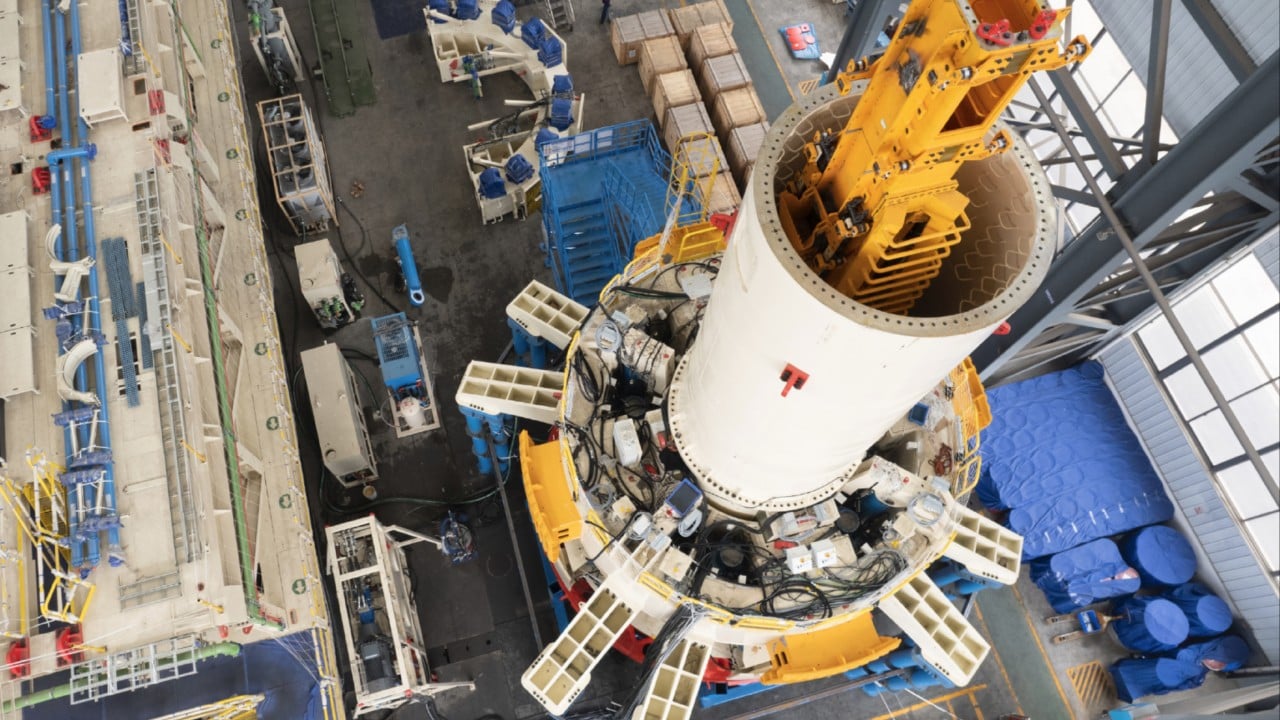
China just built a monster. It’s a 500-tonne mechanical beast designed to do one thing: crawl through the dark, cramped guts of the earth to move massive amounts of ore. We’re talking about a machine that makes your average semi-truck look like a toy. It recently finished a one-kilometer trek underground, and while that might sound like a short Sunday stroll, in the world of deep-vein mining, it’s a massive technical win. This isn't just about moving dirt. It's about how we get the minerals needed for everything from smartphones to electric car batteries without sending thousands of people into death-trap conditions.
If you’ve ever looked at the logistics of a deep-shaft mine, you know the bottleneck is always the transport. You can blast all the rock you want, but if you can’t get it to the surface efficiently, your profit margins vanish. This new carrier, developed by the China Railway Construction Corporation (CRCC), solves the scale problem. It’s a specialized heavy-load vehicle specifically engineered for the ultra-harsh environments of high-altitude or deep-crust mining where oxygen is thin and the pressure is high.
Why size actually matters in deep mining
Most mining equipment is small for a reason. Tunnels are expensive to dig. Every extra meter of width you carve out costs a fortune and risks structural collapse. But small equipment means more trips. More trips mean more fuel, more exhaust in a confined space, and more chances for something to go wrong.
The CRCC’s 500-tonne carrier flips the script. Instead of a fleet of smaller trucks creating a traffic jam in a dark hole, you have one massive unit moving an entire mountain's worth of ore in a single go. This specific machine is part of a larger shift toward "smart mining." It isn't just a dumb iron box on wheels. It’s packed with sensors that allow it to navigate tight turns with centimeters of clearance.
Think about the physics here. You’re moving 500 tonnes. That’s roughly the weight of three blue whales. Now imagine trying to steer that through a tunnel that's barely wider than the machine itself. The torque required is insane. The braking system has to be fail-proof, because if a 500-tonne load starts sliding down a 10-degree incline, nothing is stopping it.
The engineering behind the bulk
Standard tires won't work. They’d pop under the heat and pressure. This carrier uses a multi-axle system that distributes weight so it doesn't crush the very floor it’s driving on. Each wheel is often independently powered or at least highly coordinated to ensure the thing doesn't get stuck the moment the ground gets soft.
The one-kilometer test run wasn't just a fluke. It proved the cooling systems work. Underground, heat is your biggest enemy. Between the ambient temperature of the Earth's crust and the heat generated by a massive engine, things melt. CRCC’s engineers had to develop a bespoke thermal management system to keep the electronics from frying while the mechanical components are under maximum load.
Addressing the safety elephant in the room
Mining is dangerous. There’s no way to sugarcoat it. In the past, increasing production meant putting more people at risk. You’d have dozens of drivers in a single mine, all breathing in particulates and praying the ceiling stayed put.
By moving to these massive, often semi-autonomous carriers, you're reducing the "human density" in the danger zone. One of these machines replaces five or ten smaller ones. That’s fewer people in the tunnel. These carriers are increasingly being designed to be operated from a climate-controlled office on the surface. A guy with a joystick and a VR headset is way safer than a guy sitting in a vibrating cab 500 meters underground.
China’s push for this tech isn't just about being "the biggest." It’s a necessity. Their domestic mines are getting deeper. The easy-to-reach stuff is mostly gone. To keep their industrial machine running, they have to go where humans don't naturally belong. This 500-tonne carrier is the bridge to those deeper, richer deposits.
The logistics of a kilometer underground
One kilometer doesn't sound like much until you realize the environment. This isn't a paved highway. It’s a damp, dusty, uneven rock path. The carrier had to prove it could handle the "grade"—the steepness of the climb. Most mines aren't flat. They’re a series of spirals and ramps.
The carrier’s success in this kilometer-long "torture test" shows that the power-to-weight ratio is dialed in. If it can handle a kilometer, it can handle ten. This opens up the possibility of "super-mines" where the haulage distance is significantly longer than what was previously considered profitable.
What this means for global mineral prices
When the biggest player in the mining equipment game—China—drops a machine like this, the rest of the world has to pay attention. If they can lower the cost per tonne of extracted ore, they control the market. Australia, Canada, and the US are all watching this.
We’re seeing a tech race. It’s not just about who has the most gold or copper in the ground. It’s about who can get it out the cheapest. This 500-tonne carrier is a signal that China is betting on massive scale and high-tech automation to win that race. It's a bold move, and honestly, it’s working.
Common misconceptions about heavy mining tech
People think these machines are slow and clunky. They aren't. They’re surprisingly agile because of the hydraulic steering systems. Another myth is that they’re "dirty." Actually, the newer generation of these carriers is moving toward hybrid or even full-electric drivetrains.
Wait, electric? Yes. Think about it. An internal combustion engine needs oxygen and spits out poison. An electric motor doesn't. If you run a fleet of electric 500-tonne carriers, you save millions on ventilation costs alone. You don't have to pump as much fresh air down the hole because you aren't burning diesel. It’s a massive hidden saving that most people outside the industry totally miss.
The reality of the CRCC breakthrough
Is it perfect? Probably not. Maintenance on a 500-tonne machine is a nightmare. If it breaks down in the middle of a one-way tunnel, you’ve just blocked your entire mine. The pressure on the maintenance crews is astronomical. They have to use "predictive maintenance"—sensors that tell them a bearing is going to fail three days before it actually does.
But the fact that this carrier finished its mission proves the concept is sound. The era of the "ant colony" mine—hundreds of small trucks scurrying around—is ending. We’re entering the era of the "mega-mover."
If you’re an investor or just someone interested in how the world actually works, keep your eyes on these heavy-lift stats. The efficiency of ore transport is the invisible hand that sets the price of your next car or laptop.
Go look at the specs for CRCC’s heavy equipment division. You’ll see this isn't a one-off. They’re building a whole ecosystem of these giants. The next step is full autonomy, where these 500-tonne ghosts move ore 24/7 without a single human ever stepping foot in the shaft. That’s the real revolution.
To really get how big this is, check out the load-bearing stats on the latest multi-axle hydraulic trailers. The physics of moving that much weight on a slope is basically a masterclass in mechanical engineering. Don't just take my word for it—the data on "cost per tonne-kilometer" is the only metric that matters in this game, and China just lowered it significantly.