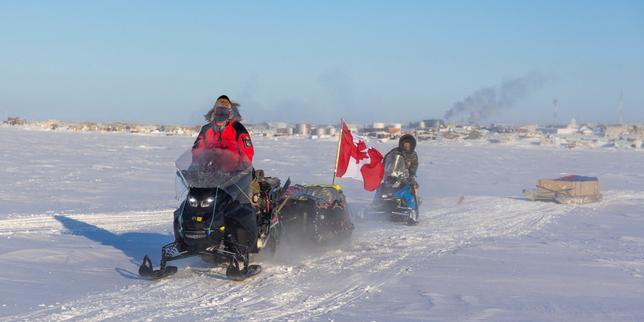
The Arctic isn't just a frozen expanse on the edge of a classroom map anymore. It's a crowded, competitive theater where the stakes involve everything from global shipping routes to massive critical mineral deposits. For decades, Canada treated the North with a "set it and forget it" attitude, relying on its vast geography to act as a natural shield. Those days are over. Melting ice and a changing geopolitical climate have turned the High North into a front line.
You might think Canada has always been a dominant player here. After all, we have the second-largest Arctic territory on the planet. But there’s a massive gap between claiming sovereignty and actually exercising it. Russia has been building nuclear-powered icebreakers and reopening Soviet-era military bases for years. China, calling itself a "near-Arctic state," is eyeing the Northwest Passage as a shortcut for its massive cargo ships. If Canada doesn't step up its investment now, it risks becoming a bystander in its own backyard.
The federal government’s recent shifts indicate they finally get the urgency. We’re talking about billions of dollars aimed at defense, infrastructure, and satellite surveillance. It's not just about flags and soldiers. It’s about ensuring that the people who actually live there—the Inuit and Northern communities—have the tools to thrive while the rest of the world looks North with greedy eyes.
The End of Geographic Isolation
For a long time, the sheer brutality of the Arctic climate was Canada's best defense. Nobody could easily navigate the ice-choked waters of the Northwest Passage, so we didn't need a massive presence. That’s changing fast. The ice is thinning. Shipping seasons are getting longer. What was once an impassable wall is becoming a highway.
This shift has massive implications for national security. If a foreign vessel enters Canadian waters without permission, we need to know about it instantly. We also need the capability to reach that vessel. Currently, our icebreaking fleet is aging and our northern hangars are sparse. The "Our North, Strong and Free" policy update is a direct response to this vulnerability. It’s an admission that we can’t take our sovereignty for granted.
Investment is flowing into new tactical helicopters and specialized maritime sensors. These aren't just toys for the military. They’re essential ears and eyes. Without them, Canada is effectively blind in a region that covers nearly 40% of its landmass. We’re also seeing a push for "dual-use" infrastructure. This means building piers and airstrips that serve both military logistics and local community needs. It’s a smart way to make a dollar go further in a place where construction costs are astronomical.
Competition for Resources and Routes
Why is everyone suddenly so obsessed with the North? Follow the money. The Arctic holds an estimated 13% of the world’s undiscovered oil and 30% of its unextracted natural gas. Beyond fossil fuels, the region is a goldmine for critical minerals like nickel, copper, and rare earth elements. These are the building blocks of the green energy transition. If you want electric vehicle batteries, you need what’s buried under the permafrost.
Russia has already staked its claim with a heavy hand. They’ve refitted more than 50 Arctic sites, including airfields and ports. They want to control the Northern Sea Route, which hugs their coastline. Canada’s Northwest Passage is the other side of that coin. It can shave weeks off a trip from Europe to Asia.
But there’s a catch. Canada maintains the Northwest Passage is internal waters. The U.S. and many European nations argue it’s an international strait. This legal friction is why Canada needs to be physically present. You can’t argue for your rules if you aren't there to enforce them. Investing in the Arctic isn't just about digging for minerals; it’s about making sure Canada stays the primary gatekeeper of its own territory.
The Human Element of Sovereignty
Infrastructure in the Arctic is notoriously bad. Many communities still rely on satellite links that are slower than what you’d find in a 1990s internet cafe. Food prices are triple what you’d pay in Toronto or Vancouver. If Canada wants to claim the North, it has to support the people who live there. Sovereignty starts with healthy, connected communities.
The government is finally putting money into telecommunications. High-speed fiber-optic cables and low-earth orbit satellite constellations like Starlink are changing the game. This isn't just for Netflix. It’s for telehealth, distance education, and local businesses. When a community is connected, it’s more resilient.
There’s also the issue of housing and energy. Most Northern towns rely on dirty, expensive diesel generators. Transitioning to small modular reactors or renewable microgrids is a huge part of the Arctic investment strategy. It’s about energy security. If a community can’t power itself, it’s vulnerable. By investing in these local needs, Canada strengthens its overall hold on the region. It’s a bottom-up approach to national defense.
Facing the Russian and Chinese Challenge
We have to be honest about the threats. Russia is currently the most significant military actor in the Arctic. They have a fleet of icebreakers that dwarfs ours. Their recent actions in Ukraine have proven they aren't afraid to ignore international norms. Canada’s response has been to deepen its cooperation with NATO and the U.S. through NORAD modernization.
Then there’s China. They don't have a single mile of Arctic coastline, yet they're pouring money into "Polar Silk Road" projects. They’re building their own icebreakers and trying to buy up mining interests in the Canadian North. Canada has started blocking some of these acquisitions under the Investment Canada Act, citing national security concerns.
This is a quiet war of influence. It’s fought through port investments, underwater cables, and scientific research stations. Canada has to be aggressive here. We can’t just say "no" to foreign investment; we have to provide a Canadian or allied alternative. That means the government needs to de-risk projects for Canadian companies so they feel confident operating in the harsh northern environment.
Logistics of Northern Investment
Building anything in the North is a nightmare. You have to deal with permafrost that’s melting and shifting, which can snap a foundation in half. You only have a few months of "sealift" where heavy equipment can be brought in by boat. If you miss the window, you wait a year.
This is why the cost of Arctic projects often doubles or triples. The new offshore patrol ships and the renovation of the North Warning System are massive undertakings. But the cost of doing nothing is much higher. If we lose control of these routes or resources, the long-term economic hit to Canada would be measured in the trillions, not billions.
The government is also looking at "underwater awareness." This involves sensors on the seabed to track submarines. With the Arctic Ocean becoming more navigable, the threat isn't just on the surface. It’s beneath the waves. Investing in this tech is a clear signal to our allies—and our rivals—that Canada is serious about monitoring every inch of its domain.
Moving Past the Rhetoric
Talk is cheap, especially in politics. We’ve heard about "Arctic sovereignty" for decades, but the actual delivery of equipment and infrastructure has been slow. The difference now is the sense of crisis. Between climate change and the aggressive postures of Moscow and Beijing, Canada no longer has the luxury of time.
The real test will be whether these multi-year funding promises actually turn into steel in the water and boots on the ground. We need to see the completion of the Nanisivik Naval Facility. We need the new polar icebreakers delivered on schedule. We need the expansion of the Canadian Rangers—the "eyes and ears" of the North—to be fully funded and equipped.
Keep an eye on the upcoming federal budgets. If the Arctic line items start getting trimmed to pay for domestic programs in the south, we know the priority has shifted back to short-term political gains. But for now, the momentum is there. Canada is finally acting like an Arctic nation instead of just a country that happens to have a lot of snow.
If you’re interested in how this affects the economy, look at the stock performance of Canadian mining companies focused on northern projects. Check the progress reports on the RADARSAT Constellation Mission. These are the metrics that tell the real story of Canada's northern push. The Arctic is the future of Canadian energy and security. It’s about time we treated it that way.