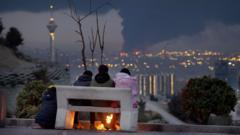
The atmosphere in Tehran has shifted from the frantic energy of a metropolis to the heavy, stagnant air of a pressure cooker. Ordinary Iranians are currently caught between the screaming engines of regional conflict and a domestic security apparatus that treats any sign of anxiety as an act of treason. While international headlines focus on the mechanics of missile exchanges and military posturing, the real story is the systematic tightening of the knot around the neck of Iranian civil society. This is not just a period of high tension. It is a calculated era of dual-front warfare where the state is fighting its own population just as aggressively as it confronts external adversaries.
The Silence of the Streets
Walk through the Grand Bazaar or the cafes of North Tehran today and you will notice something missing. It is the sound. People no longer speak freely about the price of bread or the latest news from the border. They look at their shoes. The presence of the Basij and the morality police has transitioned from a sporadic annoyance to a permanent fixture of the urban geography.
This internal mobilization serves a specific purpose. By maintaining a state of perpetual emergency, the leadership justifies the suspension of what few rights remained after the 2022 protests. The threat of air strikes provides the perfect cover for a domestic crackdown. If you complain about the crumbling economy, you are labeled a defeatist. If you question the wisdom of the current foreign policy, you are branded a foreign agent. It is an effective, if brittle, method of maintaining control.
The Economy of Fear
The rial continues its downward spiral, making the simple act of buying groceries a daily exercise in despair. But the economic collapse is not just a byproduct of sanctions or mismanagement; it is being used as a tool of pacification. When a population is focused entirely on whether they can afford meat for the week, they have less bandwidth for political organizing.
The middle class is being systematically erased. Professional families who once looked toward a future of global integration are now selling their furniture to cover rent. This desperation creates a vacuum that the state fills with a dependency model. By controlling the distribution of basic goods and subsidies, the government ensures that survival is tied directly to obedience. It is a grim transaction. You stay quiet, and you might get enough to eat.
The Sky is Not the Only Threat
Whenever the drone of aircraft is heard overhead, the reaction in Tehran is not one of patriotic fervor. It is a cold, clinical dread. People have learned that every escalation abroad results in a new layer of surveillance at home. The "Victory" posters plastered across the city walls feel increasingly hollow to a populace that sees its infrastructure failing and its internet access throttled to the point of uselessness.
The digital iron curtain is perhaps the most significant development in this recent shift. The authorities have moved beyond simple blocking. They have created an isolated ecosystem that monitors every keystroke. This isn't about stopping communication with the West; it's about making the cost of domestic communication too high to pay. If you know that your private message can be used as evidence of "war-mongering" against the state, you stop sending messages.
The Mechanics of Control
The current strategy relies on three distinct pillars of repression:
- Visibility: Large numbers of security forces in public squares to remind the public that the state is watching.
- Unpredictability: Random arrests and "invitations" for questioning that keep activists and even ordinary citizens off-balance.
- Information Monotony: The total domination of the airwaves with a single narrative of external threat, drowning out domestic grievances.
These pillars are designed to prevent the formation of any organized opposition. Without a way to talk to each other safely, the people remain a collection of isolated individuals rather than a cohesive movement.
The False Choice
The narrative pushed by the state is a simple binary: support the current path or face the total destruction of the nation at the hands of foreign powers. It is a powerful rhetorical trap. By framing every internal critic as a collaborator with external enemies, the leadership shuts down the possibility of reform.
However, this binary ignores the growing segment of the population that is disillusioned with both sides of the conflict. There is a deep, quiet exhaustion. This isn't the fiery anger of a revolution in its early stages; it is the hardened, cynical fatigue of a people who feel they have been taken hostage by their own history.
The Breaking Point
Pressure can only be applied for so long before the container fails. The current strategy of total repression relies on the security forces remaining loyal and the population remaining terrified. History shows that neither of these conditions is permanent.
Young Iranians, in particular, are reaching a point where they feel they have nothing left to lose. When you have no career prospects, no freedom of movement, and no voice in your own future, the threat of prison loses some of its sting. The state is betting that it can maintain this level of dread indefinitely. It is a high-stakes gamble that ignores the basic human need for dignity.
The dread in Iran today is not just about the possibility of bombs falling. It is about the certainty of a life lived in a perpetual crouch. Until the internal war against the citizens stops, no amount of military hardware will make the nation truly secure. The real conflict isn't happening in the skies; it's happening in every living room and every shadowed street corner where the hope for a normal life is being slowly extinguished.
The world looks at the radar screens, but the real movement is happening in the silence of the Iranian people. That silence is not consent; it is a stored energy that the state should fear more than any external strike.
Start tracking the price of basic staples in Tehran’s informal markets to see the true timeline of the coming social fracture.


