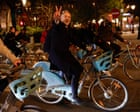
Emmanuel Grégoire is attempting to do the impossible in a city where backroom deals are as much a part of the architecture as Haussmann’s limestone. The newly minted Mayor of Paris has staked his entire political career on "absolute moral rigour," a phrase that sounds noble in a campaign speech but acts as a lightning rod for trouble in the actual halls of the Hôtel de Ville. To understand the magnitude of his challenge, one must look past the glossy press releases and into the tangled web of real estate contracts, Olympic legacy spending, and the entrenched bureaucracy that has governed Paris for decades. Grégoire isn't just fighting political opponents; he is fighting a centuries-old system designed to resist transparency.
The primary hurdle for Grégoire is that "moral rigour" is expensive and slow. In the high-stakes world of urban development, where billions of euros move between the public sector and private developers, strict ethical oversight acts as a friction point. For a city still reeling from the logistical and financial hangover of the 2024 Olympics, any delay in revenue-generating projects is viewed by critics as a self-inflicted wound. Grégoire’s success or failure hinges on whether he can prove that a clean government is more efficient than a "flexible" one.
The Ghost of the Olympic Gold Rush
Paris spent years preparing for the 2024 Games, a period marked by unprecedented spending and rapid-fire contract approvals. While the event was hailed as a logistical success, the financial autopsy is currently underway. Grégoire inherited a ledger filled with "legacy projects" that are now under intense scrutiny. Investigative audits suggest that the rush to finish infrastructure on time led to a relaxation of the very oversight mechanisms the new Mayor now promises to reinforce.
When a city has to build a swimming complex or a transit hub in record time, the temptation to skip the competitive bidding process is overwhelming. Grégoire’s predecessors often relied on a small circle of trusted contractors. Breaking this circle is his first major test. If he cancels existing questionable contracts, he risks lawsuits and stalled construction sites that blight the city. If he lets them slide, his promise of moral rigour becomes a punchline before his first year in office is up.
The conflict is visible in the Saint-Ouen and Saint-Denis developments. These areas were promised a total transformation, yet the flow of private capital has cooled as the new administration introduces stricter auditing requirements. Investors hate uncertainty. Grégoire’s insistence on "clean" money means that every euro is being tracked, which has notably slowed the pace of gentrification—a result that pleases his leftist base but infuriates the chamber of commerce.
Real Estate and the Ethics of the Arroudissements
Parisian real estate is perhaps the most opaque market in Europe. The city owns a vast portfolio of residential and commercial property, and the process of leasing or selling these assets has historically been a black box. Grégoire has proposed a centralized, digital tracking system for all city-owned assets to prevent the "sweetheart deals" that have long characterized local politics.
In the past, a deputy mayor might have the discretion to award a subsidized commercial lease to a "culturally significant" entity that happened to be run by a political ally. Under Grégoire’s proposed framework, these decisions are moved away from individual bureaucrats and into the hands of an independent ethics commission. It is a bold move, but it has created a silent insurgency within his own administration. Middle managers who have enjoyed autonomy for twenty years do not appreciate being treated like potential suspects.
The Cost of Compliance
For a medium-sized developer, the cost of meeting Grégoire’s new ethical standards is significant. It involves third-party audits, deep-dive background checks on subcontractors, and a commitment to labor standards that many firms find suffocating. Critics argue that this creates a "purity tax" that only the largest, wealthiest corporations can afford to pay. If Grégoire isn't careful, his push for morality could inadvertently hand a monopoly to the very global conglomerates he claims to want to regulate.
This is the paradox of reform. By raising the bar for entry, you often kick the ladder away from the smaller, local players who don't have the legal departments to navigate 500 pages of ethical compliance paperwork. The Mayor must find a way to make rigour accessible, or he will end up with a city that is ethically spotless but economically stagnant.
The Shadow of the National Stage
Emmanuel Grégoire does not exist in a vacuum. His moves in Paris are being watched closely by the Élysée Palace and the national media. In France, the Mayor of Paris is often a "King-in-waiting" or at least a major power broker for the presidency. By positioning himself as the paragon of virtue, Grégoire is setting a standard that he will eventually have to live up to on a much larger stage.
However, this positioning makes him a massive target. Political rivals are already digging through his past, looking for any minor inconsistency that could be framed as hypocrisy. A single improperly filed expense report or a meeting with the wrong lobbyist five years ago could be used to dismantle his entire platform. This is the danger of "absolute" rigour; it leaves no room for the human error that is inevitable in governance.
The national government, often at odds with the city's more progressive social policies, has been quiet on Grégoire’s ethical reforms. This silence shouldn't be mistaken for approval. It is a calculated wait-and-see approach. If Grégoire’s reforms cause the city’s budget to balloon or development to freeze, the state can step in and frame his "ideals" as a luxury the taxpayers cannot afford.
Power and the People
Grégoire’s most potent weapon is public sentiment. Parisians are tired of the "vieux monde" (old world) politics of secret handshakes. There is a genuine appetite for a leader who treats the city treasury like a sacred trust rather than a private bank account. To maintain this support, the Mayor needs a "big win"—a high-profile case where his new standards prevented a major fraud or saved the city millions.
Transparency isn't just about catching the bad guys; it's about building a system where the bad guys don't even try. This involves a fundamental shift in the culture of the civil service. Grégoire has begun implementing "whistleblower protection" programs within city hall, encouraging staff to report irregularities without fear of retaliation. This is a radical departure from the traditional French administrative culture of "esprit de corps," which often prioritizes departmental loyalty over external accountability.
The true test will be the upcoming redevelopment of the city's peripheral ring road, the Périphérique. It is a multi-billion euro project that involves greening, noise reduction, and massive infrastructure shifts. The opportunities for graft are enormous. If Grégoire can navigate this project without a single scandal, he will have proven that his model works. If not, his mayoralty will be remembered as a brief, idealistic intermission in a long history of institutionalized corruption.
The Invisible Lobbyists
While the Mayor focuses on official contracts, a more subtle battle is being fought in the cafes and private clubs around the 8th arrondissement. Lobbyists in Paris are experts at "soft influence." They don't offer bribes; they offer "partnerships," "consultations," and "cultural sponsorships." These are the grey areas where Grégoire’s rigour will be tested most severely.
How do you define a conflict of interest when it involves a donation to a city-backed museum from a company bidding on a sanitation contract? Grégoire’s new code of conduct attempts to draw these lines, but the ink is barely dry. The legal teams of major utility companies are already looking for the loopholes. They are searching for the gaps between the letter of the law and the spirit of the Mayor’s ideals.
Accountability as a Weapon
The most cynical view of Grégoire’s platform is that "moral rigour" is simply a tool to purge the remnants of the previous administration. By setting standards that are nearly impossible to meet, a new leader can effectively clear out the old guard and install their own loyalists under the guise of ethical renewal. While there is no direct evidence that Grégoire is doing this, the perception alone is enough to poison the well of civil service morale.
To avoid this, the Mayor must ensure that his ethics commissions are truly independent—not just populated by his own supporters. He has promised to include members of the opposition and independent legal experts in these oversight bodies. This is a risky move. It gives his enemies a front-row seat to the inner workings of his administration, but it is the only way to gain the "Authoritativeness" required to make the reforms stick.
The tension in the Hôtel de Ville is palpable. Every memo is being double-checked; every meeting is being logged. For some, this is the dawn of a professionalized, modern Paris. For others, it is the beginning of a bureaucratic nightmare where nothing gets done because everyone is too afraid to sign their name to a document.
The Long Road to Reform
The "Parisian System" was not built in a day, and it will not be dismantled by a single mayor in a single term. Emmanuel Grégoire is attempting to change the DNA of a city. This requires more than just new rules; it requires a change in the expectations of the citizenry and the behavior of the business elite.
One overlooked factor is the role of the European Union. New EU-wide anti-corruption directives are set to take effect in the coming years, and Grégoire’s local reforms may actually be a proactive attempt to align Paris with these looming standards. By moving early, he gives the city a competitive advantage over other European capitals that are still dragging their feet on transparency. This "first-mover" advantage could make Paris a safer haven for legitimate international investment, even if it causes short-term friction with domestic firms used to the old ways.
The Mayor’s gamble is that in the long run, integrity is a value-add. He is betting that the most talented workers and the most innovative companies want to be in a city where the rules are clear and the playing field is level. It is a high-stakes bet on the future of urban governance.
Would you like me to analyze the specific budgetary impacts of these new transparency measures on the 2026 Paris city budget?