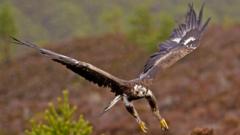
The golden eagle has not nested in the wild of England for over two decades. While recent government endorsements suggest a triumphant return for this apex predator, the political and ecological reality is far more fractured than the official press releases admit. Reintroducing a massive raptor into a modern, managed countryside is not merely a matter of opening a cage; it is an act of biological warfare against centuries of land management. To succeed, the UK government must navigate a minefield of territorial disputes between conservationists and the powerful shooting estates that dominate the northern uplands.
For years, the prospect of eagles soaring over the Lake District or the Peak District remained a pipe dream for ornithologists. Now, with the Department for Environment, Food and Rural Affairs (DEFRA) signaling a shift toward more aggressive rewilding targets, the momentum has shifted. But the "government backing" currently on the table is often more rhetorical than financial. Without a massive overhaul of how we manage "driven" grouse moors and the illegal persecution that plagues them, these birds are being released into a beautiful graveyard.
The Geography of Persecution
The primary barrier to the golden eagle’s expansion is not a lack of prey or suitable nesting sites. It is a cultural wall. Golden eagles require vast territories, often up to 15,000 hectares, to hunt and breed effectively. In the North of England, much of this land is dedicated to the intensive rearing of red grouse for sport. This creates an immediate, high-stakes conflict.
The mechanism of this conflict is simple and often violent. When an eagle takes a grouse, it isn't just eating a bird; it is eating a piece of a business model where every "brace" of grouse has a price tag attached. While the legal protection of these raptors is absolute under the Wildlife and Countryside Act, the enforcement of that law in remote moorlands is notoriously difficult. Satellite-tagged birds have a habit of "failing" or disappearing over managed estates with a regularity that defies coincidence.
If the government wants to see these birds thrive, it cannot simply fund the transport of chicks from Scotland. It must confront the reality of land use. We are asking a 21st-century conservation goal to survive in a 19th-century land management system.
The Scottish Blueprint and English Failure
To understand why England is struggling, one must look at the South of Scotland Golden Eagle Project. This initiative has successfully relocated dozens of young birds, boosting the population in the Scottish Borders to levels not seen in a lifetime. They used a specific methodology: taking "second chicks" from nests with two siblings. In the wild, the older chick often outcompetes or kills the younger one—a process known as cainism. By intervening, biologists effectively "save" a bird that likely would have died, without harming the donor population.
England, however, presents a different set of obstacles. The Lake District, once the final stronghold for the species in England, lost its last resident male in 2016. He spent years alone, calling for a mate that never arrived. The isolation of English habitats means that any new population cannot rely on natural "spillover" from Scotland. They must be manually introduced and then fiercely protected.
The government’s support currently focuses on feasibility studies and local engagement. This is soft terminology for "trying to convince angry landowners not to shoot the birds." It is a delicate dance of diplomacy that often ignores the underlying economic incentives. Until the subsidies provided to large estates are tied directly to biodiversity outcomes—specifically the presence of healthy raptor populations—the eagle remains a guest in a hostile house.
The Prey Deficit and Ecological Balance
A golden eagle is a generalist, but it has preferences. Rabbits, hares, and various moorland birds make up the bulk of its diet. In many parts of the English uplands, these populations are in flux. The decline of the mountain hare in certain regions creates a caloric gap that forces eagles to range further, increasing their exposure to human threats.
Critics of reintroduction often point to the potential for eagles to take livestock, specifically lambs. This is a common point of friction in the farming community. However, data from long-term studies in Scotland and across Europe shows that while "lamb predation" does occur, it is statistically rare and usually involves carcasses or sickly individuals rather than healthy livestock.
The real ecological value of the eagle is its role as a "top-down" regulator. By predating on mid-sized carnivores and maintaining the health of herbivore populations, they prevent the scrubland from becoming over-grazed or overrun by a single species. They are the architects of the sky, shaping the behavior of everything beneath them.
The Funding Gap and the Charity Burden
The heavy lifting of English eagle recovery is not being done by Whitehall bureaucrats. It is being done by small, underfunded charities and dedicated volunteers. The "government backing" mentioned in recent headlines is often a promise to simplify licensing or provide small grants through bodies like Natural England.
A serious reintroduction program requires more than just a permit. It needs:
- Permanent monitoring teams to track satellite data 24/7.
- Rapid response units to investigate suspicious "tag failures" immediately.
- Compensation funds for farmers that are easy to access and fairly priced.
- Long-term habitat restoration that goes beyond planting a few trees.
Without these pillars, we are engaging in "trophy conservation"—the act of releasing a charismatic animal for a photo op while ignoring the systemic reasons it went extinct in the first place.
The Genetic Bottleneck Risk
When you start a population with a handful of individuals, you run into the problem of the founder effect. If the initial birds are too closely related, the English population could suffer from inbreeding depression within a few generations. This leads to lower egg viability and weakened immune systems.
To avoid this, a long-term "bridge" must be established. This involves a decade-long commitment to bringing in birds from diverse genetic pools, potentially even from Scandinavia or Central Europe, to ensure the English eagles have the resilience to survive a changing climate.
The Tourism Economy vs. The Sporting Economy
There is a massive, untapped economic potential in "raptor tourism." In places like the Isle of Mull in Scotland, the presence of white-tailed and golden eagles brings millions of pounds into the local economy every year. People pay for hotels, guides, and meals just for a glimpse of a wingtip.
England’s rural economy is currently skewed toward a very small number of high-paying shooters. Transitioning to a broader "ecotourism" model could provide more jobs and more stable income for local communities. But this requires a shift in how rural communities view "wealth." A dead eagle is worth nothing; a live one, nesting in a visible crag, is a renewable resource.
The path forward is not through more committees or more "statements of intent." It is through the rigorous enforcement of existing wildlife laws and a fundamental redesign of agricultural subsidies. We have the science to bring the golden eagle back. We have the birds waiting in the wings. What we lack is the political courage to tell land managers that the sky no longer belongs exclusively to them.
The eagle is coming back, but its survival depends entirely on whether we have outgrown our urge to kill anything that competes with our sport. If we cannot protect the most iconic bird in our history, we have no business claiming we are leaders in global conservation. The government has given its blessing; now it must provide the shield.
Hold the line on habitat protection or watch the last of our wild spaces continue to fade into silence.