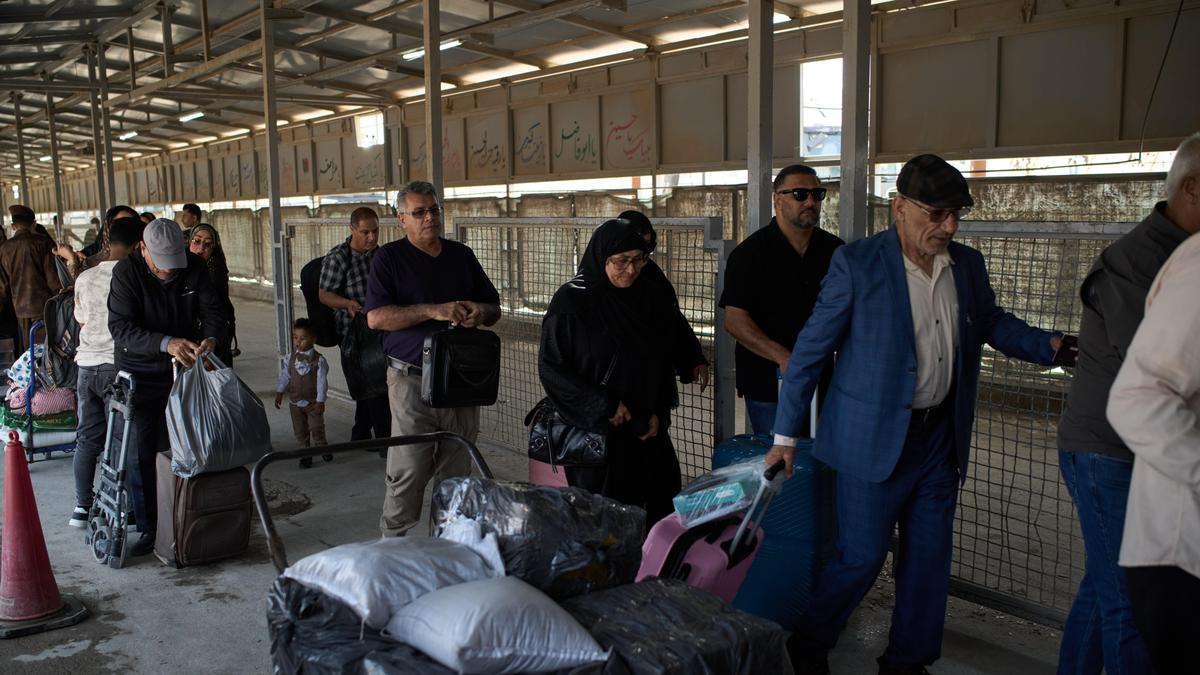
The standard narrative regarding the Iraq-Iran border is a lazy, sentimentalist trap. Journalists love to file the same story: "War disrupts life, families are separated, trade halts." It is a neat, tragic package that satisfies the Western urge for pity without requiring a single minute of actual economic analysis.
They are looking at the wrong map. Don't miss our previous post on this related article.
While the "official" trade routes might see a dip in paperwork during periods of friction, the idea that trade "halts" is a fantasy fed to us by bureaucrats who can’t see past their own ledgers. In reality, conflict on the Iraq-Iran border doesn't kill commerce; it evolves it. It forces a Darwinian shift from sluggish, state-sanctioned monopolies to the most efficient, high-speed market known to man: the shadow economy.
If you want to see where the real money is moving, stop looking at the checkpoints. Look at the mountains. If you want more about the background here, Associated Press provides an excellent breakdown.
The Myth of the Frozen Frontier
The competitor's view is built on the "Peace Dividend" fallacy—the idea that stability is the only prerequisite for prosperity. This is demonstrably false in regions with heavy state interference. When the border is "stable," it is strangled by red tape, bribes, and inefficient tariffs. A single truck of construction materials can sit at a crossing for four days because a clerk in Baghdad or Tehran hasn't had his coffee.
Conflict strips away that institutional rot.
When the state loses its grip on the border due to "disruption," the market doesn't stop. It pivots. I have watched supply chains in the Middle East and North Africa reorganize themselves overnight. What was once a slow, taxed, and brittle logistics chain becomes a decentralized, agile network of couriers, local brokers, and tribal facilitators.
The "isolated families" narrative also ignores the resilience of the informal sector. In the border towns of the Kurdistan region or the marshlands of the south, the border has always been an imaginary line drawn by Europeans a century ago. These families aren't "isolated"—they are the primary stakeholders in a multi-billion dollar arbitrage system that thrives specifically because the two nations are at odds.
Arbitrage is the Engine of the Border
Why do people trade across a dangerous border? Because of price disparity. Conflict creates massive gaps in the cost of fuel, medicine, and electronics.
The "humanitarian" lens views a closed border as a wall. The "insider" lens views it as a pressure cooker.
- Fuel Smuggling: When Iran faces sanctions or internal strife, the price of its subsidized fuel becomes a gold mine for Iraqi transporters.
- Currency Fluctuations: Tension between Baghdad and Tehran causes the Iraqi Dinar and the Iranian Rial to dance. For a savvy border merchant, "instability" is just another word for "margin."
- Supply Gaps: When official trade halts, the demand for basic goods doesn't vanish. It doubles. The person willing to navigate the "disruption" can charge a 300% premium.
To say trade is "halting" is to admit you don't understand how the Middle East works. Trade simply moves from the light to the dark, where it is more profitable, more frequent, and more essential.
Dismantling the People Also Ask Nonsense
If you search for the impact of the Iraq-Iran border conflict, you get sanitized, useless answers. Let’s correct the record.
"Does border conflict lead to long-term poverty?"
Only if you define wealth as "taxable income." For the local populations, the "disruption" is often the only time they see real cash. In a stagnant, peaceful state, the wealth is siphoned to the capital. In a conflict-heavy border zone, the wealth stays with the people who have the trucks and the guts to move the cargo.
"How can we restore trade on the border?"
You’re asking the wrong question. You shouldn't want to "restore" a broken, corrupt system. You should be asking how to formalize the efficiencies of the informal market. The current official trade agreements are just ways for political elites to collect rent. The smugglers are the only ones actually practicing free-market capitalism.
The Brutal Reality of "Stability"
Let's do a thought experiment. Imagine a perfectly peaceful, perfectly regulated Iraq-Iran border. Every crate is scanned. Every cent is taxed. Every driver has a visa.
What happens? The small-scale trader is wiped out. The family that has survived for generations by moving small batches of goods across the frontier is replaced by a massive, state-linked conglomerate. The "peace" everyone lobbies for is actually the death knell for the local entrepreneur.
I’ve seen this happen in Eastern Europe and Central Asia. The moment the "chaos" ends, the corporations move in, the margins disappear, and the locals are relegated to being low-wage security guards for the very warehouses they used to own.
The High Cost of the "Humanitarian" Lens
The biggest mistake the media makes—and the competitor article makes it in spades—is treating the people of the border as victims with no agency. They aren't waiting for a peace treaty to live their lives. They are actively exploiting the friction between two dysfunctional states to create their own economic reality.
Conflict is a tragedy on a human level, yes. But as a business reality, it is a forced restructuring. It breaks the monopolies of the capital cities. It empowers local power brokers who actually understand the terrain. It forces innovation in logistics that a peaceful, lazy government would never dream of.
Stop Trying to Fix the Wrong Problem
The world doesn't need "stabilization" efforts that prioritize state control over local survival. If you want to help these regions, you don't send more border guards or "trade facilitators" from the UN. You dismantle the barriers that make the "official" trade so unappealing in the first place.
But they won't do that. Because a border that works for the people is a border that doesn't need a government.
The disruption isn't the problem. The state's attempt to own the movement of goods is the problem. Until we admit that the "smugglers" are the most vital economic actors in the region, we will keep writing the same tired, useless articles about "isolated families" while the real world moves on without us.
If the border is "disrupted," it means the market is finally awake. Stay out of the way.