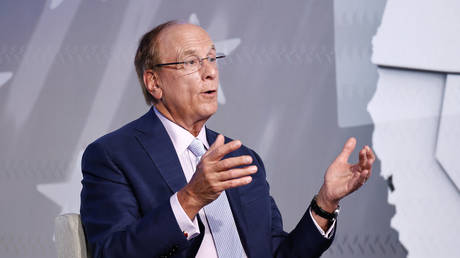
Larry Fink is not a prophet. He is a risk manager with $10 trillion in assets and a PR department that works harder than the Federal Reserve’s printing press. When the media cycle latches onto a supposed "U-turn" regarding optimism or pessimism over conflict in the Middle East, they are missing the mechanical reality of how global capital actually moves.
The consensus narrative is lazy. It suggests that a CEO’s "mood" on a potential Iran conflict dictates market direction. That is nonsense. Fink’s shift from optimism to caution isn't a change of heart; it’s a standard rebalancing of the rhetoric used to justify fee-generating strategies in a high-volatility environment.
While the headlines obsess over whether a hot war with Iran is "priced in," the real story is the structural shift in energy logistics and the quiet death of the petrodollar-driven stability we’ve relied on since 1974. If you are watching the CEO’s lips move, you are looking at the wrong indicator.
The Myth of the Rational War Pivot
Financial pundits love a redemption arc. They want to believe that the leaders of the world's largest asset managers have a moral or intellectual compass that swings based on geopolitical ethics.
The reality? BlackRock's "optimism" is a tool for capital entry. Their "pessimism" is a tool for risk mitigation and capital protection. When Larry Fink signals a U-turn on the Iranian situation, he isn't providing a geopolitical forecast. He is signaling to the market that the cost of insurance—specifically Credit Default Swaps (CDS) and energy futures—is about to become the primary driver of the quarter’s performance.
Most investors ask: "Will war break out?"
The insider asks: "How much can I charge for the volatility resulting from the threat of war?"
Conflict in the Strait of Hormuz is the ultimate "boogeyman" asset. It allows for the justification of higher energy prices without a corresponding increase in actual demand. By shifting his stance, Fink is merely aligning with the reality that the "peace dividend" is officially over. But let’s be clear: BlackRock does not lose money in a war. They own the companies that build the missiles and the companies that will eventually rebuild the power grids.
Why the Market Misreads Iranian Escalation
The "lazy consensus" assumes that a conflict with Iran leads to a simple linear spike in oil and a crash in equities. This view is twenty years out of date.
The global energy map has been redrawn. The U.S. is now a net exporter of crude. The interdependence that once made a Middle Eastern flare-up an existential threat to the S&P 500 has decoupled. What Fink knows—and what he isn't saying in his public U-turns—is that an Iranian conflict is now a regional disaster but a global re-allocation event.
- The Infrastructure Play: War requires massive immediate spending on logistics and defense. This isn't "optimism"; it's a cold calculation of government spending.
- The Fragility of the "Pivot to Green": Every time a drone flies over a refinery in the Middle East, the timeline for the energy transition gets pushed back. If you’re heavily invested in the "Green Transition" (as BlackRock is), a war in Iran is a nightmare because it forces the world back into the arms of "dirty" reliable hydrocarbons.
- The Maritime Chokepoint Fallacy: Everyone talks about the Strait of Hormuz. Nobody talks about the fact that global trade has already begun bypassing traditional chokepoints through terrestrial corridors and new Arctic routes.
The Battle Scars of "Geopolitical Experts"
I have watched firms dump billions into "safe haven" assets based on the rhetoric of CEOs who were essentially reading the same morning briefings as everyone else. In 2011, the "consensus" was that the Arab Spring would lead to a democratic boom and an investment goldmine. It led to a decade of instability and lost capital.
In 2022, the "consensus" was that the Ukraine conflict would break the European economy by Christmas. Instead, it accelerated a massive, profitable shift in LNG (Liquefied Natural Gas) infrastructure.
Fink’s U-turn is a lagging indicator. By the time the CEO of the world's largest asset manager tells you he’s worried about Iran, the smart money has already finished hedging. They’ve already bought the puts. They’ve already moved into defense primes.
If you are waiting for a CEO to tell you when to be "pessimistic," you are the liquidity for the people who got out five minutes ago.
Precision Over Platitudes
Let’s define the mechanics of this "U-turn."
When we talk about "optimism" in a war zone, we are talking about Reconstruction Alpha. This is the profit generated by being the first to provide capital for rebuilding after the smoke clears. If Fink is moving away from that optimism, it means his internal data suggests the "smoke" isn't going to clear for a generation.
He isn't worried about the war; he’s worried about the stalemate.
A stalemate is the worst-case scenario for institutional capital. It creates "stranded assets"—investments that cannot be liquidated, moved, or utilized because they are stuck in a legal or kinetic limbo.
The Contrarian Data Point: It’s Not About Iran
The obsession with Iran is a smokescreen for the real anxiety: the breakdown of the US-China-Russia triangle.
Iran is a proxy. Everyone knows it. But focusing on the proxy allows CEOs to avoid talking about the systemic failure of the globalized trade model they helped build. If Fink admits that the Iran situation is unfixable, he is admitting that the era of "low-cost, high-stability" trade is dead.
That’s a much harder pill for shareholders to swallow than a simple "U-turn" on war optimism.
The Problem With "Safe Havens"
People ask: "Should I buy gold? Should I buy Bitcoin?"
These are the wrong questions. The right question is: "Who controls the physical delivery of the world's essential goods during a hot war?"
In a scenario where Iran and its proxies escalate, the value isn't in a shiny metal or a digital string of numbers. The value is in Supply Chain Sovereignty.
- Physical Ownership: Own the tankers, not the oil.
- Geography: Invest in the "Near-Shoring" hubs that don't require transit through a missile range.
- Energy Independence: Companies that provide localized power generation will outperform any "global" conglomerate every single time.
Stop Looking for "Growth" in a Fire
The most dangerous thing an investor can do right now is try to "buy the dip" on a geopolitical crisis.
The competitor article wants you to believe that Fink’s change of heart is a signal of a coming market correction. I’m telling you it’s a signal of a permanent Regime Shift. We are moving from an era of "Just-in-Time" efficiency to an era of "Just-in-Case" redundancy.
Redundancy is expensive. It kills margins. It lowers P/E ratios across the board.
Fink is "pessimistic" because he realizes the era of 20% annual returns on a globalized portfolio is being replaced by a grind for 5% in a fragmented, warring world.
The Brutal Truth of the U-Turn
The U-turn is a PR move to protect the brand when the inevitable volatility hits. By saying "I told you I was worried," the CEO avoids being blamed for the drawdown. It’s the ultimate "Cover Your Asset" maneuver.
If you want to survive the coming decade, ignore the "optimism" or "pessimism" of the billionaire class. They have the luxury of being wrong. You don’t.
Instead of tracking Fink’s rhetoric, track the movement of physical commodities. Watch the insurance premiums on hulls in the Persian Gulf. Watch the shift in sovereign wealth fund allocations in Riyadh and Abu Dhabi. They aren't listening to Larry Fink; they are watching the drones.
The era of the "CEO as Oracle" is over. The era of the "Internalized Supply Chain" has begun.
Don't wait for the next U-turn. Get off the road entirely.