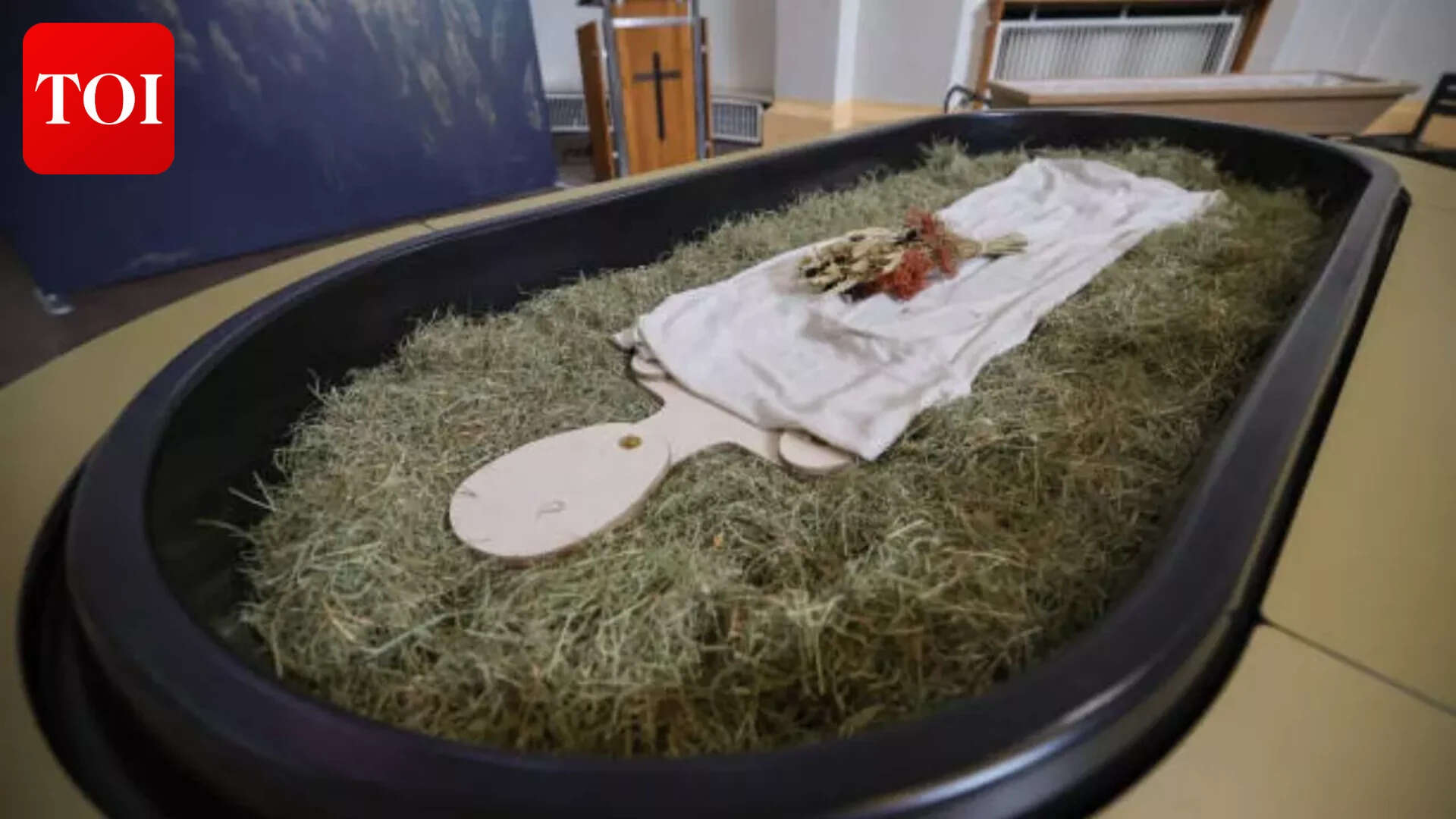
The legislative friction surrounding Oklahoma House Bill 3371, which proposes the legalization of Natural Organic Reduction (NOR), signals a collision between traditional funerary ontologies and emerging bio-industrial efficiency. While Representative Jim Shaw characterizes the process as a "disgusting step," the debate is fundamentally an economic and environmental resource-allocation problem. The transition from cremation and burial to NOR—commonly known as human composting—requires a shift from viewing the deceased as a static memorial object to viewing them as a biological input within a closed-loop nutrient cycle.
The Biomechanical Mechanism of Natural Organic Reduction
To evaluate the validity of the legislative opposition, one must first isolate the technical process from its cultural optics. NOR is not a passive decomposition. It is an accelerated, managed thermophilic aerobic digestion.
- The Containment Environment: The body is placed within a modular steel vessel, surrounded by a high-carbon bulking agent (wood chips, alfalfa, and straw). This creates a specific carbon-to-nitrogen ($C:N$) ratio required for microbial optimization.
- Thermophilic Acceleration: Oxygen is pulsed through the vessel to stimulate aerobic bacteria. These microbes generate heat as a metabolic byproduct, raising the internal temperature to between 55°C and 71°C.
- Pathogen Inactivation: This sustained thermal window is the critical safety threshold. It ensures the destruction of most common pathogens and the breakdown of pharmaceuticals, though it does not neutralize prions (e.g., Creutzfeldt-Jakob disease), which remains a primary regulatory constraint for the industry.
- Mechanical Refinement: Post-vessel, the remaining inorganic materials (prosthetics, pacemakers) are removed via magnetic and manual screening. The remaining bone fragments are processed through a cremulator—identical to standard cremation—and reintegrated into the soil.
The result is approximately one cubic yard of nutrient-dense soil. The efficiency of this process is measured by its "Global Warming Potential" (GWP). Standard cremation requires roughly 28 gallons of fuel and releases approximately 540 pounds of $CO_2$. NOR, by contrast, operates at a net-negative or neutral carbon footprint by sequestering carbon back into the earth's topsoil.
The Three Pillars of Legislative Resistance
The "heavy flak" cited in the Oklahoma legislature can be categorized into three distinct frameworks: The Yuck Factor (Affective Heuristics), The Sanctity of the Corpse (Theological Integrity), and The Regulatory Risk of Soil Distribution.
The Affective Heuristic: "The Yuck Factor"
Representative Shaw’s characterization of the bill as "disgusting" is an example of the "wisdom of repugnance" argument. In policy-making, this is often a placeholder for a lack of a formal ethical framework. This sentiment stems from the blurring of the line between "human" and "waste." When a body is transitioned into "fertilizer," it loses its status as a distinct entity and becomes a commodity. This ontological shift triggers a visceral defensive response in conservative legislative bodies that prioritize the "dignity of the remains" as a static, non-utilitarian state.
Theological Integrity and the Desecration Argument
The opposition often argues that NOR violates the "Imago Dei" or the inherent sanctity of the human form. From a structural perspective, this is a debate over the finality of the vessel. Traditional burial preserves the vessel for as long as possible; cremation destroys it instantly; NOR repurposes it. The legislative bottleneck in Oklahoma is largely a result of the failure to reconcile "repurposing" with "respect." If the state defines respect as "preservation," NOR will always be viewed as a violation.
The Regulatory Risk of Soil Distribution
The most grounded technical concern involves the "end-use" of the resulting soil. Oklahoma's agricultural sector relies on strict biosafety standards. The logic follows:
- If human-derived soil is spread on commercial farmland, does it enter the food chain?
- How does the state monitor the transition of "remains" to "regulated agricultural input"?
- The liability shift: Once the soil leaves the NOR facility, who is responsible for its chemical composition?
The Economic Competitive Landscape
The funerary industry in the United States is currently a $20 billion market dominated by consolidation. The push for NOR is not just an environmental movement; it is a disruptive market entry.
The Cost Function of Death Care:
- Traditional Burial: $7,000 - $12,000 (Includes casket, vault, embalming, plot).
- Direct Cremation: $1,000 - $3,000.
- Natural Organic Reduction: $4,000 - $5,500.
NOR occupies the "premium-green" segment. It appeals to a demographic that finds cremation too industrial and traditional burial too wasteful. For Oklahoma, the rejection of the bill is also a protection of the existing infrastructure of funeral homes and cemeteries that are not yet equipped to handle the specialized vessels and HVAC requirements of NOR facilities.
Structural Deficiencies in the Opposition’s Logic
The primary logical gap in the "disgusting" argument is the "Consistency Bias." Opponents of human composting rarely apply the same "disgust" metrics to existing practices that are objectively more invasive.
- Embalming: This involves the systemic replacement of blood with formaldehyde (a known carcinogen) to create a temporary aesthetic of life.
- Cremation: This is the rapid oxidation of human tissue via fossil fuel combustion.
If "dignity" is defined as a return to nature, NOR is arguably more aligned with that principle than the chemical preservation found in modern funeral parlors. The opposition's failure to account for the environmental externalities of embalming fluid leaching into groundwater creates a logical bottleneck. They prioritize the visual dignity of the process over the ecological impact of the outcome.
The Scalability Bottleneck
Even if the Oklahoma bill passes, NOR faces a significant "Throughput Problem." A standard cremator can process a body in two hours. An NOR vessel requires 30 to 60 days. This creates a massive real estate requirement for any facility aiming for scale.
- Facility Density: To match the capacity of a single cremator, an NOR facility would need 360 vessels.
- Energy Overhead: While $CO_2$ emissions are lower, the energy required to maintain constant airflow and temperature over two months is non-trivial.
The strategic play for advocates is to stop framing NOR as "composting"—which carries the connotation of waste—and start framing it as "Soil Remediation." By shifting the language from biology to ecology, the legislative friction decreases.
The Oklahoma legislature’s resistance is a symptom of a broader transition period where bio-technology outpaces cultural definitions of the self. The move toward Natural Organic Reduction is inevitable as land-use constraints in urban centers make traditional cemeteries economically unviable. The state's choice is not between "disgusting" and "dignified," but between adopting a managed, regulated nutrient cycle or continuing to subsidize a linear, high-emission funeral model that is increasingly detached from the values of the modern consumer.
The most effective legislative path forward for House Bill 3371 is the implementation of a "Zone-Based End-Use" restriction. By limiting the distribution of NOR-derived soil to non-agricultural state forests or private memorial gardens, the state can bypass the biosafety concerns regarding the food chain while still providing citizens with a carbon-neutral death-care option. This compromise satisfies the utilitarian requirement of the bill while mitigating the "disgust" factor by ensuring human-derived soil remains within "sacred" or "protected" boundaries rather than entering the commodity market.