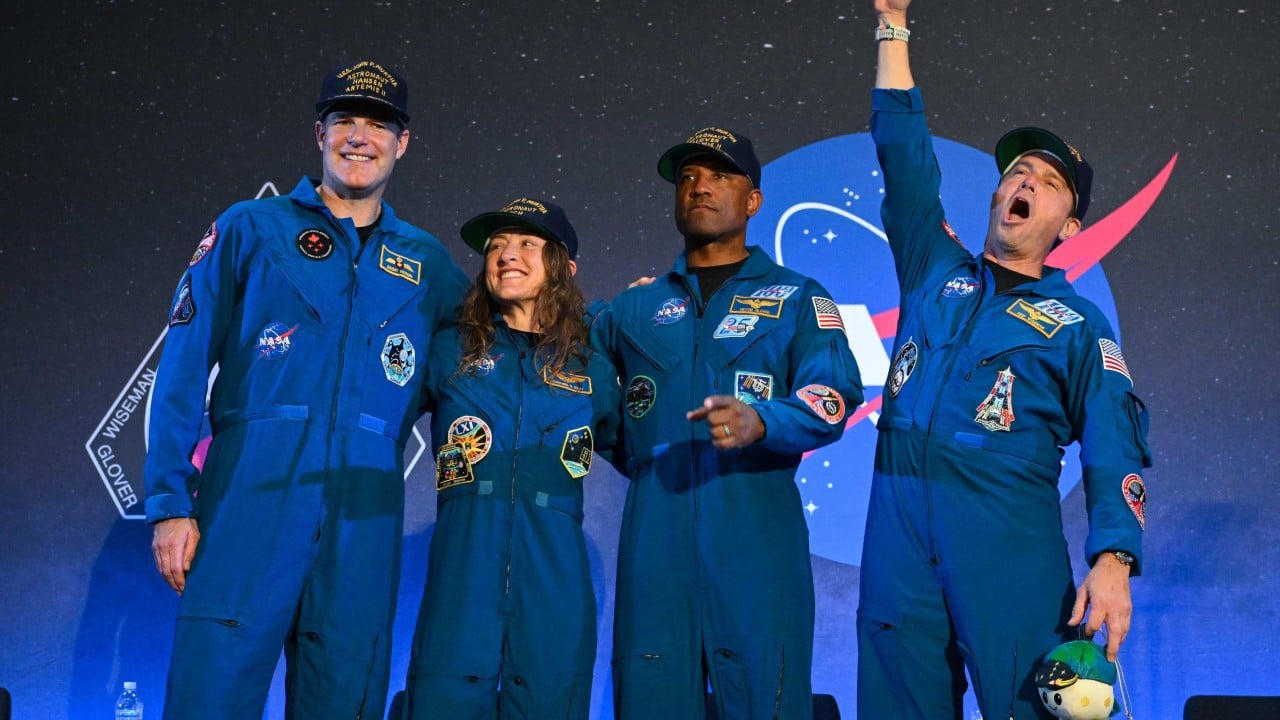
The cheers at Ellington Field weren't just for four people in flight suits. When the Artemis II crew touched down in Houston, the air felt different. It wasn't just another photo op for NASA. It was a visceral reminder that we're finally done practicing in low Earth orbit. We're going back to the moon, and this time, we aren't just visiting for the sake of a flag.
The crowd didn't care about the humidity. They cared about the fact that Reid Wiseman, Victor Glover, Christina Koch, and Jeremy Hansen represent the first human beings to head toward the lunar vicinity in over fifty years. After their recent training milestones, their homecoming served as a loud, clear signal. The hardware is ready. The math is checked. The humans are prepared.
The weight of being home
"It’s a special thing to be on Planet Earth," Reid Wiseman told the crowd. He wasn't being poetic for the sake of a soundbite. When you spend your days inside a vacuum-sealed tin can or submerged in a giant pool at the Neutral Buoyancy Lab, you start to appreciate things like wind and gravity. The crew spent the last few months pushed to their physical limits. They've been living in the Orion capsule's simulators, figuring out exactly how to handle a spacecraft that’s vastly more complex than the Apollo command modules of the sixties.
Houston is the heart of this operation. It's where the flight controllers live. It's where the software gets written. Bringing the crew back to Ellington Field is a tradition that dates back to the Mercury days, but this feels heavier. This isn't a victory lap. It’s a pit stop.
The Artemis II mission won't land on the moon. It’s a ten-day flyby. Some critics argue that we should just skip straight to the landing, but that’s a dangerous way to look at orbital mechanics. You don't take a brand-new deep-space vehicle on a quarter-million-mile trip without testing the life support systems in a real high-radiation environment first.
Moving beyond the Apollo nostalgia
We need to stop comparing Artemis to Apollo. It's a different beast entirely. Apollo was a sprint driven by Cold War panic. Artemis is a marathon designed for staying power. The crew isn't just flying a mission; they're testing the foundational tech for a permanent lunar presence.
Victor Glover, who will be the first person of color to leave low Earth orbit, has been vocal about the technical shift. He isn't just a pilot; he’s a systems expert. The Orion spacecraft relies on a level of automation that would have looked like magic to Neil Armstrong. But automation doesn't mean the crew is just along for the ride. If the communication links drop while they're behind the far side of the moon, those four people are the only brains in the universe that can bring that ship home.
The diversity of this crew isn't just about PR. It's about a global shift in how we view space. Jeremy Hansen is a Canadian Space Agency astronaut. His presence on the mission highlights that the moon isn't just American real estate anymore. It’s an international project. This matters because it spreads the cost and the brainpower. If one country loses interest, the mission doesn't die.
The technical reality of the Orion capsule
People often ask why this is taking so long. The answer is simple. Space is hard, and deep space is harder.
The Orion capsule has to survive a reentry speed of about 25,000 miles per hour. That generates temperatures near 5,000 degrees Fahrenheit. The heat shield is a marvel of engineering, but it’s been a point of contention in recent NASA reports. Engineers found some unexpected charring during the uncrewed Artemis I flight. They’ve spent months analyzing that data.
The crew's return to Houston coincides with the final fixes on those thermal protection systems. You don't put humans on top of a Space Launch System (SLS) rocket unless you're 100% sure that shield won't flake off in chunks.
- Radiation Protection: Orion is built to handle the Van Allen belts.
- Redundancy: Every major system has a backup, and usually a backup for the backup.
- Human Factors: The interior is cramped, but it’s designed to keep four people alive and sane for nearly two weeks.
Why you should care about a moon flyby
It’s easy to get cynical about space travel when we have problems on the ground. But the tech developed for these missions ends up in your pocket and your hospital. The water purification systems on Artemis will likely be used in drought-stricken areas on Earth. The light-weight materials will make cars more efficient.
But honestly? It’s about the perspective.
When Christina Koch talks about looking back at Earth, she isn't talking about a pretty picture. She’s talking about the "Overview Effect." It’s a cognitive shift that happens when you see the planet without borders. It’s a fragile blue marble in a void. Koch already holds the record for the longest single spaceflight by a woman. She knows what isolation feels like. Her expertise in long-duration missions is why she’s on this crew. She knows how to keep a team functioning when the stakes are literally life and death.
The training grind in Houston
Now that they're back in Texas, the schedule is brutal. They aren't just doing gym workouts. They're in the water. They're in the simulators for twelve hours a day. They're practicing "manual override" scenarios that hopefully never happen.
The Neutral Buoyancy Lab (NBL) near Johnson Space Center is where they spend a lot of their time. It’s a massive pool that contains a full-scale mockup of the spacecraft. They practice egress—getting out of the capsule after it splashes down in the Pacific. If the waves are high and the capsule is bobbing, getting out without sinking the craft is a nightmare. They do it until it’s muscle memory.
They also work closely with the recovery teams. The U.S. Navy is a huge part of this. When Orion hits the water, a specialized ship has to be there within minutes. The crew has been meeting with the divers and the deck crews to ensure everyone is on the same page. A bad recovery can be just as fatal as a bad launch.
What happens next for the Artemis II team
The mission is currently slated for late 2025 or early 2026, depending on how the final hardware integration goes at Kennedy Space Center. The crew will spend the next several months between Houston and Florida. They'll be checking the actual vehicle that will carry them. This isn't like a commercial flight where you just board the plane. They know every bolt and every wire in that capsule.
You can follow the progress through the NASA Artemis blog, but the real story is in the small updates. Watch for the completion of the vacuum chamber tests. Watch for the final software "handshake" between the SLS rocket and the Orion capsule. These are the milestones that actually matter.
If you want to understand the scale of this, go visit Space Center Houston. Look at the size of the Saturn V they have on display. Then realize that the SLS rocket is even more powerful. We're living in the middle of a historical pivot. Don't blink. The next few years will define the next century of human exploration.
Get involved by tracking the mission updates directly. Don't wait for the mainstream news to catch up when the launch is a week away. The real work is happening right now in the labs and simulators of Houston. Stay updated on the NASA SLS progress reports and the Orion integration schedule. This is the closest we've ever been to leaving our backyard for good.