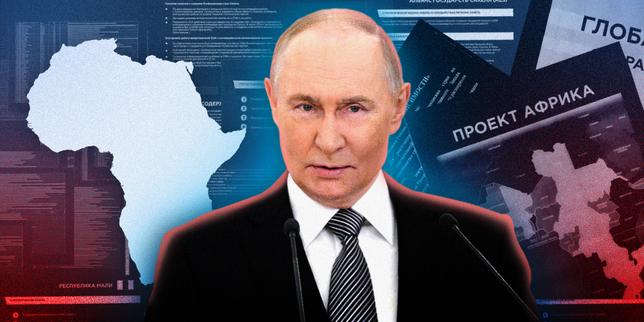
The leak of 1,400 internal documents from Russian influence apparatuses reveals a shift from ad-hoc propaganda to a vertically integrated industrial complex designed to capture African cognitive environments. This is not merely a collection of social media posts; it is a calculated deployment of digital mercenary forces designed to erode Western institutional legitimacy while installing a pro-Kremlin ideological substrate. To understand the effectiveness of these operations, one must analyze them through the lens of structural dependency, information arbitrage, and the systematic exploitation of local grievances.
The Three Pillars of Russian Influence Engineering
The leaked data suggests that Russian operations in the Sahel and Central African Republic (CAR) function through three distinct, yet overlapping, operational layers. This modularity allows the Kremlin to maintain plausible deniability while ensuring that tactical failures in one area do not compromise the broader strategic objective.
1. Institutional Infiltration and Elite Capture
Russian strategists do not prioritize the general public initially. The primary objective is the acquisition of influence over decision-makers. This is achieved through "advisory packages" that bundle military security with political consulting. By embedding advisors directly into the offices of African heads of state, Russia creates a closed loop of information where the leader becomes dependent on Russian intelligence for domestic survival. The cost of exiting this relationship becomes prohibitively high, as the same Russian assets providing security often possess the kompromat or the kinetic means to destabilize the regime if it pivots away from Moscow.
2. The Narrative Arbitrage Engine
Russia identifies existing fissures in the local information environment—colonial trauma, economic disparity, or religious tension—and amplifies them. They do not invent new grievances; they apply a force multiplier to existing ones. This is a form of information arbitrage where the cost of generating a polarizing narrative is near zero, while the cost for a democratic government to debunk it or provide a constructive counter-narrative is exponentially higher.
The documents detail the use of "troll factories" that are increasingly localized. Instead of using Russian operators with poor language skills, the apparatus recruits local influencers and journalists. These individuals are provided with "thematic guidelines" but are encouraged to use local slang and cultural references, making the propaganda indistinguishable from authentic grassroots sentiment.
3. Kinetic-Digital Synchronization
Unique to the Russian model is the tight coupling of physical paramilitary presence (via organizations formerly under the Wagner umbrella, now restructured as the Africa Corps) and digital campaigns. When a Russian-backed paramilitary unit enters a new territory, a synchronized digital campaign precedes them to "soften" the environment. This involves:
- Discrediting UN or French peacekeeping missions through staged or exaggerated reports of human rights abuses.
- Promoting the Russian "alternative" as a non-interference model of security.
- Flooding local Telegram channels with highly produced video content portraying Russian soldiers as liberators.
The Cost Function of Narrative Dominance
The efficiency of these operations is rooted in a specific economic reality: the asymmetry of information warfare. Russia operates on a "high-noise, low-accuracy" model. In this framework, the objective is not necessarily to make the audience believe a specific lie, but to make them doubt the possibility of any objective truth.
- Production Cost: Low. Utilizing AI-generated images, deepfake audio, and inexpensive local labor.
- Distribution Cost: Near-zero. Leveraging the algorithmic tendencies of Facebook and X (formerly Twitter) which prioritize engagement (outrage) over veracity.
- Defense Cost: Massive. Requires high-level diplomatic engagement, media literacy programs, and transparent governance—all of which take years to build.
This creates a strategic bottleneck for Western actors. While the West attempts to compete through "fact-checking" and "strategic communications," Russia is busy redefining the underlying reality. Fact-checking is a reactive measure that inherently concedes the initiative to the aggressor.
Structural Vulnerabilities in the African Digital Landscape
The leaked documents highlight why the African continent is particularly susceptible to these tactics. It is not a lack of intelligence among the population, but rather a series of structural vulnerabilities in the digital infrastructure.
The Mobile-First Information Monopoly
In much of the Sahel, the internet is Facebook and WhatsApp. When a platform provides free or "zero-rated" data for its own services, it becomes the sole source of news for millions. Russian operators exploit this by creating thousands of private WhatsApp groups where "news" is disseminated as peer-to-peer recommendations. This bypasses the traditional editorial scrutiny of even the most basic news organizations.
The Vacuum of Local Independent Media
Decades of economic instability have hollowed out local journalism. When a Russian-funded "news agency" offers free high-quality content, local radio stations and newspapers—desperate for material—frequently carry it without realizing its origin. The leak confirms that Russia has systematically bought out or subsidized dozens of local media outlets across West Africa to act as "laundering" stations for Kremlin-aligned narratives.
Quantifying the Impact of "The African Initiative"
The "African Initiative," a specific entity identified in the leaked 1,400 pages, functions as a hybrid media-intelligence organ. Its performance is measured not by traditional "clicks," but by its ability to catalyze physical protests or policy shifts.
- Protest Mobilization: The documents link specific digital campaigns to the "spontaneous" anti-French protests in Bamako and Ouagadougou. The metric of success here is the transition from a digital impression to a physical body in the street.
- Geopolitical Displacement: The ultimate KPI is the expulsion of Western military forces. The withdrawal of French and American troops from Niger and Mali represents a 100% success rate for the digital-kinetic synchronization strategy.
The Limits of Russian Hybrid Warfare
Despite its current momentum, the Russian model faces three fundamental risks that the leaked documents hint at but cannot solve.
- The Overpromise Gap: Russia positions itself as a security provider. If the security situation continues to deteriorate—as it has in parts of Mali despite Russian presence—the "liberator" narrative will eventually collapse under the weight of empirical reality.
- Economic Insignificance: Russia offers security and ideological alignment, but it cannot replace the West or China as a primary economic partner or infrastructure builder. Its "influence" is a thin layer of security and media, lacking a deep economic foundation.
- Resource Overextension: Maintaining 1,400 pages of operational complexity across a dozen countries is expensive. As the war in Ukraine consumes more of the Kremlin's financial and human capital, the quality and frequency of African operations may degrade.
Strategic Realignment for Counter-Influence
Competing with Russia in Africa requires moving beyond "counter-disinformation." The following strategic adjustments are necessary for any entity looking to restore information integrity in the region:
- Decentralize the Response: Centralized "fact-checking" hubs located in Europe or the US are ineffective. Investment must shift toward supporting local, vernacular-language investigative journalism that has the cultural capital to call out foreign interference.
- Target the Distribution Infrastructure: Engaging with big tech platforms to fix the algorithmic bias toward "outrage engagement" in developing markets is more critical than debunking individual posts. The plumbing is the problem, not just the water.
- Focus on Tangible Security Outcomes: The most effective counter to a Russian "security" narrative is a demonstrably safer environment. Efforts should focus on professionalizing local military forces rather than just providing hardware or digital support.
The Russian playbook in Africa is a masterclass in low-cost, high-impact disruption. It treats the human mind as a theater of war and the digital landscape as the primary battlefield. The leaked documents provide the map; the challenge now is whether Western and African stakeholders have the institutional agility to redraw it.
The immediate move for regional actors is the establishment of independent, sovereign digital auditing bodies. These must be capable of tracking the financial flows between foreign state-linked entities and local media influencers. Without financial transparency, the "grassroots" will remain a manufactured product of external interests.