The water doesn't move the way it used to. If you stand on the bank of a typical British river today, you are looking at a ghost of a system. It is straight. It is fast. It is efficient at one thing and one thing only: carrying every drop of rain toward the sea as quickly as humanly possible. We spent centuries tidying up the wilderness, pulling out the snags and the debris, convinced that a clean river was a healthy one. We were wrong.
Now, when the sky opens up, the water has nowhere to go but up and out, into living rooms and over sandbags. We tried to engineer our way out of the mess with concrete and steel, but the water always finds the crack. While we were busy pouring cement, we forgot that nature had already designed a solution. It’s small, it’s furry, and it has orange teeth.
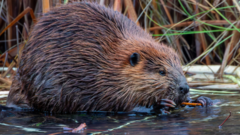
The beaver is returning to the wild, and it isn't just a feel-good story for naturalists. It is a desperate, necessary recruitment of a master builder.
The Midnight Engineer
Picture a farmer named Jack. He isn't a real person, but he represents a thousand voices echoing across the marshlands of the South West. Jack watches the horizon every October with a knot in his stomach. He knows that three days of heavy rain means the stream at the bottom of his property will transform from a trickle into a predator. For years, Jack has cleared the brush. He has dug the channels deeper. He has played by the rules of traditional land management. Yet, every year, the silt builds up, the banks erode, and the water gets closer to his door.
One night, something changes. There is a sound in the darkness that hasn't been heard in these parts for four hundred years. It isn't the rush of water, but the rhythmic thwack of a flat tail against mud.
By dawn, the stream looks different. A mess of willow branches and mud has been shoved into the flow. To the untrained eye, it looks like a clog. To the river, it is a lung.
The Beaver Trust and various local wildlife charities are currently finalizing plans to release more of these animals into open river systems across the country. This isn't a fenced-in experiment anymore. This is the real thing. They are moving from "trial" to "resident." The goal is simple: let the beavers do the work we are too slow, too broke, or too unimaginative to do ourselves.
The Physics of a Wet Sponge
We often think of dams as walls. We see them as barriers that stop the flow. But a beaver dam is more like a filter. It creates a series of tiered ponds that turn a racing torrent into a slow, meandering soak.
Think about a sponge. If you pour a glass of water onto a wooden table, it splashes everywhere. It runs off the edges. It makes a mess. If you place a sponge on that table first, the water disappears. It stays held in the fibers, slowly evaporating or trickling out hours later.
A beaver dam turns a valley into a giant, living sponge.
When the heavy rains hit Jack’s farm, the water hits the beaver’s construction first. The energy of the flood is broken. The water spreads out into small, shallow pools behind the dam. The silt—the dirt that usually chokes the river downstream—settles to the bottom, feeding the soil instead of clogging the estuary. By the time the water reaches Jack’s house, the "peak" of the flood has been shaved off. The danger has been muffled.
But the benefit doesn't stop when the rain ends. During a summer drought, when the ground is cracked and the grass is yellow, those beaver ponds are still there. They hold the water in the landscape, slowly recharging the groundwater. While the neighbor’s creek has run bone-dry, Jack’s stream is still flowing, fed by the reservoir the beavers built for free while he was sleeping.
The Price of a Pelt
It is hard to believe we almost wiped them out entirely. In the 16th century, beavers were walking currency. We hunted them for their fur, which made the finest hats in Europe, and for castoreum, a secretion used in perfumes and medicine. By the time the 1700s rolled around, the British beaver was a memory.
When we killed the last one, we didn't just lose a species. We lost the maintenance crew.
Without beavers, our rivers began to "incise." They cut deeper into the earth, disconnecting from the floodplains. The complex wetlands—the nurseries for fish, the hunting grounds for owls, the homes for dragonflies—simply dried up. We traded a vibrant, chaotic, self-sustaining ecosystem for a series of sterile pipes.
Bringing them back isn't just about nostalgia. It’s about admitting a mistake. It’s about recognizing that a wild river is safer for humans than a managed one.
The Friction of Progress
Not everyone is cheering at the riverbank. If you make your living from the land, the idea of a wild animal "remodeling" your drainage system is terrifying. There are real concerns from the farming community about localized flooding. If a beaver decides to dam a culvert under a road or flood a field of high-value crops, the "human-centric narrative" suddenly feels very intrusive.
The charities leading these releases aren't ignoring this. They can't afford to. The success of the beaver’s return depends entirely on social license.
This means "Beaver Officers" are now a real job description. These experts work with landowners to install "beaver deceivers"—pipes that go through a dam to control the water level without the beaver realizing it. It means if a tree is particularly precious, you wrap the trunk in wire mesh. It requires a shift in how we view the land. We have to stop seeing it as something we own and start seeing it as something we share with a partner who has a very different set of priorities.
The stakes are invisible until they aren't. We don't notice the lack of biodiversity until the songbirds stop visiting. We don't notice the loss of wetlands until the insurance premiums for flood zones become unaffordable. We don't notice the river is dying until it's just a brown gutter.
A New Kind of Wild
There is a specific kind of magic that happens when a beaver enters a habitat. Within months, the "engineer" invites a whole host of subcontractors.
Frogs arrive to lay eggs in the still, clear water of the ponds. Water voles—those shy, disappearing icons of the British countryside—find safety in the complex banks. Otters follow the fish, which find refuge in the deep pools and shade provided by the fallen willows. Kingfishers have a stable place to hunt.
Even the trees benefit. While it looks like the beavers are "killing" trees by gnawing them down, they are actually coppicing them. The willow and alder regrow with multiple stems, creating a thick, bushy habitat that provides more nesting space than a single tall trunk ever could. It is a cycle of renewal that feels almost intentional.
We are watching the birth of a New Wild. This isn't the "wilderness" of the Serengeti or the Amazon. This is a wild that lives alongside us, tucked behind a suburban housing estate or at the edge of a village green. It is a wild that asks us to be a little bit more patient and a little less controlling.
The Ripple Effect
The upcoming releases are a gamble, but they are a calculated one. The data from previous closed-site trials, like those in Devon and Scotland, is undeniable. The water quality improves. The flood risk drops. The life returns.
But the real impact isn't in the data. It’s in the feeling of standing by a pond that wasn't there last year. It’s in the sight of a child seeing a wild mammal that their great-great-great-grandparents only knew from books. It’s in the quiet realization that we don't have to have all the answers.
We spent four hundred years trying to master the water. We built walls, we diverted flows, and we polished the riverbeds until they were slick and dangerous. We thought we were the only architects that mattered.
Now, we are stepping back. We are opening the crates and watching as a few dozen animals waddle into the current. They don't have blueprints. They don't have government grants. They just have an instinct to build, to slow things down, and to stay.
The water is starting to move differently again. It’s slowing down. It’s spreading out. It’s breathing.
A muddy, tangled, chaotic future is coming to our riverbanks, and for the first time in a long time, that is exactly what we need.
The architect has returned to the site, and he’s already started on the foundation.