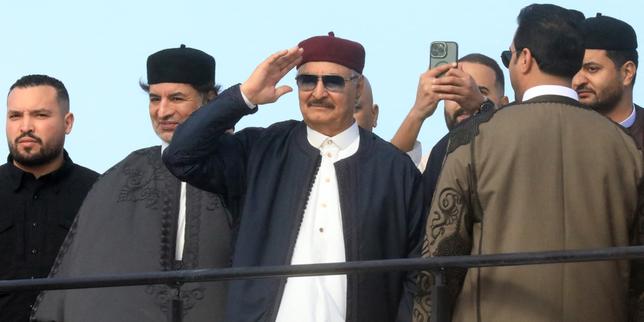
The desert wind in eastern Libya doesn't just move sand. It carries the weight of a decade of fragmented history, the smell of cordite, and the heavy, silent pressure of money moving where eyes cannot follow. In the sun-bleached offices of Benghazi, power is often measured by the caliber of a rifle or the length of a military convoy. But the most potent form of power in the territory controlled by Field Marshal Khalifa Haftar doesn't wear a uniform. It wears a bespoke suit, speaks the polished English of high-tier global finance, and operates within the sterile, air-conditioned quiet of offshore bank accounts.
This is the world of Ahmed Gadalla.
To understand the survival of the Haftar clan—a family that has transformed a military insurgency into a sprawling, sovereign-adjacent corporate empire—you have to look past the tanks. You have to look at the ledgers. Money is the oxygen of war. Without it, the "Libyan National Army" is just a collection of aging hardware and ambitious men. Gadalla is the man who keeps the lungs pumping. He is not a soldier. He is the master of the shadow bridge, the financial engineer who connects a sanctioned, war-torn patch of North Africa to the gleaming glass towers of international liquidity.
The Ledger and the Sword
Imagine a merchant in a bustling Mediterranean port centuries ago. He needs to move gold across borders where pirates roam and kings demand a cut of every coin. He doesn't carry the gold himself. He carries a piece of paper—a promise, a credit, a ghost of value that only those in his secret network recognize.
In the modern era, Ahmed Gadalla has perfected this ancient craft. As the former managing director of EFG Hermes in the UAE and a veteran of the cutthroat world of investment banking, he brought a level of institutional sophistication to the Haftar family that they simply could not find in the chaotic streets of Tobruk. He didn't just manage their money; he institutionalized their influence.
The problem for any unrecognized regime is legitimacy. If the world doesn't recognize your government, the world’s banks won't touch your cash. It’s a financial exile. But Gadalla understood a fundamental truth of the 21st century: money has no nationality if you disguise its passport well enough. Through a complex web of holding companies, shell entities, and strategic partnerships stretching from Cairo to Dubai, he turned "Haftar money" into "Global Capital."
This isn't just about greed. It's about the terrifying realization that in a broken state, the one who controls the currency controls the peace. When a family controls the ports, the gold mines, and the black-market fuel exports, they aren't just leaders; they are the economy itself.
The Architecture of the Shadow State
Consider a hypothetical young graduate in Benghazi. Let's call him Omar. Omar wants to start a small logistics company. In a normal country, he goes to a bank. In Haftar’s Libya, Omar’s success depends entirely on whether his business interests intersect—or interfere—with the Military Investment and Public Works Authority. This entity is the crown jewel of the Haftar family's financial grip. It is a state within a state, a military-run conglomerate that swallows everything from scrap metal exports to telecommunications.
Gadalla’s role was to be the brain of this leviathan. He provided the strategic "veneer" required to engage with international partners. When you look at the sheer scale of the Haftar family’s holdings, it becomes clear that this isn't a traditional military junta. It is a leveraged buyout of a nation.
Under Gadalla’s guidance, the financial operations became more than just a way to pay soldiers. They became a way to buy silence and loyalty. By funneling vast sums through the banking sectors of neighboring allies, the clan ensured that their survival was in the financial interest of regional powers. If Haftar falls, the debts go unpaid. If the debts go unpaid, the banks in Cairo and Abu Dhabi feel the sting. It is the ultimate insurance policy: being too indebted to fail.
The Cost of Cold Efficiency
There is a quiet, rhythmic clicking in a high-frequency trading room that sounds nothing like a battlefield. Yet, the decisions made there ripple outward, eventually manifesting as bread lines in Tripoli or fuel shortages in the south. Gadalla’s expertise allowed for the manipulation of letters of credit—the very lifeblood of Libyan imports.
When a country has two central banks and two competing governments, the "middlemen" become the real kings. By navigating the rift between the Central Bank of Libya in Tripoli and the eastern authorities, Gadalla helped the Haftar clan exploit price differences in currency and commodities. It is a game of arbitrage played with the lives of six million people.
The tragedy of the "Financial Shadow" is that it is invisible. You can film a bombed-out building. You can photograph a refugee boat. But how do you capture the image of a billion dollars vanishing into a series of nested Cayman Island corporations? How do you show the human cost of a diverted fuel shipment that was sold on the black market to fund a private jet for a general’s son?
Gadalla’s brilliance was his ability to make these transactions look mundane. He spoke the language of "compliance," "due diligence," and "portfolio management." He transformed the raw, often violent extraction of Libyan wealth into the sanitized, boring language of a quarterly report.
The Friction of Reality
But even the most sophisticated financial machinery eventually grinds against the reality of the dirt. For a time, Gadalla was the golden boy of the eastern administration, the bridge to the West and the guarantor of the family’s wealth. However, in the world of absolute power, being indispensable is a dangerous game. When you know where all the bodies—and all the billions—are buried, you become a liability as much as an asset.
The tension within the Haftar inner circle is a classic study in Shakespearean paranoia. On one side, you have the sons, Saddam and Khalid, who are being groomed for a dynastic succession. On the other, you have the technocrats like Gadalla, who understand that the family’s power is a house of cards held together by international banking regulations that could change at the stroke of a pen in Washington or Brussels.
The reports of Gadalla’s shifting status—whispers of fallouts, of side-lining, of the "shadow financier" moving further into the shadows—point to a deeper instability. It reveals a truth that no investment banker can fix: you cannot buy a soul for a country. You can fund an army, and you can bribe a tribe, but you cannot create a functioning economy out of the systematic looting of its future.
The Ghost in the Machine
We often think of war as a series of maps with moving arrows. We think of it as a clash of ideologies. But look closer. Beneath the flags and the rhetoric, it is often just a high-stakes accounting exercise.
Ahmed Gadalla represents a new breed of player in global conflict. He is the "Conflict Financier." He doesn't need to fire a shot to change the outcome of a siege. He just needs to delay a wire transfer or trigger a margin call. He is the proof that in the modern age, the most effective weapon isn't the Kalashnikov; it's the SWIFT code.
As the sun sets over the Mediterranean, reflecting off the luxury villas of the elite and the crumbling facades of the war-weary, the money continues to move. It flows through the digital ether, jumping from server to server, shedding its history with every hop. It leaves behind a trail that only a few, like Gadalla, know how to read.
The real story of Libya isn't found in the speeches given at the United Nations. It is found in the quiet ledgers of men who treat nations like distressed assets. They buy low, they sell high, and they leave the people to settle the debt.
The gold is gone. The promises remain. The ledger is never truly closed.
The wind continues to blow across the dunes, erasing the footprints of those who walked there, but the digital footprints of the billions remain, etched into the hidden architecture of a world that prefers not to look. The architect may step back into the gloom, but the structure he built still stands, cold and impenetrable, a monument to the power of the invisible.


