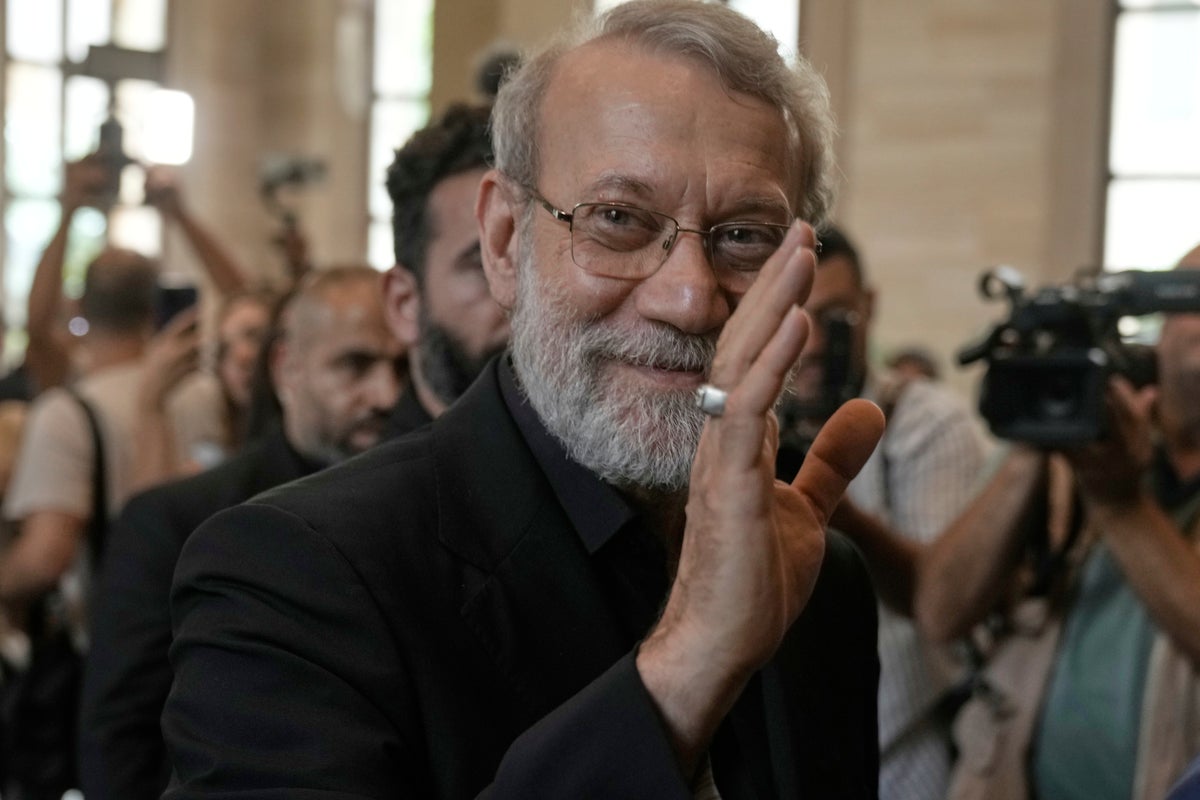
Ali Larijani isn't your typical fire-breathing revolutionary. He doesn't scream slogans at rallies or wear military fatigues to grab headlines. He’s much more effective than that. For decades, Larijani has operated as the cerebral "strongman" of the Iranian establishment, a philosopher-turned-politician who knows exactly where the bodies are buried. When he talks about "eliminating" threats to Iran, people in Washington and Tel Aviv stop and listen.
He’s the ultimate insider. You can't understand modern Iran without understanding how Larijani bridges the gap between the hardline clerical elite and the pragmatic technocrats who actually keep the lights on. He represents a brand of sophisticated defiance that's far more difficult for the West to counter than simple bluster. He's the guy who can quote Kant in the morning and oversee a ballistic missile strategy in the afternoon.
The Architect of Iranian Resistance
Larijani comes from one of Iran's most influential "power families." His brothers hold or have held top positions in the judiciary and the clergy. This isn't just nepotism. It's a localized deep state. He served as the Speaker of the Parliament for twelve years, a record that gave him unparalleled control over the country's legislative direction.
He isn't just a talker. During his time as the head of the Supreme National Security Council, he was the face of Iran’s nuclear negotiations. He's the one who mastered the art of "negotiating while advancing," a strategy that kept European diplomats busy while Iranian centrifuges kept spinning. He understands the Western psyche better than almost anyone else in Tehran. He knows when to offer a smile and when to show the iron fist hidden underneath.
His relationship with the West is defined by a cold, calculated realism. He doesn't hate the U.S. because of some abstract religious fervor. He views the U.S. as a structural obstacle to Iranian hegemony in the Middle East. That makes him a much more formidable opponent than a simple ideologue. You can't easily bargain with someone who views the entire geopolitical map as a giant chess game where "win-win" is just a fairy tale told to losers.
Why the Elimination Threat Matters
When Larijani directed rhetoric toward Donald Trump regarding "elimination," it wasn't a throwaway line for a local newspaper. It was a calculated signal sent through the Islamic Revolutionary Guard Corps (IRGC) channels. In the world of Iranian high politics, words are weapons.
The Iranian leadership has a long memory. They haven't forgotten the 2020 assassination of Qasem Soleimani. For a man like Larijani, "elimination" is a matter of judicial and strategic necessity. He views it as a way to restore the "balance of terror." If the U.S. can take out Iran’s top general, Larijani’s logic dictates that Iran must show it can reach the highest levels of American power.
This isn't just about revenge. It's about deterrence. Larijani's philosophy is rooted in the idea that weakness invites aggression. By maintaining a credible threat against high-level U.S. targets, he believes he’s actually preventing a full-scale war. It's a dangerous gamble. But Larijani has built his entire career on these kinds of high-stakes maneuvers.
The Intellectual Root of His Power
Unlike many of his peers, Larijani holds a PhD in Western Philosophy. He wrote his dissertation on Immanuel Kant. This matters. It gives him a framework for understanding international law and Western logic that his predecessors lacked. He uses the West's own language against it.
He's been described as a "rational radical." He wants the same things the hardliners want—regional dominance and the survival of the Islamic Republic—but he wants to achieve them through statecraft and strategic patience. He’s the guy who ensures the IRGC’s muscle is directed by a sophisticated brain.
Navigating the Internal Power Struggle
It hasn't all been smooth sailing for him. In the 2021 presidential election, the Guardian Council disqualified him from running. Many saw this as a move by the ultra-hardliners to clear the path for Ebrahim Raisi. But Larijani didn't go away. He didn't flee into exile or start an insurgency. He stayed in the shadows, waiting.
The death of Raisi in a helicopter crash in 2024 changed the math. Suddenly, the "pragmatic conservative" wing needed a heavyweight. Larijani’s name immediately shot back to the top of the list. He’s the bridge-builder the system needs when it feels like it's cracking under the weight of sanctions and internal dissent. He’s the "safe pair of hands" for the Supreme Leader, Ali Khamenei.
What a Larijani-led Strategy Looks Like
If Larijani continues to exert dominant influence or eventually takes a higher office, expect a shift in how Iran handles its "Axis of Resistance." He won't scale back the proxies in Lebanon, Yemen, or Iraq. Instead, he'll likely integrate them more tightly into Iran’s formal diplomatic strategy.
He’ll use the threat of regional escalation as a bargaining chip to force the U.S. back to the table on Iranian terms. He’s a master of the "salami-slicing" technique—taking small, incremental steps toward his goals that are each too small to trigger a war, but collectively change the entire landscape.
- Nuclear Ambiguity: He'll keep Iran exactly one screwdriver's turn away from a weapon, using that proximity to extract concessions.
- Regional Integration: He’ll focus on building ties with China and Russia to bypass Western sanctions entirely.
- Asymmetric Warfare: He'll continue to support unconventional threats while maintaining "plausible deniability" through sophisticated legal and diplomatic frameworks.
The West often makes the mistake of thinking Iran is a monolith. It isn't. There are factions. There are rivalries. Larijani is the one who knows how to play those factions against each other to keep the system stable. He’s the ultimate survivor in a political system that usually eats its own.
The Reality of the Strongman Label
Calling him a "strongman" is almost too simple. He’s an institutionalist. He believes in the power of the office and the weight of the state. He isn't interested in being a cult of personality. He wants to be the man who ensures the Islamic Republic survives for another century.
When he threatens a former U.S. President, he’s speaking for a segment of the Iranian elite that feels the West only understands the language of force. He’s telling the world that Iran won't be bullied, and that the cost of crossing Tehran will be personal and permanent.
You should keep a close eye on his movements in the coming months. As Iran navigates a volatile transition period and a direct confrontation with Israel, Larijani's influence will likely be the deciding factor in whether Tehran chooses a path of calculated escalation or a tactical retreat. He's never been one for retreats.
If you want to track this more closely, start by monitoring the official statements from the Iranian Parliament and the Supreme National Security Council. Watch for shifts in tone. If the rhetoric becomes more legalistic and philosophical, that’s the Larijani touch. It means they’re setting a trap. Don't fall for the idea that a "moderate" or "pragmatist" is a friend to the West. In Larijani's world, pragmatism is just a more efficient way to win a long-term war.