The light in a television studio is different from the light in a Silicon Valley data center. One is warm, tactile, and smells faintly of dust and hairspray. The other is a cold, oscillating blue, humming with the sterile vibration of a thousand server racks. For decades, these two worlds existed on opposite sides of a digital canyon. One told stories; the other sold access to them.
Now, the canyon has a bridge. Expanding on this topic, you can find more in: The Childcare Safety Myth and the Bureaucratic Death Spiral.
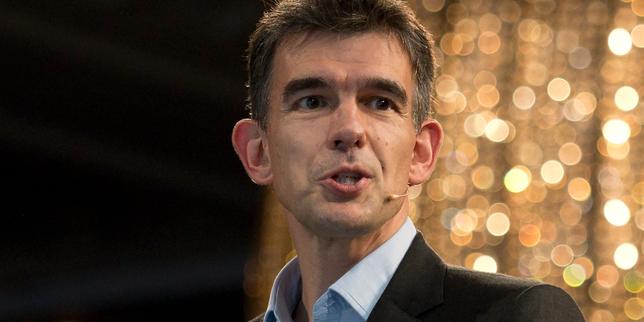
Matt Brittin, the man who spent nearly two decades as the face of Google in Europe, is moving from the world of "search" to the world of "soul." His appointment to the top of the BBC is not just a standard corporate reshuffle. It is a collision of philosophies. It is the moment the world’s most storied public broadcaster admits that being a national treasure is no longer enough to survive a digital siege.
Imagine a specialized watchmaker, a craftsman who has spent eighty years perfecting the internal gears of a mechanical clock. This is the BBC. Now, imagine a man who spent twenty years building the satellite system that tells every phone on earth exactly what time it is. This is Brittin. The watchmaker still makes the most beautiful objects in the room, but the man with the satellite controls the attention of the person wearing the watch. Analysts at Bloomberg have shared their thoughts on this matter.
The Architect of the Invisible
To understand why this move matters, you have to look at what Brittin actually did at Google. He wasn't just a manager. He was the diplomat-in-chief during a period when the internet stopped being a fun hobby and started being the infrastructure of human consciousness. He navigated the treacherous waters of European privacy laws, the "right to be forgotten," and the complex tax debates that haunt multinational giants.
He knows where the bodies are buried in the digital economy.
The BBC is currently a fortress under pressure. Its funding model—the license fee—is a relic of a broadcast era that feels increasingly alien to a generation that doesn't own a television. To a twenty-year-old in a flat in Manchester, paying for the right to receive a signal through the air feels as logical as paying a tax for the right to use a candle. They live in the stream. They live in the feed.
Brittin’s task is to take a British institution and make it speak the language of the algorithm without losing its British accent.
The Ghost in the Machine
Consider a hypothetical viewer named Maya. Maya is twenty-four. She cares deeply about climate change, loves high-production period dramas, and hasn't turned on a traditional linear TV channel in three years. She finds her news through TikTok snippets and her entertainment through Netflix’s "Recommended for You" rail.
For the BBC, Maya is a ghost. They know she exists, but they can’t find her.
If the BBC produces the greatest documentary of the decade, but Maya’s algorithm decides she’d rather see a video of a cat falling off a sofa, the BBC has failed its mandate. This is the existential dread that keeps broadcasting executives awake at night. It isn't a lack of quality. It is a lack of visibility.
By hiring a Google veteran, the BBC is betting that the secret to their survival isn't just better shows—it’s better math. They need someone who understands how to fight for space on a smartphone screen that is already crowded with the distractions of a billion-dollar attention economy.
But there is a friction here. Google is built on the idea of giving people exactly what they want, instantly. The BBC is built on the idea of giving people what they need, even if they didn't know they wanted it. If you only eat what the algorithm serves you, you end up with a digital diet of candy. The BBC’s job is to make sure there is still some protein in the mix.
The Cost of the Connection
The tension in the halls of Broadcasting House is palpable. There are those who fear that bringing in a "Big Tech" titan will strip away the creative eccentricity that makes the BBC unique. They worry that "Auntie"—as the broadcaster is affectionately known—will start making decisions based on data points rather than creative intuition.
Data tells you that people like explosions and fast cuts. Intuition tells you that a three-minute silent shot of a lone hiker on a Scottish moor can break a viewer's heart.
Brittin’s challenge is to protect the hiker while acknowledging the explosion. He has to convince a skeptical public—and an even more skeptical government—that the BBC is still a necessary public square. In an age of deepfakes and AI-generated hallucinations, the value of a trusted, human-verified news source should be higher than ever. Yet, the paradox is that the more "essential" the service becomes, the harder it is to fund.
He is stepping from a company that prints money into an organization that has to beg for it.
The New Frontier of Trust
We often talk about "platforms" and "publishers" as if they are separate entities. They aren't anymore. A publisher that doesn't understand the platform is a ghost; a platform that doesn't have quality publishing is a desert.
The appointment of Matt Brittin is a signal that the desert is looking for an oasis.
The stakes are higher than a simple career move. If the BBC fails to transition into this next era, we lose more than just Doctor Who or the World Service. We lose a shared cultural language. We lose the one thing that still pulls a fractured nation together for a few hours on a Sunday night.
Brittin isn't just running a media company. He is attempting a heart transplant on a national icon. He has to take the cold, efficient logic of Mountain View and pump it into the warm, messy, creative heart of London.
The hum of the server racks is getting louder. The warmth of the studio lights is flickering. Somewhere in the middle, a man who knows both worlds is trying to find the switch.
Success looks like Maya finally finding that documentary. Failure looks like a dead signal in a world that never stops talking.
The antenna is still standing, but the wind is picking up.
Would you like me to analyze the historical parallels between this move and previous media transitions, such as the shift from radio to television?