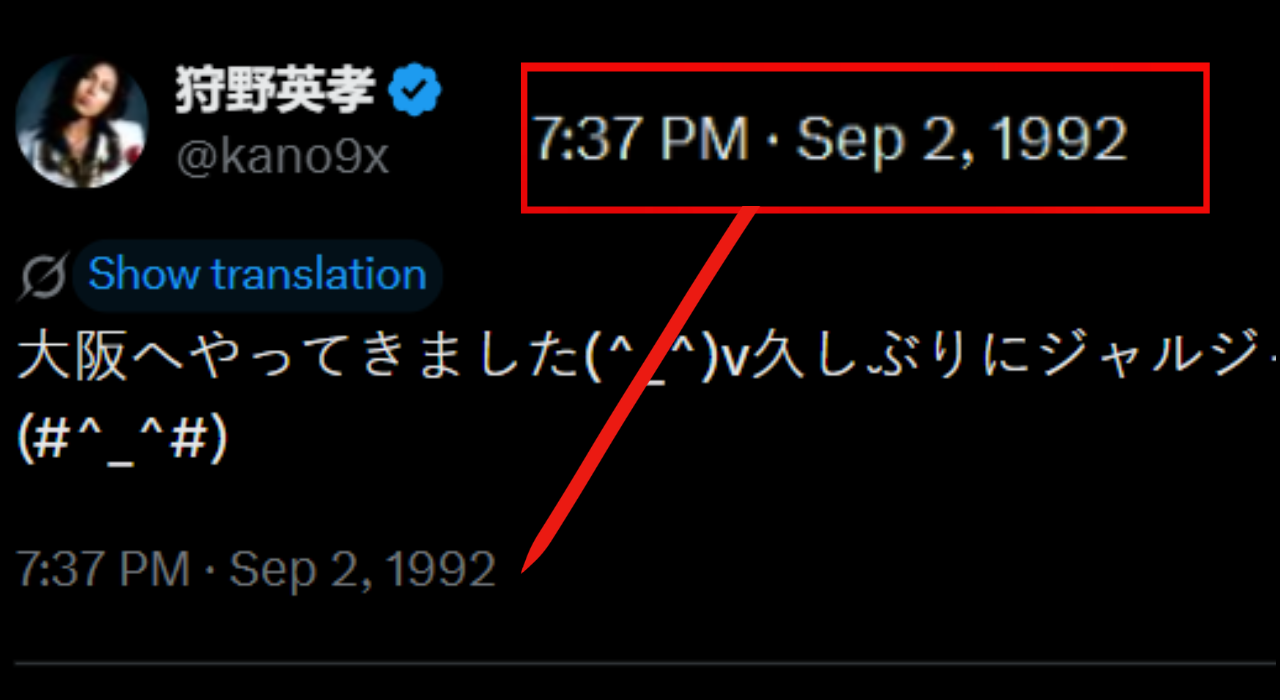
Stop chasing ghosts in the machine. The internet is currently obsessed with a "1992 tweet" written in Japanese that supposedly predates Jack Dorsey’s first post by fourteen years. The tech tabloids are calling it a glitch, a mystery, or a sign of time travel. They are all wrong. It isn't a mystery; it’s a fundamental misunderstanding of how databases actually function and why the concept of a "timestamp" is the most fragile lie in computing.
If you believe a date on a screen is an immutable fact, you’ve already lost the game.
The Lazy Consensus of the Glitch
The common narrative surrounding this viral X post is that Twitter's transition to X, or some deep-level database migration, "flipped a bit" and accidentally assigned a 1992 date to a modern post. This explanation is comforting because it suggests the system is generally reliable and this is just a one-off error.
It’s lazy. It’s also technically illiterate.
Most modern social media platforms utilize Unix time, a system that counts the number of seconds elapsed since January 1, 1970 (the Unix Epoch). To get a date in 1992, you don’t just "have a glitch." You have a specific integer value in a database column that represents a point in time before the web even had a browser.
The viral 1992 post isn't a spooky digital anomaly. It is the result of Unix Epoch manipulation or a specific metadata injection. When you see a post from 1992 on a platform founded in 2006, you aren't looking at a "impossible" tweet. You are looking at a failure of data validation.
The Myth of Immutable Records
We’ve been conditioned to think that the internet is a permanent, chronological record. We assume that because a platform says a post happened at 4:02 PM on a Tuesday, that is an objective reality stored in a vault.
I’ve seen engineers at Tier-1 tech firms manually "fix" database entries with a simple SQL command because a celebrity complained about a typo or a timestamp looked messy for a marketing campaign.
UPDATE tweets SET created_at = '1992-08-01 12:00:00' WHERE tweet_id = [REDACTED];
The "1992 tweet" is a masterclass in how easy it is to gaslight an entire user base by changing one string of numbers. In the early days of Twitter, and certainly during various architectural overhauls (like the move from Ruby on Rails to a more distributed Scala-based infrastructure), the "created_at" field was often just another piece of metadata that could be modified, spoofed, or corrupted during a migration.
Why 1992? The Specificity of the Lie
Why 1992? Why not 1970 or 1980?
The year 1992 is significant because it sits right at the dawn of the public internet. It’s early enough to be "impossible" for Twitter, but late enough to be "plausible" for a tech-savvy user who wants to pretend they were using an early IRC bridge or a pre-alpha version of a protocol that eventually became X.
This isn't a glitch. It’s likely a Legacy API Artifact.
In the mid-2000s, dozens of third-party apps were syncing with Twitter. Many used custom protocols. If an app sent a malformed date—or if a developer was testing a client and manually set their system clock to 1992—the server-side database often accepted that input without a second thought. This is a classic "Garbage In, Garbage Out" scenario. The platform didn't "create" a 1992 tweet; it simply failed to reject a post that claimed to be from 1992.
The Security Implication Everyone is Ignoring
The "People Also Ask" sections of the web want to know if this means Twitter was secretly around in the 90s. That’s the wrong question.
The real question is: If a user can spoof a timestamp to 1992, what else can they spoof?
Digital forensics relies on the "Three Pillars": Identity, Content, and Time. We already know Identity is a joke (thanks to the $8 blue check era). We know Content can be edited. If Time is also a variable that can be manipulated by simple database errors or API exploits, then the "digital record" has zero evidentiary value.
I’ve worked on systems where a "1992" error was actually a symptom of a Clock Drift issue in a distributed database cluster. When nodes in a data center lose synchronization, they can revert to a "zero" state or a default fallback date. If a write operation happens exactly at that moment of desynchronization, the database records the fallback date.
It’s not a ghost. It’s a server heartbeat failing in a way that creates a funny screenshot for the masses while hiding a massive architectural vulnerability.
Stop Trusting the Interface
The 1992 tweet is a reminder that the User Interface (UI) is just a skin. It is a visual representation of a series of messy, often contradictory database tables.
When you see a 1992 timestamp, you are seeing the "backstage" of the internet. You are seeing the point where the automation failed and the raw, unverified data leaked through to the front end.
The counter-intuitive truth? The internet isn't a chronological history. It’s a giant, editable spreadsheet where the "Date" column is just as flexible as the "Text" column.
The Industry Reality Check
- Migrations are Messy: Every time a company "rebrands" or changes its backend architecture (like the chaotic shift from Twitter to X), data integrity takes a backseat to uptime.
- APIs are Trusting: Legacy APIs often trust the client’s timestamp. If your phone thinks it’s 1992, the app might believe it too.
- Validation is Expensive: Checking every single post against a "logical" timeline takes processing power. Most platforms skip the logic check to save milliseconds on the "Post" button.
The Verdict on the "World’s Oldest Tweet"
There is no "oldest tweet" from 1992. There is only a modern post with a broken metadata tag.
The obsession with this "mystery" proves that as a society, we are still remarkably naive about how our digital lives are stored. We treat the database like a stone tablet when we should treat it like a whiteboard.
Stop looking for time travelers. Start looking for the overworked systems administrator who forgot to set a MIN_DATE constraint on the SQL table.
The "impossible" 1992 tweet isn't a hole in the space-time continuum. It’s a hole in the code. And if you can't see the difference, you're the one being hacked.
Check the metadata yourself. Don't ask if the tweet is real. Ask why the system was allowed to lie to you.